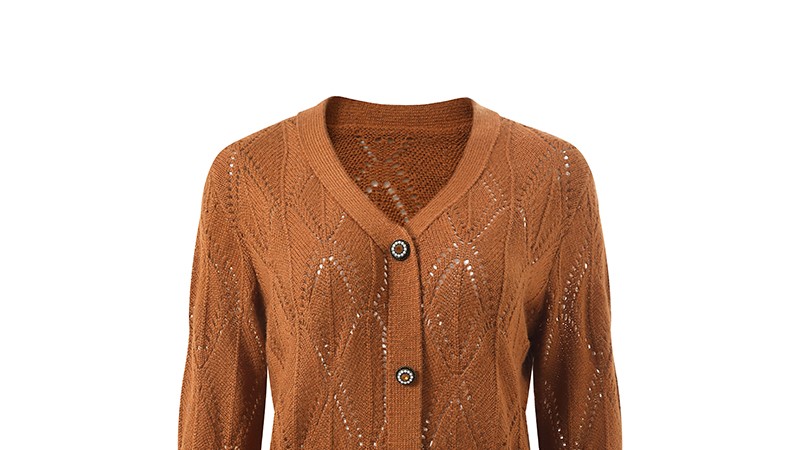
Why Gauge and Fiber Balance Matter in Holiday Women’s Cardigans
For fashion brands building holiday collections or seasonal wholesale lines, selecting the right women’s metallic cardigan OEM depends on technical alignment—not only visual appeal. A 7GG knit with 370g fabric weight offers structured drape and moderate warmth, while the 40% wool, 45% acrylic, and 15% metallic fiber blend balances natural texture, durability, and controlled shimmer.
Unlike lighter gauges used for fine layering pieces or heavier knits for outerwear-weight garments, 7GG is a practical midpoint for V-neck cardigans intended for mid-season retail windows and gifting periods. It supports perceived quality, shelf impact, and wearability across varied climates.
Key Technical Baseline
- Gauge: 7GG
- Fiber composition: 40% wool, 45% acrylic, 15% metallic fiber
- Fabric weight: 370g
- Silhouette: Single-breasted V-neck cardigan
- Development: OEM and private label for holiday collections and seasonal wholesale
How 7GG Gauge Shapes Performance and Perception
Gauge defines needle count per inch and directly influences fabric density, recovery, and hand feel. At 7GG, the stitch structure is open enough to accommodate metallic fiber integration without compromising flexibility, yet tight enough to help reduce excessive snagging or pilling during repeated folding and display.
Buyers should confirm how gauge interacts with yarn twist and metallic filament denier during sampling, since metallic content can affect stitch definition and surface reflectivity. This gauge also supports clean shaping around the V-neck opening and single-breasted closure without excessive bulk at the placket or shoulder seams.
It is not inherently better than 5GG or 9GG. Rather, it is more appropriate for cardigans positioned between casual knitwear and tailored outer layers—especially where seasonal versatility matters.
Fiber Composition: Functionality Before Flash
The 40% wool, 45% acrylic, and 15% metallic fiber composition reflects a deliberate trade-off. Wool contributes natural resilience and thermal regulation. Acrylic supports dimensional stability, colorfastness, and cost control across large runs. Metallic fiber adds controlled luminosity without sacrificing washability or seam integrity.
Acrylic’s dominance does not imply compromise. It helps enable consistent batch-to-batch appearance and reduces sensitivity to humidity and storage conditions, which is critical for holiday inventory holding.
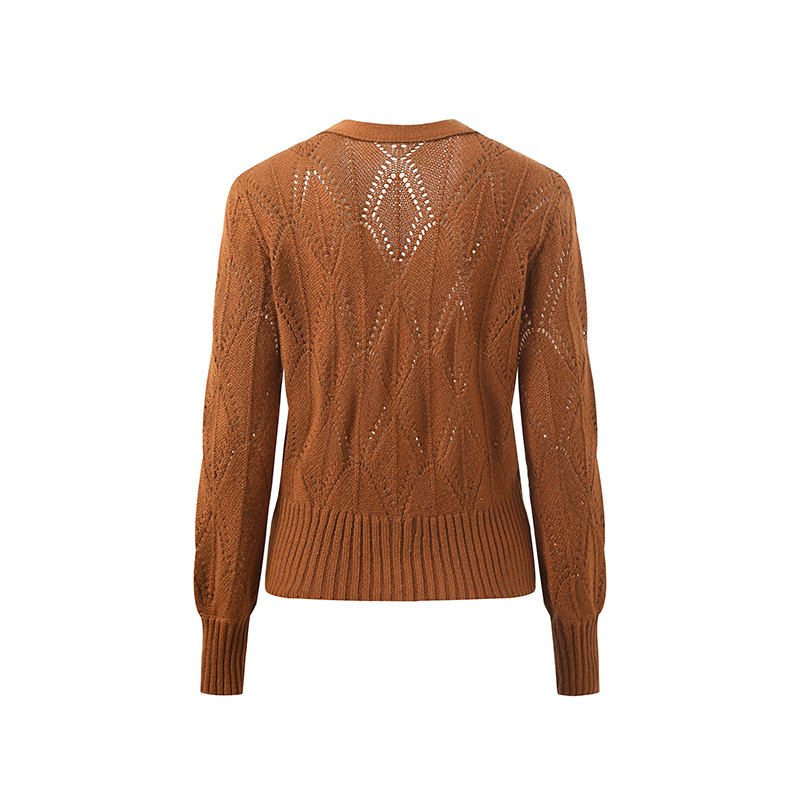
Buyers should verify metallic fiber type, such as polyester-coated versus nylon-based, and filament integration method, such as core-spun versus blended. These factors affect light diffusion, abrasion resistance, and compatibility with garment dyeing. Final performance depends on yarn supplier selection and knitting tension calibration.
V-Neck Silhouette: Fit, Layering, and Seasonal Positioning
A single-breasted V-neck silhouette serves specific commercial functions in women’s cardigans. It visually elongates the neckline, accommodates varied underlayers such as turtlenecks, collared shirts, and camisoles, and reads as polished yet relaxed—ideal for holiday gifting and transitional retail.
The V-depth, shoulder line, sleeve cap height, and body ease all require explicit specification in the tech pack. Since fabric weight is fixed at 370g, fit adjustments should be made through grading rather than fabric substitution.
Brands targeting premium department stores may prioritize longer body length and narrower sleeve openings. Fast-fashion partners may request shorter hemlines and wider armholes for speed-layering appeal. Neither is objectively superior. The choice must align with target customer behavior and channel-specific hang tests.
OEM/ODM Development: What to Confirm Before Sampling
When evaluating this style for wool blend cardigan private label production, buyers should treat the provided specs as a baseline—not a locked configuration. Key items requiring joint confirmation include:
- Metallic fiber origin and test reports, such as Oeko-Tex Standard 100 if required
- Seam construction method, such as flatlock versus coverstitch, and thread type
- Care labeling compliance for target markets, including US FTC, EU REACH, and UK CA requirements
- Trimming specifications, including buttons, buttonholes, hanger loops, and packaging tags
- Fabric shrinkage tolerance and post-knit finishing, such as steaming, brushing, or anti-pilling treatment
None of these are implied by the base spec sheet. Each affects cost, lead time, and QC pass rates, and should be documented before bulk production.
Matching the Cardigan to Your Program Type
Holiday knitwear manufacturer partnerships differ from ongoing private label programs in pacing, risk tolerance, and margin structure. For holiday collections, speed-to-market and visual consistency across SKUs often outweigh minor variations in drape.
Seasonal wholesale buyers often require size-set flexibility and extended color palettes, which demand robust yarn lot management. Private label brands building long-term identity may prioritize repeatable hand feel over seasonal novelty, making fiber sourcing transparency and mill documentation essential.
There is no single optimal path. A brand launching its first knitwear line may benefit from pre-developed 7GG templates. An established label may re-engineer the same silhouette using alternative wool percentages or recycled acrylic—provided the base gauge and weight remain compatible with existing machinery and fit blocks.
Recommended Product
Women’s Metallic Wool Blend Cardigan | 7GG Shimmer V-Neck Knitwear OEM — Designed for metallic fiber cardigan wholesale and holiday-focused development, this single-breasted V-neck style uses 7GG construction and a balanced wool-acrylic-metallic blend to support visual differentiation and production scalability.
Frequently Asked Questions
How do I assess whether this 7GG metallic cardigan fits my brand’s aesthetic and functional needs?
Evaluate against three criteria. First, does the 370g weight align with your target layering use case, such as over blouses versus standalone wear? Second, does the V-neck proportion complement your existing top silhouettes? Third, is the level of metallic reflectivity consistent with your brand’s seasonal mood board—subtle sheen or high-impact shimmer? Physical sampling remains essential because digital renderings cannot replicate light interaction or hand feel.
What should be included in the initial tech pack for OEM development?
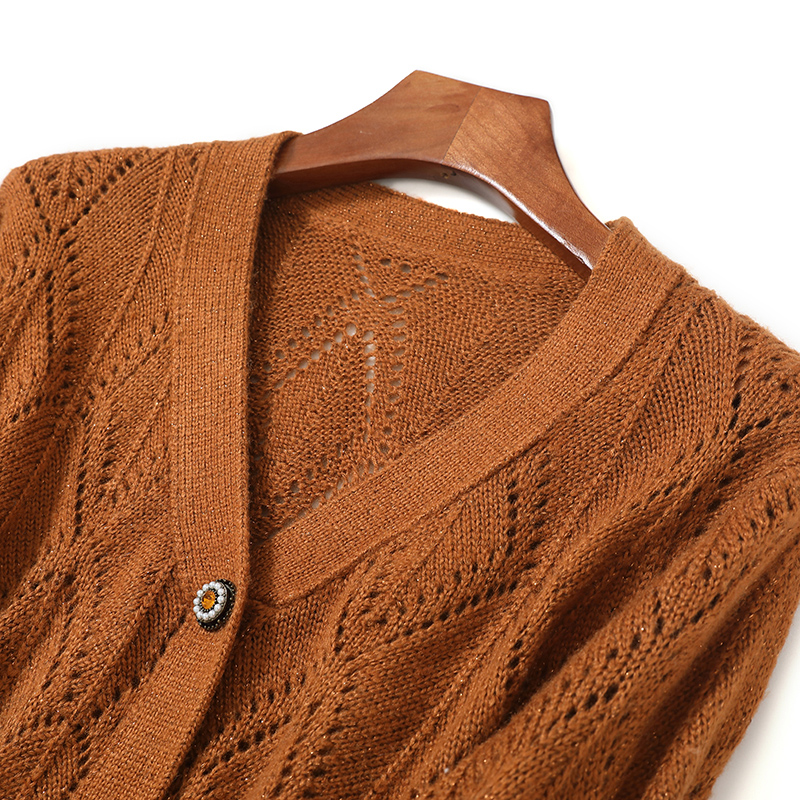
Your tech pack must specify exact measurements, including ease allowances, stitch types, seam finishes, trim placements, care label language, and
packaging requirements. For metallic fiber blends, explicitly state whether metallic filament visibility must be uniform across body, sleeves, and collar, or if directional variation is acceptable. Do not assume default settings apply.
How does fiber composition affect washing and care instructions?
Wool content introduces potential for felting or shrinkage if agitated or exposed to temperature extremes. Acrylic improves dimensional stability but may generate static or lint. Metallic fibers may oxidize or dull if exposed to chlorine or prolonged UV. Final care instructions must be validated through lab testing rather than inferred from composition alone.
Can I modify the metallic fiber percentage without changing gauge or weight?
Potentially, but not automatically. Increasing metallic content beyond 15% may reduce yarn strength and increase breakage during knitting. Decreasing it may alter luster and require compensatory adjustments in wool and acrylic ratios to maintain 370g weight and drape. Any change requires new yarn sourcing, gauge recalibration, and full prototype review.
What are the key sampling checkpoints for this style?
Confirm consistency of metallic sheen across panels and lighting conditions, V-neck symmetry and collar roll behavior after steaming, buttonhole elasticity and placket alignment under tension, seam visibility and coverage at high-stress points such as shoulders and underarms, and accurate representation of fabric weight and hand feel relative to approved reference swatches.
Final Selection Depends on Context—Not Catalogs
No women’s metallic cardigan OEM specification is universally optimal. A 7GG, 370g, wool-acrylic-metallic V-neck cardigan offers clear advantages for holiday collections and seasonal wholesale, but only when its technical profile matches your brand’s customer expectations, distribution model, and development capacity.
Its value comes from intentional alignment: gauge supporting structure and shimmer, fiber composition balancing performance and cost, and silhouette enabling versatility. For private label programs, it serves as a proven starting point—not a finished solution. Contact our team to discuss your knitwear project and explore customized manufacturing solutions.