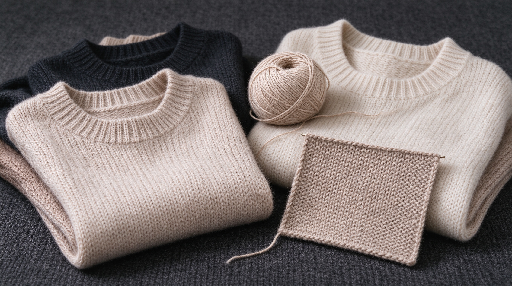
Why Yarn Should Be Considered First for Women’s Knitwear
For women’s knitwear, yarn is more than just a material that determines how soft a garment feels.
Even with an identical sweater silhouette, different yarns yield completely finished‑garment outcomes. Thickness, drape, loft, surface texture, warmth and overall wearing experience will all vary accordingly.
Take a simple crew‑neck sweater as an example:
Wool yarn delivers a classic, natural overall impression
Merino wool produces finer, lighter‑weight finished goods
Lambswool typically offers enhanced softness and loft
Cashmere helps establish premium, lightweight product positioning
Cotton yarn works better for spring‑summer or transitional‑season items
Blended yarns strike a balance among hand‑feel, durability, appearance and cost.
Therefore, there is no “one‑size‑fits‑all perfect yarn” for women’s knitwear. The priority is to source yarn that aligns with your product positioning, design style and end‑use scenarios.

Define Product Positioning Prior to Yarn Selection
Many developers start sweater projects by asking: “What is the best yarn?”
A more logical approach is to ask: “What performance do we want this garment to deliver?”
Clarify product direction based on the dimensions listed below.
Product Style
For classic business‑oriented items, consider naturally textured yarns such as wool or merino wool. For casual, relaxed‑fit or everyday autumn‑winter wear, wool, lambswool and various blended yarn options are suitable. For luxury and premium‑focused collections, cashmere or cashmere‑blend constructions may be explored.
Wearing Season
Autumn‑winter pieces prioritise warmth and substantial thickness. Spring‑autumn transitional styles emphasise lightness, breathability and layering versatility. Spring‑summer knitwear can utilise cotton yarn or lightweight blends.
Price Positioning
Raw‑material costs differ substantially across fibre types. Yarn selection influences both finished‑garment performance and retail price positioning. Blended yarns are widely adopted when balancing commercial viability and cost control.
Yarn Selection Guide for Common Women’s Knitwear
Wool
Wool is a prevalent natural fibre for autumn‑winter knitwear.
It delivers good thermal retention and natural texture, suitable for:
Crew‑neck sweaters
V‑neck sweaters
Cardigans
Rib‑knit tops
Core‑item autumn‑winter sweaters
Texture‑rich knit styles
Wool is ideal for collections highlighting natural, classic autumn‑winter aesthetics.
Merino Wool
Merino wool features finer fibre diameters, making it widely used in women’s knitwear requiring refined hand‑feel.
Recommended applications:
Lightweight knit tops
Business‑style women’s apparel
Fine‑gauge knitwear
Autumn‑winter base‑layer knits
Premium core‑item basics
Merino wool preserves the natural benefits of wool while offering refined next‑to‑skin comfort.
Lambswool
Lambswool is characterised by softness, loft and comfort.
Well‑suited for:
Casual autumn‑winter sweaters
Oversized knitwear
Soft‑aesthetic women’s apparel
Everyday‑wear items
Warm‑focused knit silhouettes
Where design briefs prioritise softness, fluffiness and comfort, lambswool often out‑performs purely thickness‑driven alternatives.
Cashmere
Cashmere targets products defined by exceptional softness, light weight and premium positioning.
Suitable for:
High‑end women’s wear
Lightweight sweaters
Luxury knit cardigans
Premium core‑item knits
Autumn‑winter luxury collections
Higher material cost does not automatically mean better fit for your product. Cashmere may not be appropriate for mass‑market commercial lines or designs requiring heavy‑duty everyday durability.
Cotton Yarn
Cotton is extensively used for spring‑summer and transitional‑season knitwear.
Applications include:
Lightweight women’s knit tops
Spring‑summer cardigans
Fine‑gauge crew‑neck knits
Casual everyday knitwear
Cotton‑based textured knits
Select cotton yarn when your design calls for a light, natural spring‑summer wearing sensation.
Blended Yarns
Blending is not solely for cost reduction. Combining different fibres allows tuning of hand‑feel, appearance, durability, dimensional stability and cost according to project requirements.
Examples:
Wool + Nylon: For styles needing wool‑like aesthetics plus improved durability
Wool + Cotton: Adjusts seasonal performance and wear comfort based on blend ratios
Wool + Acrylic: Common for commercial‑grade knitwear, balancing cost and visual appearance
When assessing blends, focus not merely on fibre components but the rationale for the blend and target finished‑garment behaviour.

Yarn Thickness Also Transforms Sweater Performance
Even with identical fibre composition, yarn thickness can produce drastically different finished‑garment results.
Thicker yarns tend to deliver:
Substantial bulk ‑ High loft
Pronounced texture
Chunky‑knit aesthetics
Finer yarns are preferred for:
Fine‑gauge knitwear
Lightweight sweaters
Business‑oriented silhouettes
Fitted styles
Multi‑piece layering
Consequently, specifications such as “100 % Wool” or “100 % Cotton” are insufficient on their own. You must jointly evaluate yarn count, machine gauge and knit structure.
For wool as an illustration:
Thick yarn paired with low gauge yields bold chunky autumn‑winter knitwear
Fine yarn paired with high gauge creates lightweight, refined women’s knitwear
Greater Softness Does Not Always Equal Better Suitability
“Softness” is frequently promoted as a selling point for women’s knitwear. Over‑prioritising softness, however, may overlook core design requirements.
For instance:
A chunky‑knit sweater with prominent 3‑D texture requires structural support from yarn; excessively soft yarn will result in poorly defined patterns
A lightweight, drape‑focused women’s knit top demands soft, fine, fluid material properties
Yarn selection must weigh hand‑feel, visual appearance, structural integrity, drape, thickness and intended wearing scenario collectively. This approach is more meaningful than direct comparisons of yarn softness alone
Yarn Influences Colour and Surface Effects
Identical colour will render differently across distinct yarn substrates:
Lofty yarns soften colour perception
Fine‑count yarns deliver sharper, clearer colour definition
Knit structures further modify lustre and shadow effects
Colour development and yarn specification are therefore interdependent in women’s‑knitweardevelopment.
Projects featuring special colours, colour‑blocking or complex knit construction require simultaneous
evaluation of:
Yarn colour‑absorption performance
Dyeing behaviour
Knit structure
Surface texture
Inter‑colour visual interaction
This workflow ensures finished‑garment output aligns closely with original design intent.
Build Your Own Yarn‑Selection Framework
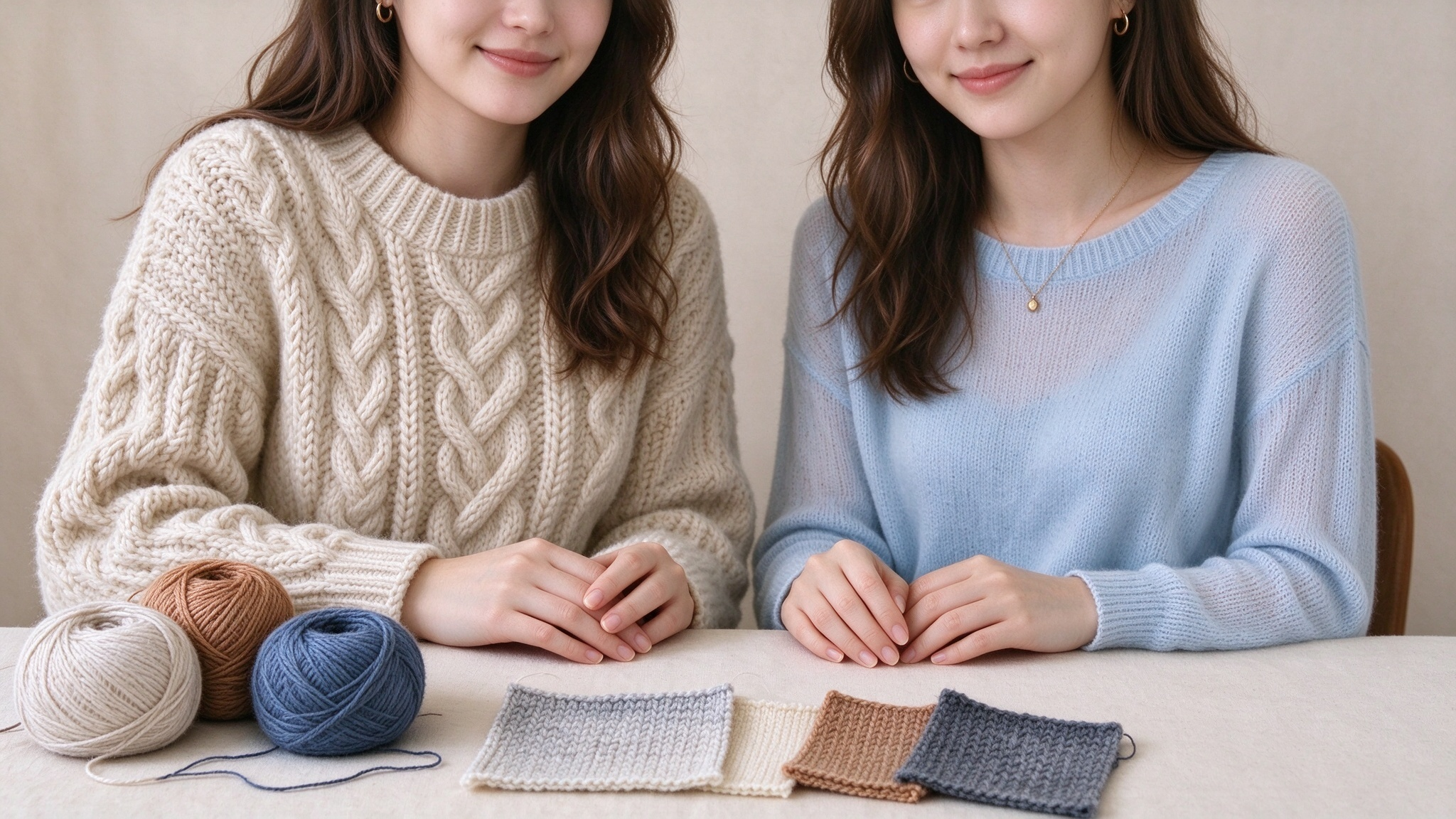
Overseas brands and buyers should first define a concise product profile.
Sample profile: Product Type: Women’s autumn‑winter crew‑neck sweater
Style: Minimalist, everyday‑wear, commercial‑grade
Target Markets: Europe / North America End‑use
Scenarios: Daily wear, commuting
Thickness: Medium weight
Hand‑feel: Soft without excessive loft
Appearance: Clean, refined Price
Positioning: Mid‑range Design
Brief: Core basic with subtle textured accents
Once these parameters are locked, selecting yarn and knit structure becomes far more efficient than browsing long lists of yarn names without context.
Yarn Selection Must Serve Product Design
In knitwear development, yarn specification is not an isolated procurement step.
A complete product‑development logic links:
Yarn → Gauge → Knit Structure → Silhouette → Dimensions → Finished‑Garment Performance
For example:
A cable‑knit sweater requires yarn capable of rendering well‑defined cable patterns
A jacquard sweater demands consideration of multi‑colour‑yarn compatibility and pattern execution within knit construction
Lightweight women’s knitwear places high priority on yarn fineness, machine gauge and garment drape
Effective yarn selection is not about sourcing premium raw materials in isolation,it is about identifying materials that enable your design vision.
Product‑Development Competency Matters for Women’s‑Knitwear OEM
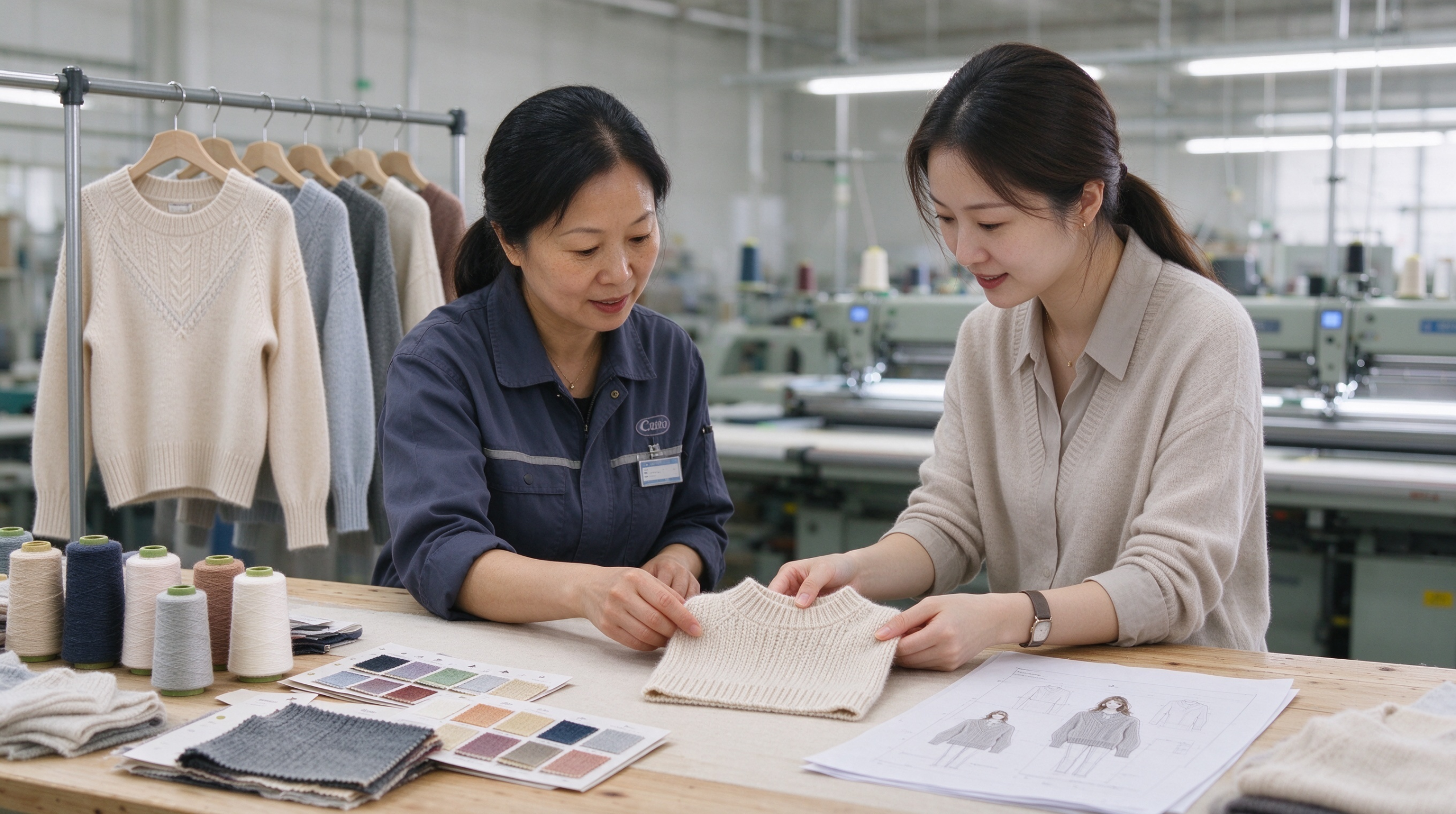
Overseas brands developing women’s knitwear normally come with established design direction. Inputs may include reference images, tech packs, sketches or physical sample garments.
The core challenge is translating conceptual designs into production‑ready knitwear. This process covers not only yarn selection but:
Yarn specification
Colour development
Gauge determination
Knit‑structure definition
Silhouette construction
Dimension specifications
Finished‑garment weight
Labelling and packaging
For OEM projects, product‑development expertise carries equal weight to manufacturing capability.

How Jiaxing Kaida Apparel Co., Ltd. Supports Women’s‑Knitwear OEM Development
Jiaxing Kaida Apparel Co., Ltd. provides OEM knit‑wear manufacturing services for overseas brands, wholesalers and apparel buyers.
For clients with defined product directions, development can commence from reference photos, design sketches, tech packs or physical sample garments. We adjust yarn, colour, gauge and knit‑structure parameters to match your original design intent.
Our portfolio spans standard commercial knitwear and complex‑construction styles including:
Cable‑knit sweaters
Jacquard sweaters
Colour‑block knit sweaters
Rib‑knit sweaters
Texture‑knit sweaters
Fleece‑knit sweaters
This development model suits overseas clients with established brand language seeking reliable OEM production support.
From Design Sketch to Production‑Ready Knit Garment
Developing women’s knitwear is not a simple sequence: select yarn → start manufacturing.
A rational workflow is: Product Positioning → Define End‑use Scenario & Price Tier → Select Appropriate Yarn → Match Gauge & Knit Structure → Finalise Colours & Details → Sample Development → Final Knit‑Garment Output
Yarn selection is only one critical stage within the full development cycle. For overseas brands, it is equally vital to partner with an OEM manufacturer capable of interpreting design briefs and integrating material, gauge, knit‑structure and finished‑garment‑performance requirements.
Conclusion
No universal “best yarn” exists for women’s knitwear.
Wool suits classic autumn‑winter knitwear
Merino wool delivers refined knit styles
Lambswool emphasises softness and loft
Cashmere serves premium lightweight collections
Cotton caters to spring‑summer and transitional‑season items
Blended yarns are tuned to diverse project‑specific requirements
The priority is matching yarn, gauge, knit structure and product positioning, rather than pursuing higher‑priced or nominally superior‑composition yarns.
Overseas brands with clear design directions do not need to start development completely from scratch. Reference images, sketches, tech packs or physical samples can all act as starting points for women’s‑knitwear OEM projects.
Jiaxing Kaida Apparel Co., Ltd. specialises in OEM knit‑wear manufacturing. We deliver custom development for yarn, colour, gauge, knit structure and finished‑garment silhouettes. Our offering includes core basics such as crew‑neck sweaters, V‑neck sweaters, cardigans and rib‑knit tops, alongside complex‑construction styles: Cable Knit, Jacquard Knit, Colour‑Block Knit, Texture Knit and more.
For overseas brands and buyers, Kaida delivers more than sweater manufacturing: we provide end‑to‑end product‑development support covering concept formulation, material selection, knit‑structure engineering, sampling and OEM mass production.
Once your women’s‑knitwear design direction is finalised, the next step is selecting suitable yarn and translating your concept into saleable production‑ready garments. That is the value Jiaxing Kaida Apparel brings to women’s‑knitwear OEM development.