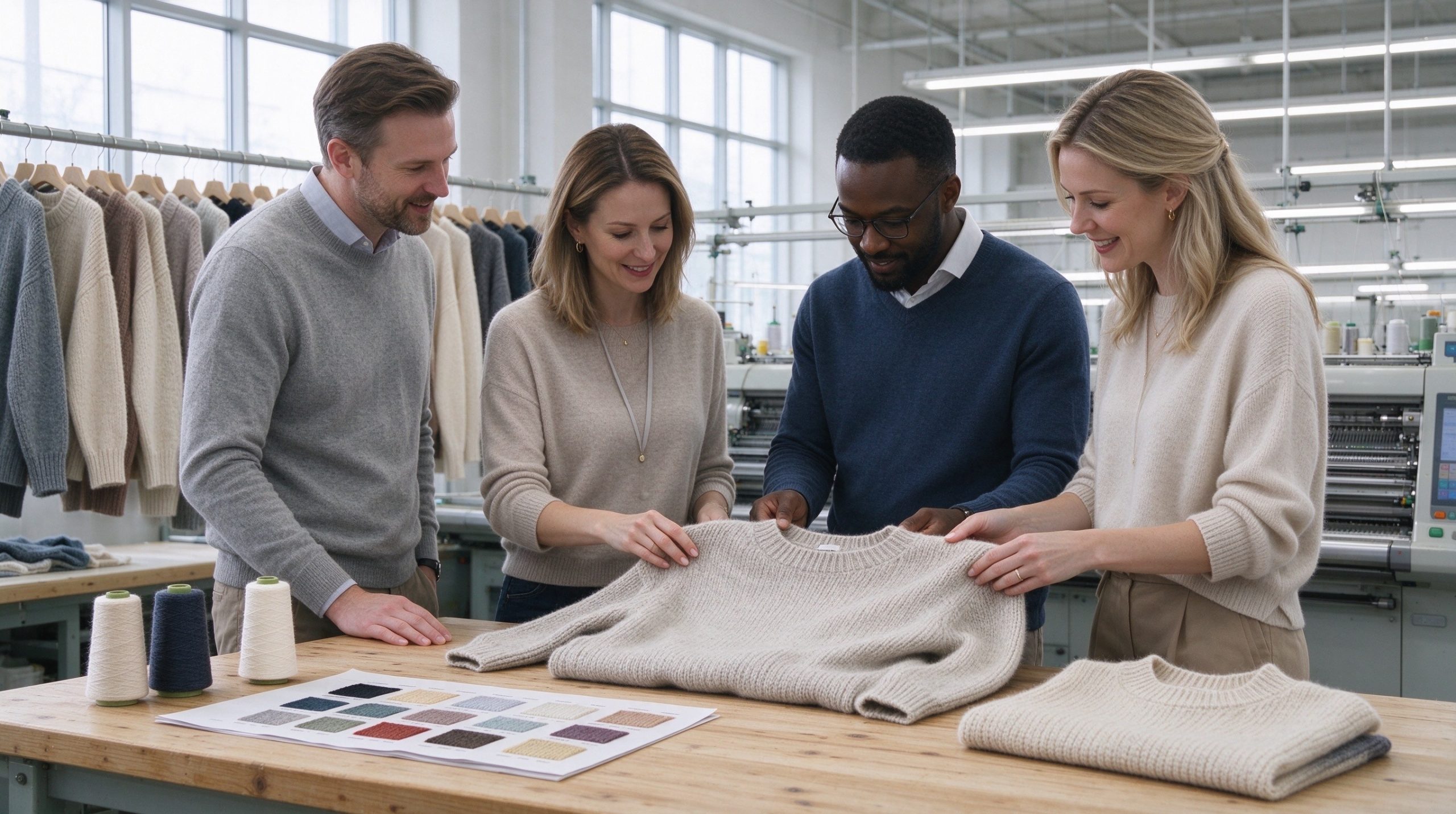
For overseas apparel brands, wholesalers and purchasing companies, finding a factory that can produce sweaters is not difficult.
What truly takes time to assess is whether the factory genuinely understands the product, can deliver satisfactory samples, and maintain consistent quality during mass production.
For wool sweaters and knitwear in particular, the final outcome is not determined by style alone. Yarn, gauge, knit structure, weight, sizing, hand-feel, workmanship and finishing all affect the finished sweater.
Therefore, placing a trial order with a new sweater manufacturer before committing to a full-scale production order is a practical procurement approach.
The purpose of a trial order is not merely to confirm “whether production is possible.” More importantly, it helps you judge:
Is this manufacturer suitable for your brand’s future product development and long-term partnership?
1. Check Whether the Manufacturer Truly Understands Your Product
Many procurement projects start with a product image and a quotation.
Buyers send product pictures, order quantities and basic requirements, and suppliers quickly provide a price.
For knitwear, however, simply knowing “this is a wool sweater” is far from enough.
The manufacturer needs to clarify:
- What yarn will be used?
- What gauge is required?
- What knit structure will be adopted?
- What is the target weight of the sweater?
- What are the sizing and fit requirements?
- Are special processes needed?
- Does it require jacquard, cable knit, color-blocking or special textures?
- What are the labelling and packaging requirements?
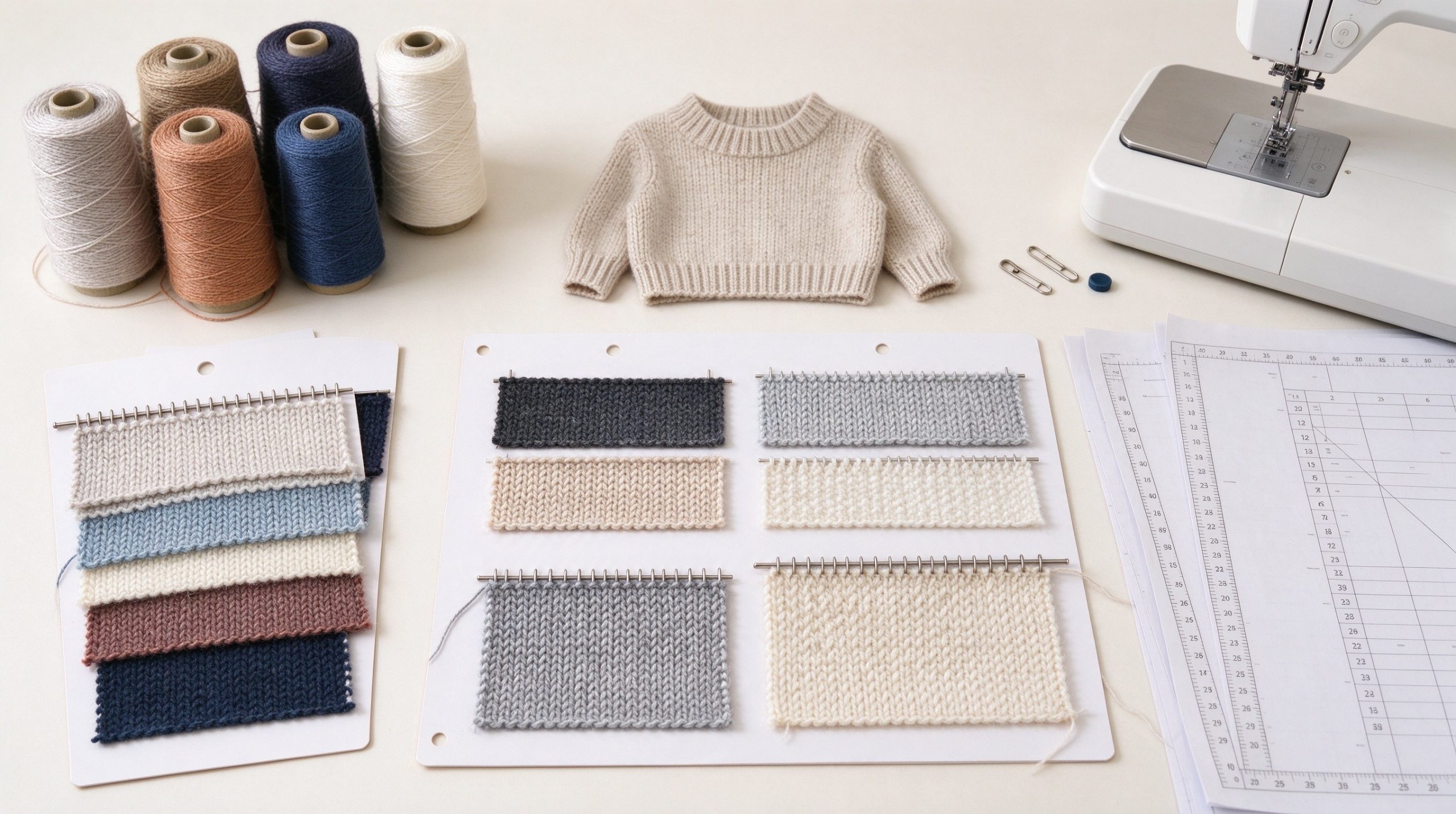
For example, for two identical-looking crew-neck wool sweaters, different gauges and yarns can result in major differences in thickness, weight, hand-feel and cost.
Therefore, at the inquiry stage, do not only focus on how fast the supplier replies.
Pay more attention to whether the supplier proactively asks for product-specific details.
A manufacturer with solid knit production expertise will usually raise product-related questions before quoting and sampling.
2. Sample Turnaround Matters, Yet Sample Accuracy Counts More
Many buyers first ask:
How long will sampling take?
Sampling speed is important, but for sweaters, sample accuracy is often more critical.
A knit sample should be checked carefully for:
- Sizing
- Fit
- Hand-feel
- Weight
- Gauge
- Knit density
- Color
- Neckline
- Cuffs
- Hem
- Overall appearance
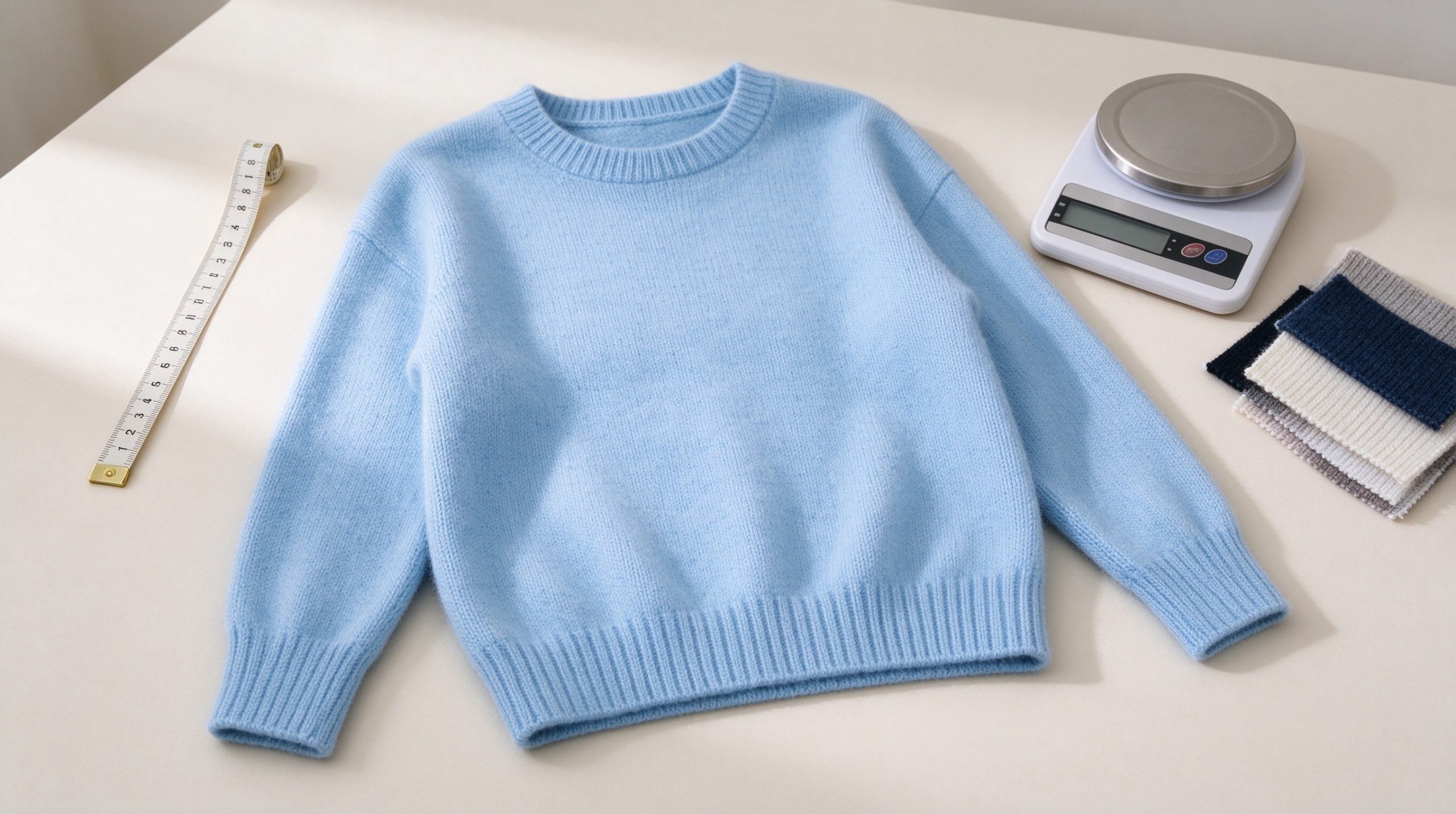
For instance, with the same wool yarn, products in 5-gauge and 12-gauge will show obvious differences in thickness, weight and hand-feel.
If a sample only looks similar visually but has deviations in sizing, weight or knit structure, these problems will become more prominent once mass production begins.
When evaluating samples, you should not only ask:
“Does it look like the reference?”
You should also ask:
“Does this sample meet brand standards and can it serve as the benchmark for subsequent production?”
3. Yarn Selection Directly Determines Sweater Quality
Yarn is a vital component in sweater manufacturing.
Common sweater materials include:
- Wool
- Merino wool
- Lambswool
- Cashmere
- Wool-nylon blend
- Wool-cotton blend
- Wool-acrylic blend
- Cotton and cotton blends
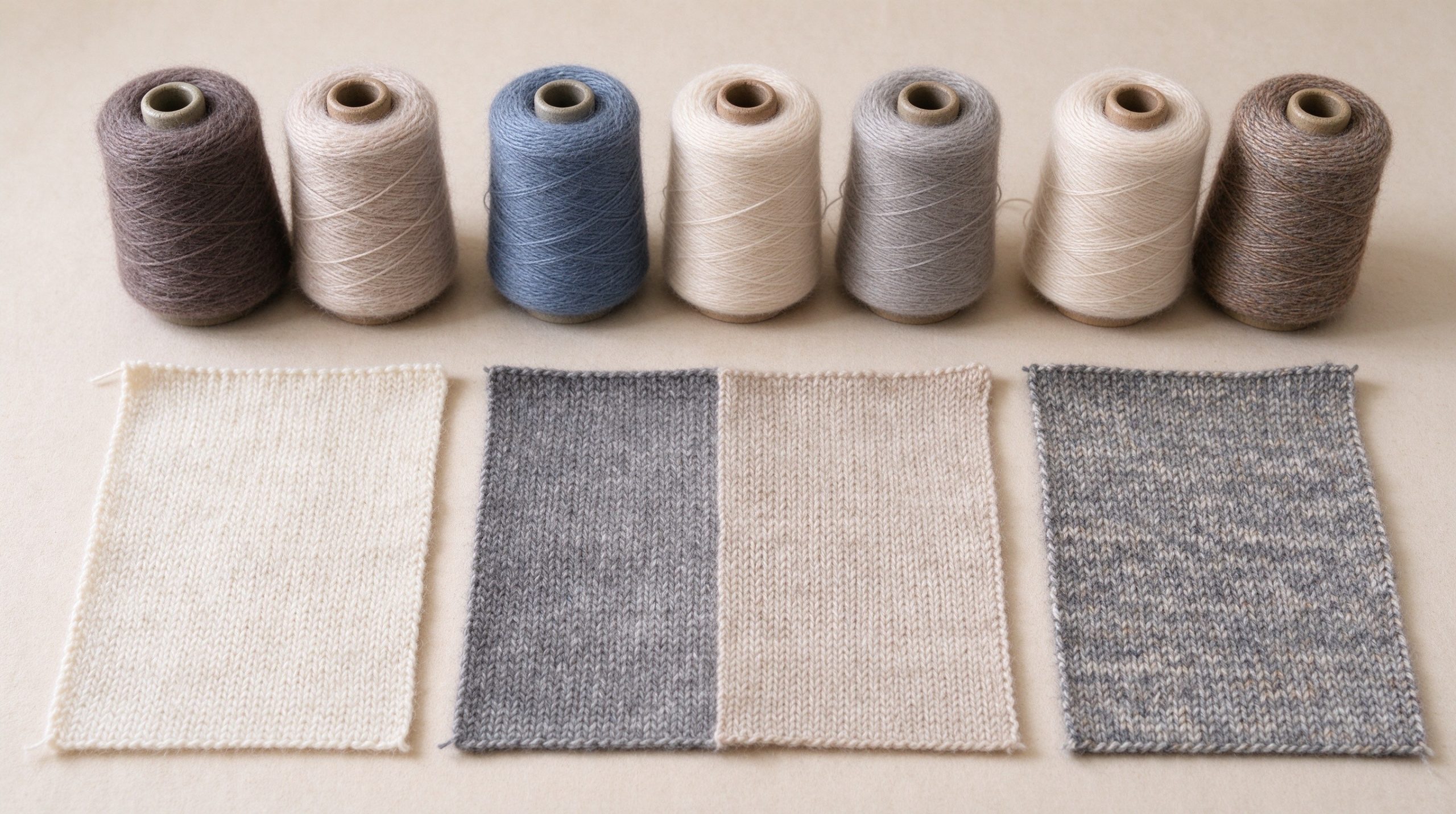
Different yarns influence a sweater’s softness, warmth, weight, durability, pilling performance and cost.
If your brand has finalized yarn composition, the manufacturer must produce strictly to these specifications.
If your brand only has general requirements — for example, desiring soft, warm products at a controlled cost — it is critical to see whether the manufacturer can propose reasonable yarn alternatives.
A professional sweater manufacturer should not only “produce to specifications,” but also understand the characteristics of various yarns and offer sensible recommendations aligned with product positioning.
4. Do Not Overlook Gauge and Knit Structure
Gauge is a core parameter in sweater production.
Common gauges include 3G, 5G, 7G and 12G.
Different gauges affect:
- Sweater thickness
- Sweater weight
- Surface appearance
- Hand-feel
- Knit density
- Production cost
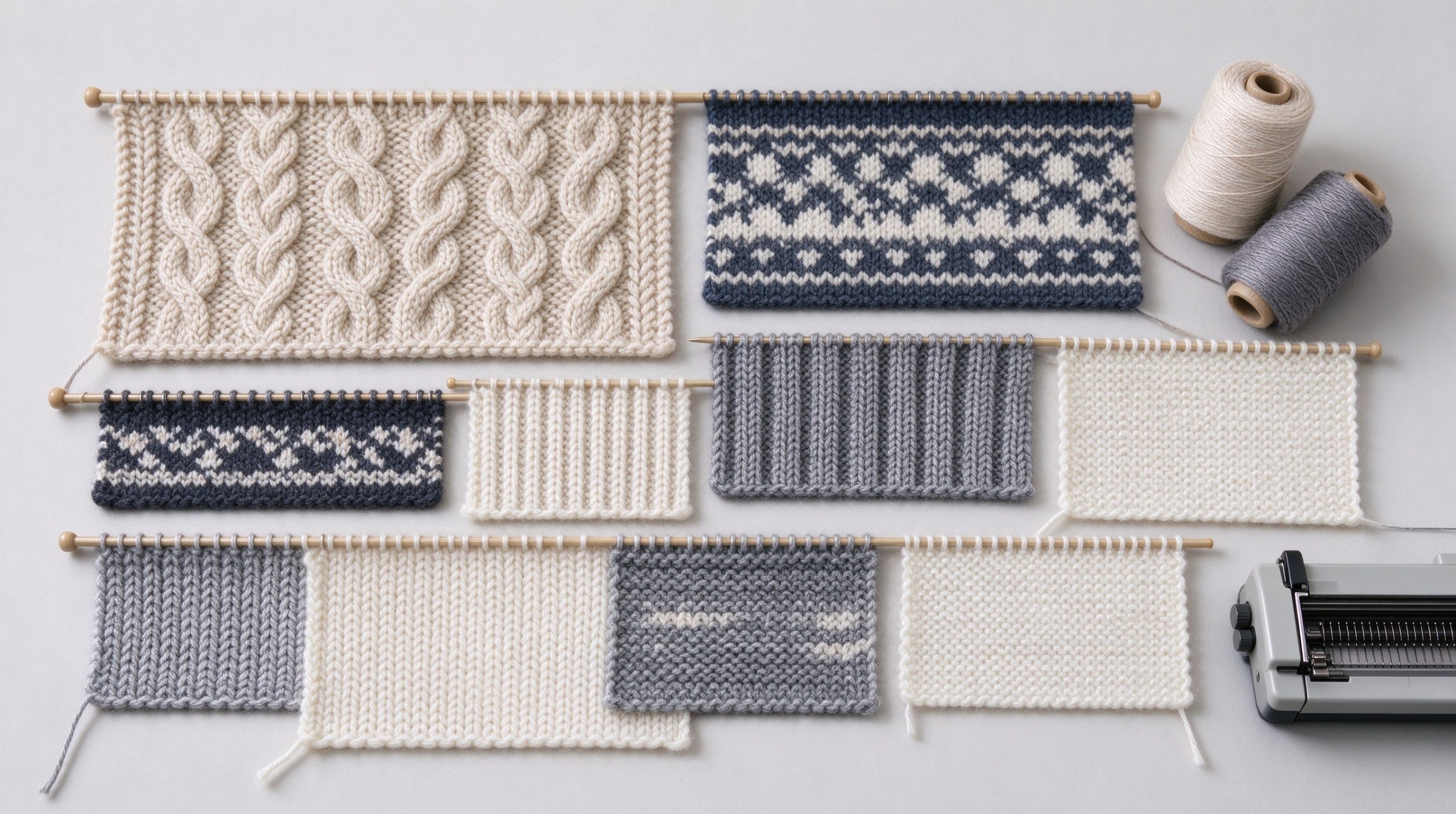
Generally, heavier gauges suit chunky knitwear, while finer gauges work for lightweight, delicate knit garments.
Gauge, however, cannot be considered in isolation.
It must match the yarn and knit structure.
For example, cable knits, jacquards, ribbing and fine-gauge items all impose distinct requirements on gauge and manufacturing techniques.
When selecting a sweater manufacturer, you may ask:
“Why is this gauge chosen for this product?”
If the manufacturer can explain the choice by linking yarn, structure, thickness and product positioning, buyers can better understand its technical capabilities.
5. Avoid Choosing Purely Based on the Lowest Quotation
Price is a major factor in procurement, but the final unit price should not be your sole benchmark.
For example:
| Supplier | Quoted Price |
|---|---|
| Supplier A | USD 15/pc |
| Supplier B | USD 14/pc |
| Supplier C | USD 12/pc |
These figures alone cannot tell you whether a supplier is suitable for your project.
Quotations may differ due to variations in:
- Yarn composition
- Yarn quality
- Gauge
- Sweater weight
- Knit structure
- Trims and accessories
- Packaging
- Minimum order quantity (MOQ)
- Production lead-time
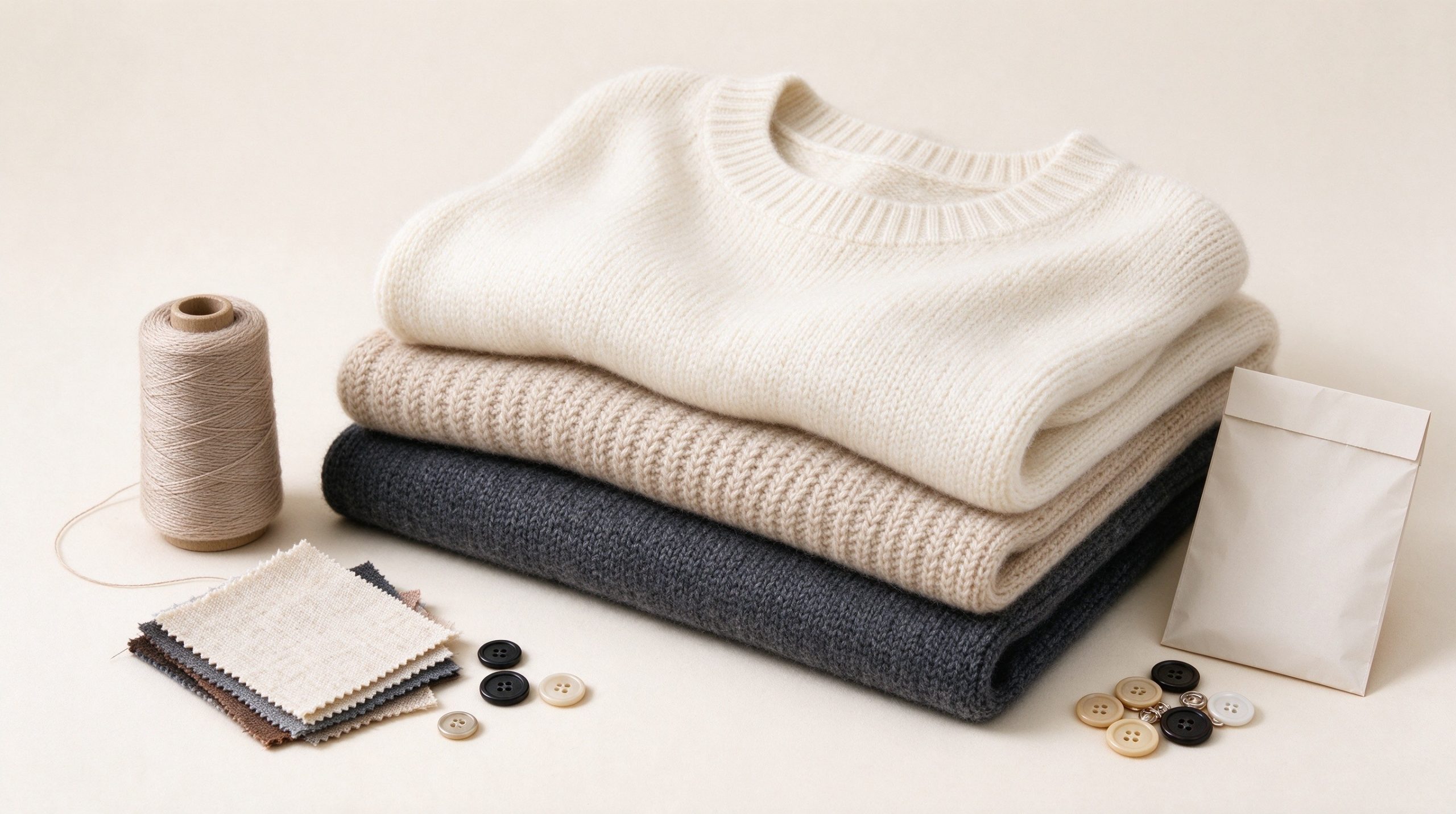
When there is a substantial price gap between suppliers, first verify whether both parties are quoting for exactly the same product specifications.
For example, one supplier may use a high percentage of natural wool while another adopts a different blending formula. Price differences in such cases are normal.
What deserves comparison is not price in isolation, but:
What product do you get for that price?
6. The Ultimate Test: Can Sample Quality Be Replicated Stably in Mass Production?
This is one of the most critical criteria for assessing a new supplier.
Some factories can produce excellent samples, yet mass-produced goods may suffer from sizing drift, color shade variation, weight fluctuation or inconsistent hand-feel.
Once the sample is approved, formalize all key production standards in writing, such as:
- Yarn specifications
- Color
- Gauge
- Sizing
- Weight
- Knit structure
- Finishing
- Packaging method
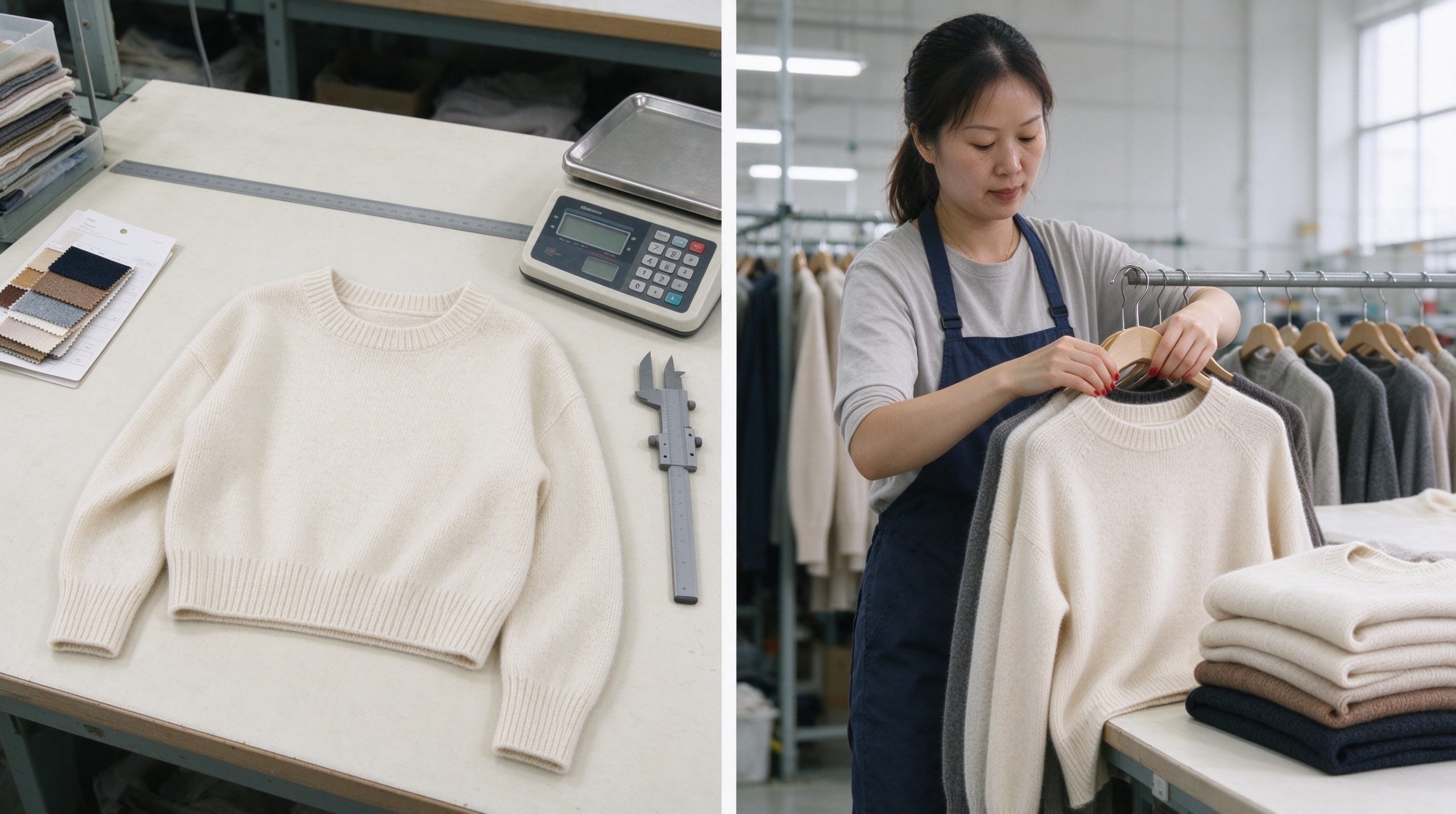
The approved sample should serve as the key reference for mass production.
For custom manufacturing, what truly matters is not:
“How good is the sample?”
Instead, it is:
“Can mass production consistently follow the approved sample?”
7. Ensure the Manufacturer’s Capabilities Match Your Product Types
Not every sweater factory is equipped to produce all varieties of knitwear.
Basic Knit Items
- Crew-neck sweaters
- V-neck sweaters
- Cardigans
- Rib-knit sweaters
- Half-zip sweaters
- Knit polos
Complex Knit Items
- Jacquard knits
- Cable knits
- Color-blocked knits
- Special-texture knits
- Brushed knitwear
- Specialty knit structures
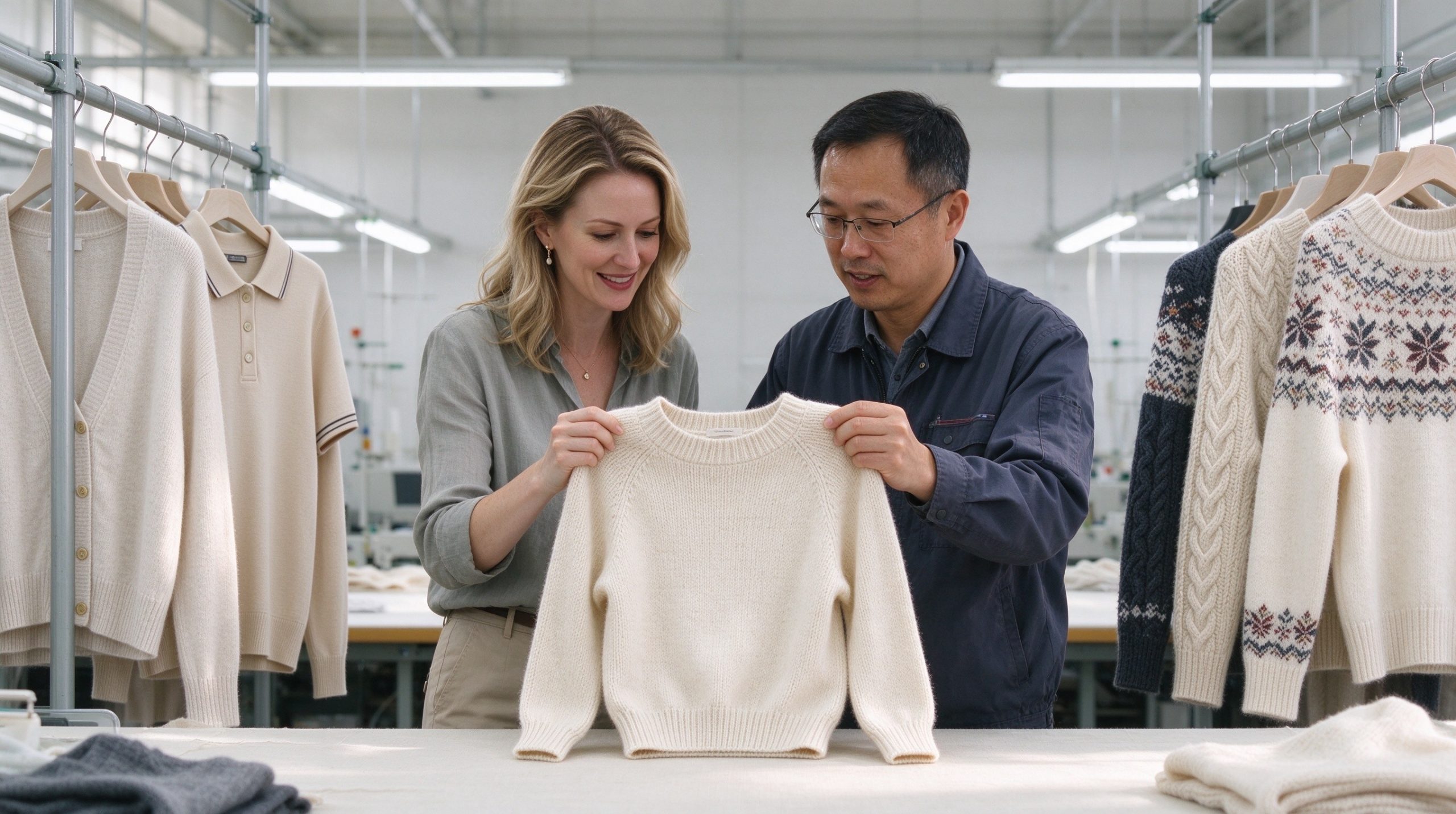
Brands sourcing mainly basic styles will prioritize price, quality, MOQ and lead-time.
Brands developing complex knitwear must place greater emphasis on the manufacturer’s sampling capacity, process understanding and mass-production consistency.
Rather than simply asking:
“Can you make sweaters?”
Share an actual product and ask the manufacturer to explain:
“How would you develop and produce this item?”
Real-product references reveal far more than marketing photos on factory websites.
8. Communication Efficiency Affects Product Development Cycles
Sweater development rarely succeeds in one attempt.
The typical workflow is:
Inquiry → Yarn Selection → Sampling → Revision → Confirmation → Mass Production
Throughout this process, adjustments are frequently required for:
- Sizing
- Color
- Neckline
- Sleeve length
- Weight
- Knit structure
- Hand-feel
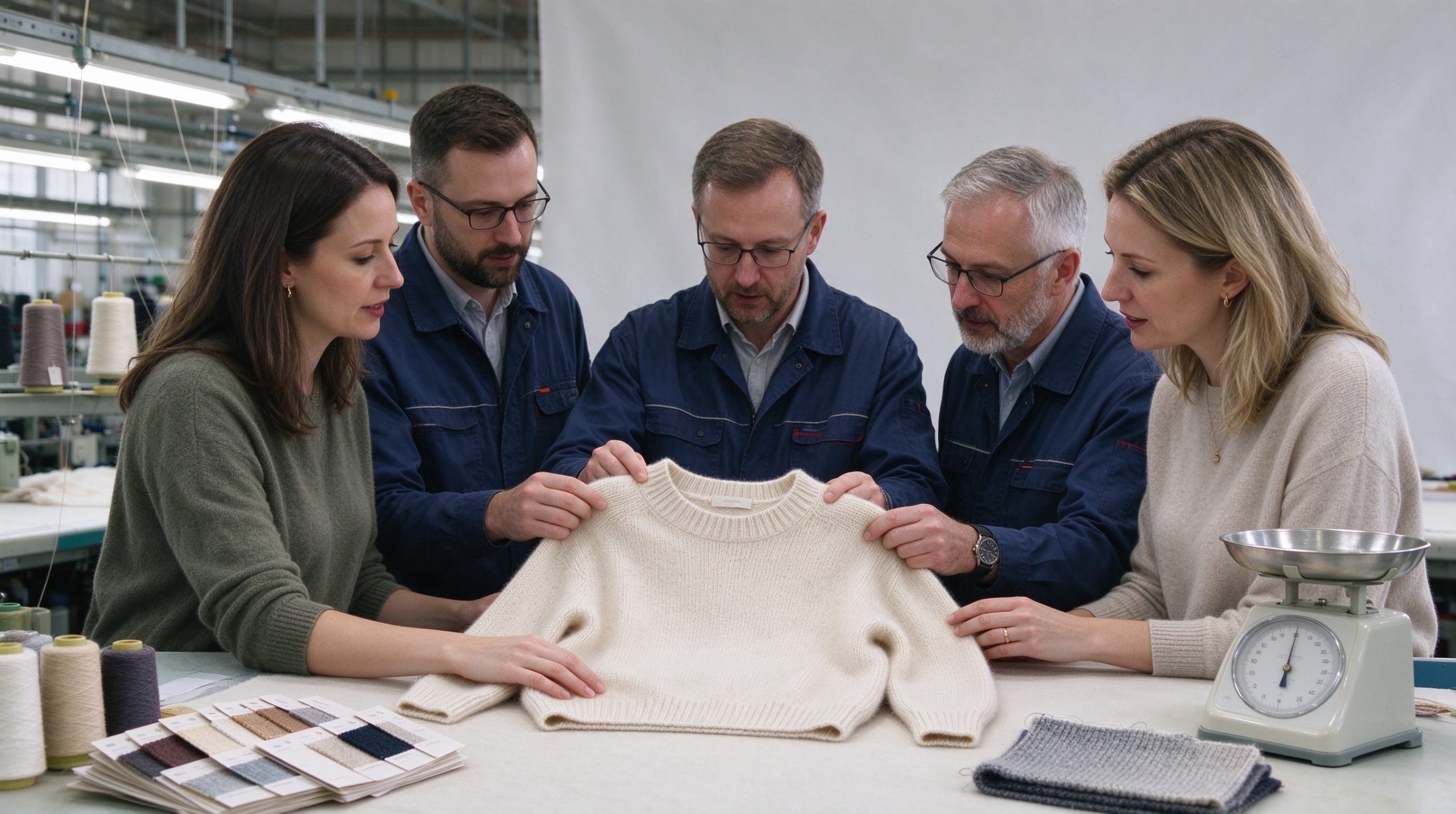
Take client feedback such as:
“This sweater is too heavy.”
This is not necessarily a straightforward revision request.
The manufacturer must diagnose whether the issue stems from yarn, gauge, knit density or overall weight.
The ability to translate client product feedback into concrete production requirements is an essential competency for a sweater manufacturer.
9. Use Trial Orders to Test Products You Will Actually Produce in Future
If your brand will mostly produce basic crew-neck sweaters, your trial order can start with this style.
If your brand focuses on jacquard, cable-knit, color-blocked or wool-blend styles in future, select a trial-order style closely aligned with your upcoming product portfolio.
A trial order should verify more than:
“Can the factory make one sweater?”
It should verify:
“Can the factory stably produce the exact products our brand needs?”
Solid performance on a simple basic sweater does not guarantee stable output for complex knitwear.
Therefore, trial-order styles should correlate with your brand’s core future product range.
10. Conduct a Full-Scale Evaluation After Receiving Trial-Order Goods
When trial-order goods arrive, do not only examine outward appearance.
Carry out inspections across three dimensions.
1. Product Performance
Check:
- Sizing
- Fit
- Hand-feel
- Weight
- Color
- Knit structure
- Overall workmanship
2. Production Performance
Assess:
- Sample accuracy
- Lead-time
- Packaging
- Communication responsiveness
- Production consistency
3. Commercial Performance
Review:
- Actual cost
- MOQ
- Revision turnaround
- Problem-solving capacity
- Re-order capability
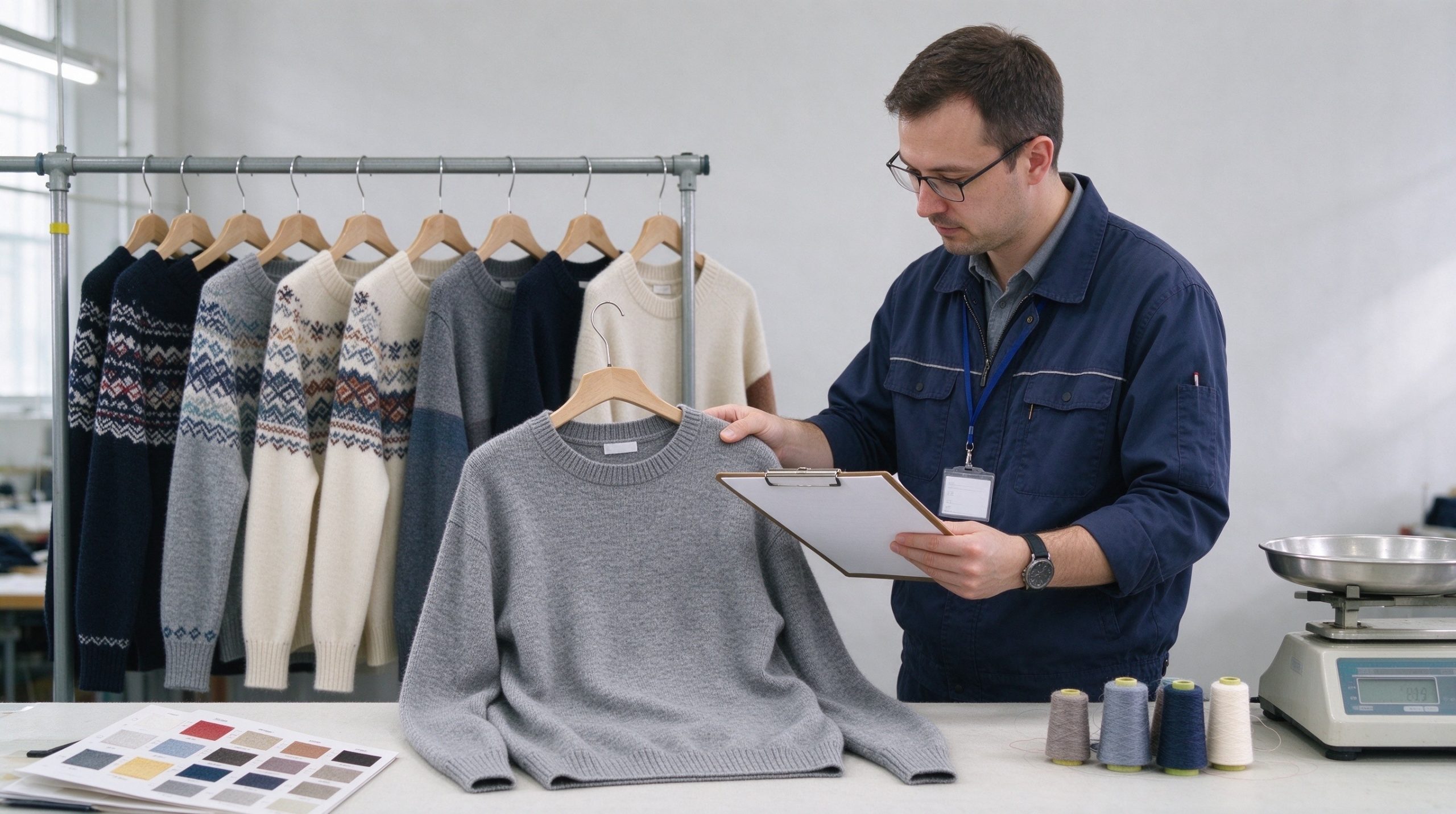
Upon completing this evaluation, buyers can clearly assess whether the manufacturer is suitable for follow-on orders and ongoing product development.
Jiaxing Kaida Apparel: Custom Manufacturing for Sweaters & Knitwear
Jiaxing Kaida Apparel Co., Ltd. provides custom sweater and knitwear manufacturing services for overseas brands, wholesalers and purchasing clients.
The product range includes commercial everyday knitwear as well as custom items with sophisticated knit structures, such as:
- Wool sweaters
- Wool-blend sweaters
- Merino-wool knitwear
- Lambswool knitwear
- Knit cardigans
- Half-zip knit tops
- Jacquard knits
- Cable knits
- Color-blocked knits
- Special-texture knits
At the product-development stage, clients may supply technical drawings, product specifications, reference samples or product images.
Every key detail can be confirmed before sample development and production, including:
Yarn → Gauge → Knit Structure → Sizing → Color → Labelling → Packaging
For overseas brands, custom sweater manufacturing is more than just producing a sample.
It is equally important to establish clear production standards from the product-development phase and implement these standards consistently in mass production.
Conclusion
When selecting a sweater manufacturer, do not rely solely on quotations or promotional photos from factory websites.
Focus instead on:
- Product comprehension
- Yarn expertise
- Knit technical know-how
- Sample accuracy
- Mass-production stability
- Quality control
- Communication efficiency
A well-planned trial order enables buyers to comprehensively evaluate a manufacturer before committing to large-volume orders.
For overseas brands with ongoing sweater and knitwear procurement needs, manufacturers that maintain stability across product development, sampling, production and quality control can be evaluated as potential long-term suppliers.
FAQ
Q1: What customizations are available for sweater OEM?
Based on product images, technical drawings or reference samples, sweater OEM projects can include customization of yarn, color, gauge, knit structure, sizing, labelling, packaging and more.
Q2: Can you produce complex knit styles?
Yes. Custom development can include jacquard, cable-knit, color-blocked, special-texture knitwear and other complex knit items.
Q3: How do overseas brands start sweater OEM cooperation?
Provide product images, technical drawings or reference samples. The next step is to confirm yarn specifications, MOQ, sampling requirements and production lead-times.
Q4: How long does sweater sampling take?
Sampling lead-time depends on the style, yarn and process complexity. A specific timeline can be assessed after complete product information is received.
Q5: What is the MOQ for sweater OEM?
MOQ varies according to style, color, yarn and production requirements. Each project can be evaluated according to its specific specifications.
Q6: How can a buyer identify a sweater manufacturer suitable for long-term cooperation?
Samples and trial-order results can be used to evaluate product understanding, sampling quality, production stability, quality control, lead-time performance and communication efficiency.