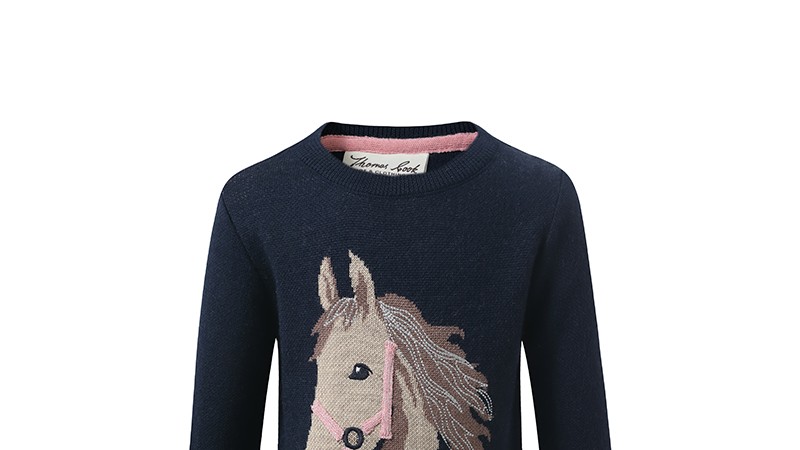
When sourcing Girls’ Wool Blend Jacquard Sweater units for equestrian uniforms, private label childrenswear collections, or premium schoolwear programs, B2B buyers must align technical specifications with brand positioning—not just aesthetics.
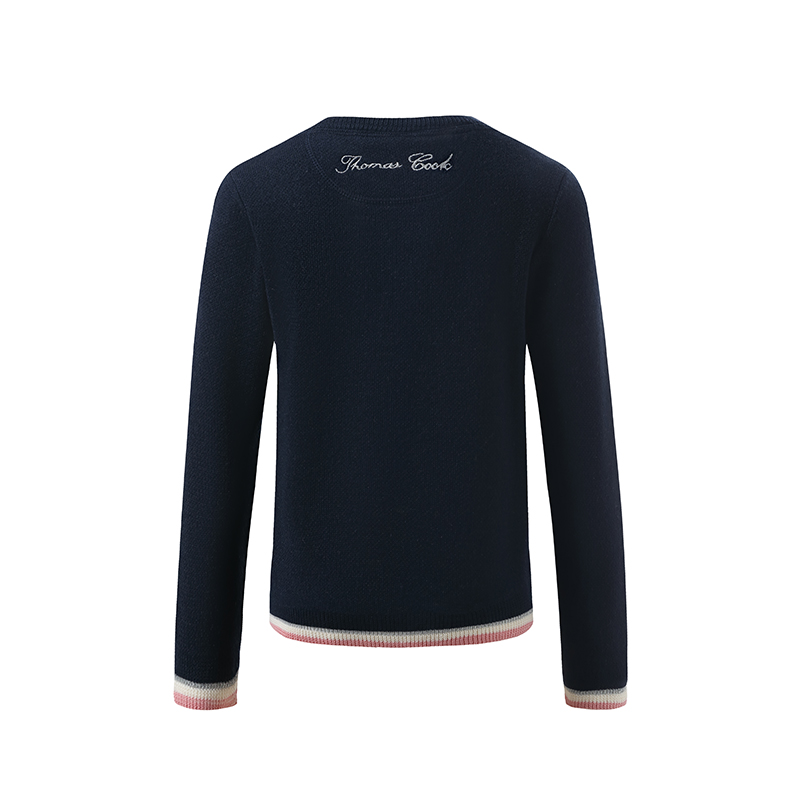
For this specific product variant, the critical procurement parameters are: a 12GG knit, crewneck silhouette, front horse jacquard motif with subtle metallic yarn accents, and a 50% wool / 50% acrylic composition. These parameters directly impact durability, care compliance, brand visual hierarchy, and fit consistency across age-based sizing. Misalignment here risks unmet end-user expectations—especially in performance-adjacent contexts like equestrian wear, where heritage cues matter but functional ease cannot be compromised.
Why Gauge and Construction Matter for Brand-Consistent Knitwear
Gauge (stitches per inch) is not merely a production detail—it defines handfeel, drape, weight, and visual texture. A 12GG construction sits mid-range: denser than 7GG or 9GG (which tend toward chunkier, more relaxed silhouettes), yet more open and breathable than 14GG or 16GG (often used for fine-gauge, fitted layers).
For Girls’ Wool Blend Jacquard Sweater applications, 12GG offers the balanced structure needed to hold a front jacquard motif clearly while retaining enough flexibility for active movement—critical for equestrian or school environments.
Procurement Tip: Buyers should confirm whether the 12GG specification applies uniformly across body, sleeves, and ribbing; variations here affect fit integrity and seam alignment during assembly.
Crewneck vs. Alternative Necklines: Fit, Function, and Brand Tone
The crewneck is a deliberate choice—not neutral. Unlike V-necks or turtlenecks, it delivers clean, closed framing ideal for logo placement, layered styling under jackets or blazers, and consistent appearance across diverse body types in children’s sizing. In equestrian and schoolwear contexts, it signals tradition without formality; in boutique retail, it supports minimalist or heritage-led storytelling.
However, crewnecks require precise rib elasticity and recovery testing—especially when blended with wool, which may relax over time. Buyers evaluating this Girls’ Wool Blend Jacquard Sweater should request stretch-and-recovery data for the ribbing and verify that ease allowances accommodate growth room for children’s wear without compromising neckline shape retention.
Front Horse Jacquard + Metallic Yarn: Design Integration, Not Decoration
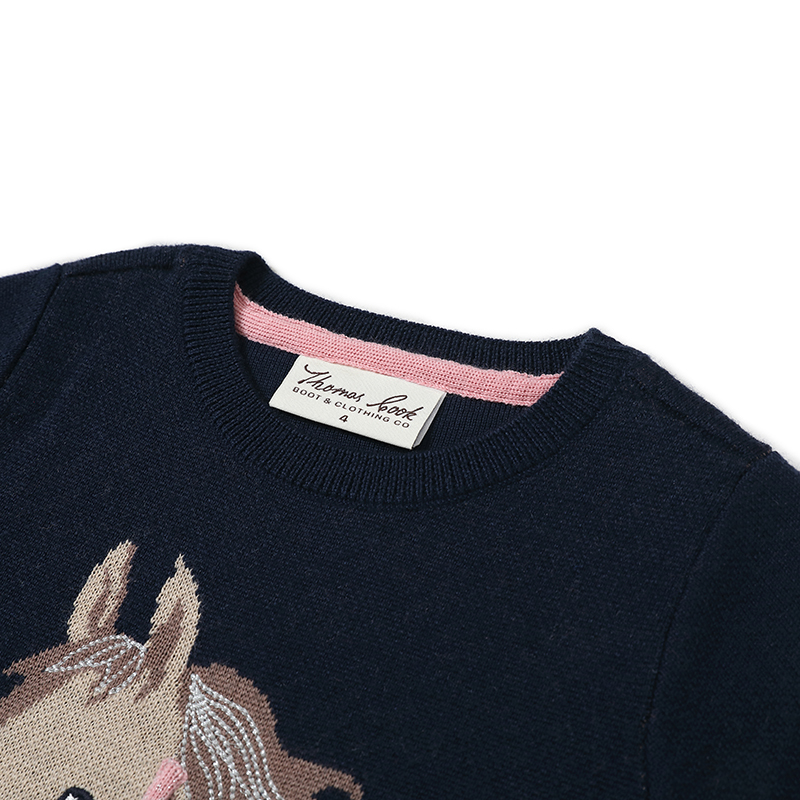
The front horse jacquard is not a printed or embroidered add-on—it is integrally knitted into the fabric structure. This means design fidelity depends on yarn tension control, gauge stability, and pattern repeat accuracy during production.
Subtle metallic yarn accents introduce additional procurement variables: reflectivity level, abrasion resistance, washfastness, and compatibility with wool-acrylic blending during dyeing and finishing. These details are not interchangeable across suppliers. A brand developing an equestrian line must ensure the jacquard motif reads legibly at standard viewing distances (e.g., 1–2 meters for uniform identification) and maintains contrast under varied lighting—indoor arena, outdoor schooling, or classroom settings. Sampling should include side-by-side comparisons under natural and artificial light.
Fabric Composition: Balancing Warmth, Care, and Performance
The 50% wool / 50% acrylic blend serves distinct procurement objectives: wool contributes natural insulation, breathability, and drape; acrylic adds tensile strength, shape retention, and cost-stable processing. Crucially, this ratio supports easy care—a non-negotiable for schoolwear programs and parents managing children’s wardrobes.
Yet ‘easy care’ is not self-defining: it must be validated against standardized home laundering protocols (e.g., ISO 6330), including shrinkage, pilling, and colorfastness after multiple cycles. Buyers should specify required test methods early and avoid assuming compliance based on fiber percentage alone. Acrylic content also influences static propensity—a consideration for dry-climate equestrian facilities or heated classrooms.
Selecting by Brand Context: Childrenswear, Equestrian, Boutique, Schoolwear
No single spec fits all scenarios—even within the same Girls’ Wool Blend Jacquard Sweater category:
- Private label childrenswear brands: Prioritize growth allowance, seam softness, and labeling compliance (e.g., CPSIA tracking, fiber content disclosure); jacquard clarity matters less than tactile safety.
- Equestrian brands: Require motif authenticity (e.g., breed-specific horse anatomy), color coordination with breeches/boots, and abrasion resistance at shoulder/elbow zones—areas not covered by the front jacquard but critical for longevity.
- Boutique retailers: Assess hang, drape, and shelf presence; metallic yarn must catch light without appearing costume-like.
- Premium schoolwear programs: Demand uniformity across batches, strict size grading, and documentation for sustainability or ethical sourcing claims—if those are part of the brand’s public positioning.
A buyer’s selection framework should begin with channel, then customer age band, then layering requirements—not with fabric first.
OEM/ODM Development Checklist: What to Confirm Before Sampling
For any Girls’ Wool Blend Jacquard Sweater project, these items require explicit confirmation—not assumption:
- Whether the 12GG gauge applies identically to main body, sleeves, and ribbing—or if secondary gauges are used for functional zones;
- Yarn source and lot consistency protocol, especially for metallic components prone to batch variation;
- Approved washing and finishing process (e.g., superwash treatment for wool, softener type for acrylic compatibility);
- Fit approval method: graded size set vs. fit model reference; measurement tolerance bands per size;
- Labeling and packaging specifications—including language, legal disclaimers, and hangtag material options;
- Documentation scope: tech pack format, measurement chart standards (ASTM D5583, ISO 8559), and photo shoot guidelines for pre-production samples.
Recommended Products
Custom Girls’ Wool Blend Jacquard Sweater Manufacturer | Private — Designed for brands requiring OEM/ODM development of the exact 12GG crewneck style with front horse jacquard and metallic yarn accents, supporting private label children’s knitwear collections, equestrian apparel lines, boutique retail assortments, and premium schoolwear programs.
Frequently Asked Questions
Q: What gauge and neckline does this girls’ wool blend jacquard sweater use?
A: It is a 12GG crewneck sweater with a front horse jacquard design and subtle metallic yarn accents.
Q: What fiber blend is used, and what care benefits does it offer?
A: The sweater is knitted from a soft 50% wool and 50% acrylic blend, designed for warmth, durability, and easy care.
Q: Can this sweater be customized for private label children’s or equestrian collections?
A: Yes. The product page states flexible OEM/ODM customization for private label children’s knitwear collections, equestrian brands, boutique retailers, and premium schoolwear programs.
Q: What should buyers provide before initiating development?
A: A complete tech pack including size chart, detailed measurements, approved yarn references, artwork files for jacquard, labeling instructions, and packaging specifications. Fit preferences and target price range should also be shared to guide material and construction options.
Q: How is jacquard motif clarity verified during sampling?
A: Clarity is assessed visually at 1m distance under controlled lighting, alongside stitch definition checks using magnification. Buyers should specify acceptable tolerance for float length, pattern distortion, and metallic yarn visibility—especially in shadowed areas of the motif.
There is no universal ‘best’ Girls’ Wool Blend Jacquard Sweater. The optimal version emerges only when gauge, neckline, motif execution, fiber balance, and care profile are evaluated jointly against brand goals, end-user context, and distribution channel requirements.
A 12GG crewneck with horse jacquard works for equestrian identity—but only if its construction supports real-world use, its care aligns with user behavior, and its customization path accommodates your brand’s operational needs. Buyers should treat each parameter as interdependent—not isolated—and confirm every detail during pre-production sampling.
Contact our team to discuss your knitwear project and explore customized manufacturing solutions.