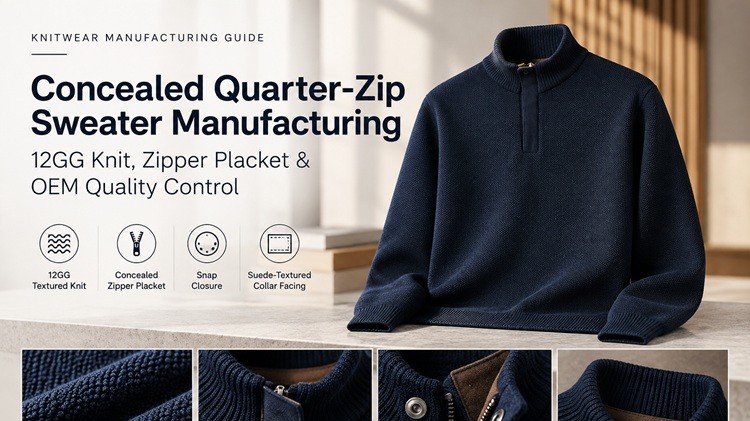
For fashion brands and apparel sourcing teams, choosing a concealed quarter-zip sweater manufacturer requires more than comparing fabric composition, garment weight, and unit price. A concealed zipper placket introduces additional construction details that can influence collar stability, fastening performance, sample development, and consistency across bulk production.
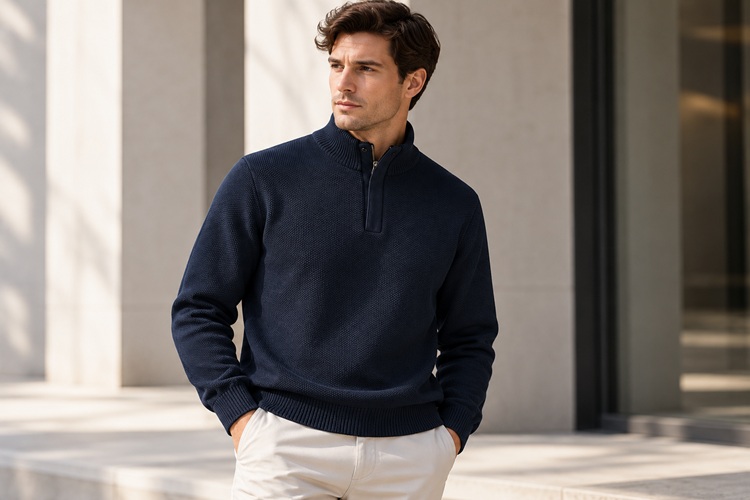
Unlike a conventional exposed-zip sweater, a concealed quarter-zip design uses an outer placket to cover much of the zipper hardware. This creates a cleaner front appearance but also requires careful attention to placket dimensions, zipper alignment, snap placement, and fabric behavior.
This manufacturing guide examines the technical and sourcing considerations behind a 12GG textured polyester quarter-zip sweater, using Kaida Knitwear’s Men’s Quarter-Zip Sweater as a product reference for OEM, ODM, and private label development.
What Is a Concealed Quarter-Zip Sweater?
A concealed quarter-zip sweater features a partial front zipper covered by a knitted or fabric placket. Depending on the design, the placket may conceal most of the zipper teeth and tape while leaving the puller accessible for fastening.
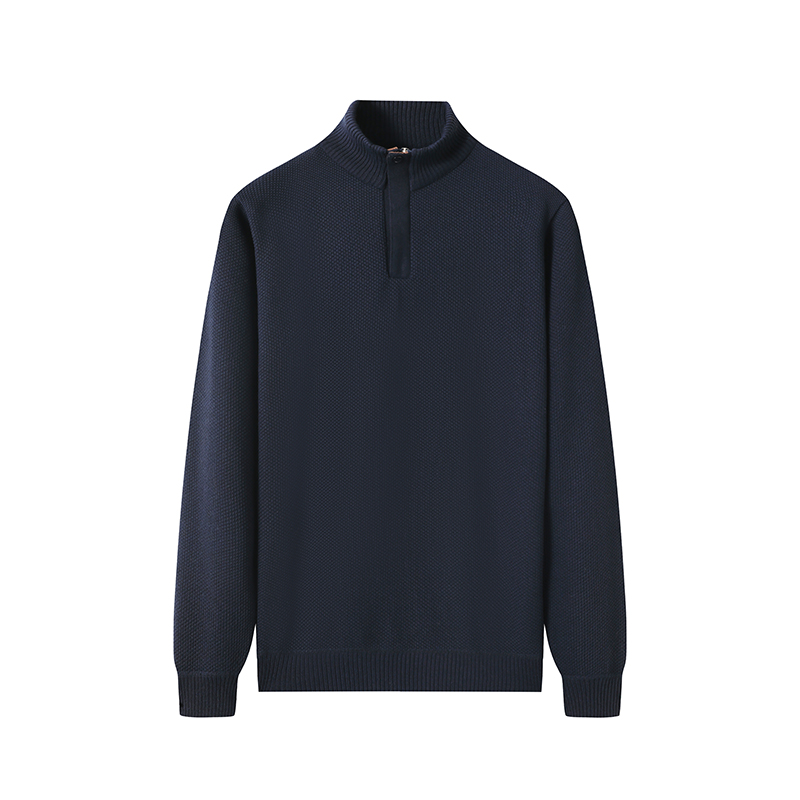
The referenced Kaida Knitwear design combines several construction elements:
- 12GG textured knit: A relatively fine-gauge knitted structure with a defined rice or moss stitch-inspired surface.
- 100% polyester yarn: A synthetic fiber option suitable for commercial menswear development, with performance depending on yarn and finishing specifications.
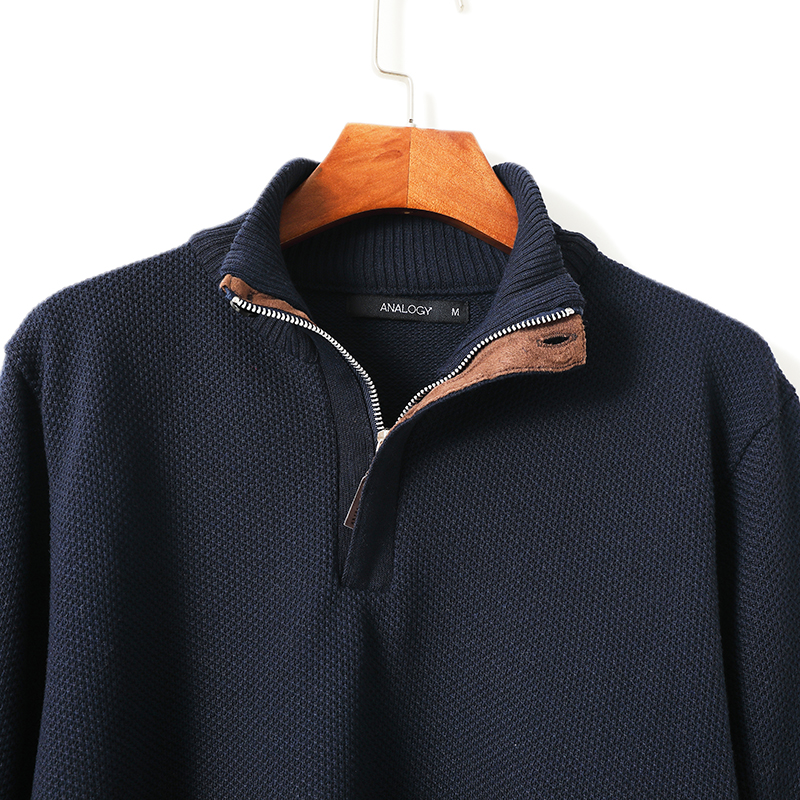
- Concealed metal zipper: A partial front fastening system covered by an outer knitted placket.
- Concealed snap closure: An additional fastening detail used to help secure the placket.
- Suede-textured collar facing: A contrasting inner collar detail that contributes to the garment’s appearance and feel.
- Ribbed cuffs and hem: Knitted finishing details that influence fit, edge recovery, and overall garment proportions.
For private label buyers, the main advantage is design differentiation. However, the additional fastening and collar components also create inspection points that should be included in the technical package.
12GG Textured Knit: Gauge, Stitch Structure, and Material Selection
What Does 12GG Mean in Sweater Manufacturing?
In flat knitting, 12GG generally refers to a knitting machine gauge of approximately 12 needles per inch. Compared with coarser configurations such as 5GG or 7GG, it is commonly associated with finer yarns and more compact knitted structures.
However, gauge alone does not determine garment thickness, durability, softness, or weight. These characteristics also depend on:
- Yarn count and the number of yarn ends used.
- Knitting tension and stitch density.
- Stitch construction and surface texture.
- Fiber composition and yarn manufacturing method.
- Washing, heat setting, and other finishing processes.
For an OEM quarter-zip sweater, buyers should specify the required fabric appearance and measurements rather than relying solely on the knitting gauge.
Rice and Moss Stitch-Inspired Textures
The referenced sweater uses a textured knit surface described as rice or moss stitch-inspired. These structures create visual depth through alternating stitch formations rather than relying on printed decoration.
During development, buyers should evaluate whether the texture remains consistent across the front, back, and sleeves. Particular attention is needed near the zipper opening, where panel construction and additional stitching may affect the appearance of the knitted surface.
Important sample checks include:
- Consistency of stitch definition across garment panels.
- Visible differences in knitting tension.
- Distortion around the zipper placket and collar.
- Surface appearance after the specified finishing process.
- Dimensional changes following appropriate care testing.
Why Use 100% Polyester Knit?
The reference design specifies 100% polyester. Polyester can offer useful characteristics for commercial knitwear, including strength, dimensional stability, and relatively straightforward care, depending on the yarn construction and finishing method.
Nevertheless, polyester performance varies considerably. Buyers should not assume that every polyester knit will have the same pilling resistance, moisture behavior, shrinkage characteristics, or handfeel.
For private label production, relevant evaluation areas may include:
- Fabric weight and handfeel.
- Dimensional stability after washing.
- Colorfastness to washing and rubbing.
- Pilling resistance.
- Surface appearance after repeated care cycles.
- Compatibility with zipper tape, collar facing, and other trims.
Testing methods and acceptance criteria should be agreed upon according to the intended market and buyer requirements.
Concealed Zipper Placket Construction: Key Manufacturing Challenges
The zipper placket is the defining technical feature of this sweater. While a concealed construction can produce a refined appearance, it requires coordination between knitted fabric, zipper components, additional closures, and garment assembly.
1. Zipper Alignment and Placket Coverage
The outer knitted placket should cover the intended portion of the zipper without interfering with normal operation.
Buyers should confirm:
- Finished placket width and length.
- Whether the zipper is fully or partially concealed.
- Alignment of the left and right front edges.
- Position of the zipper puller when closed.
- Clearance for smooth opening and closing.
- Appearance of the front opening when the garment is worn.
Uneven placket dimensions can cause visible asymmetry, while excessive fabric tension may produce rippling around the zipper.
2. Metal Zipper Selection
The reference sweater uses a metal zipper. Its performance depends on component quality, tape construction, slider compatibility, and installation accuracy.
During sample approval, buyers should review zipper length, tooth finish, slider movement, puller design, tape color, and attachment method.
Where required, zipper strength and durability testing should follow agreed methods and acceptance limits. Metal composition and applicable chemical restrictions should also be reviewed for the destination market.
3. Concealed Snap Placement
The additional concealed snap helps secure the placket, but its positioning must be coordinated with the zipper and surrounding fabric.
Inspection should cover:
- Correct snap alignment when the garment is closed.
- Secure attachment to the intended fabric layers.
- Appropriate opening and closing force.
- Absence of visible distortion around the snap.
- Compatibility with garment washing and care requirements.
For production orders, buyers may specify snap attachment strength requirements and an appropriate inspection procedure.
4. Placket Stability After Washing
Knitted fabric, zipper tape, and collar-facing materials may respond differently to washing, drying, and finishing.
If these components change dimensions at different rates, the finished garment may develop puckering, twisting, or uneven placket edges.
For this reason, sample evaluation should include the complete assembled garment rather than testing the knitted fabric alone.
Collar Facing, Ribbed Cuffs, and Garment Fit
Suede-Textured Inner Collar Facing
The sweater includes a suede-textured inner collar facing, providing a contrasting surface within the stand collar.
For OEM development, the buyer should confirm the facing material, thickness, attachment method, color, and care compatibility.
Important inspection points include:
- Collar symmetry and finished height.
- Even attachment of the inner facing.
- Absence of excessive seam bulk.
- Comfort around the neckline.
- Color consistency between the facing and outer knit.
- Collar shape retention after the specified care process.
The facing should be evaluated together with the zipper and placket because these components meet in a relatively small area of the garment.
Ribbed Cuffs and Hem
Ribbed cuffs and hems help define the sweater’s fit and silhouette. Their elasticity and recovery depend on the stitch structure, yarn, and finishing.
During sampling, buyers should review cuff circumference, rib depth, hem dimensions, and consistency between the left and right sleeves.
Excessive tightening or poor recovery can affect comfort and the garment’s appearance after repeated wear.
Regular Fit and Size Grading
The reference product uses a men’s regular-fit silhouette and lists sizes from S to 5XL, with customization options.
For bulk orders, size grading should consider more than proportional increases in width and length.
Buyers should review:
- Chest width and body length.
- Shoulder width and sleeve length.
- Armhole depth and sleeve proportions.
- Collar dimensions and zipper opening length.
- Cuff and hem measurements.
- Finished garment measurement tolerances.
Where appropriate, request fit samples in representative sizes before approving the complete size range.
OEM and Private Label Customization Options
Brands developing a private label quarter-zip sweater can use the reference design as a starting point for different market positions and collection requirements.
| Customization Area | Possible Options | Buyer Considerations |
|---|---|---|
| Knit structure | Texture, stitch density, panel design | Appearance, handfeel, production feasibility |
| Yarn | Alternative compositions and colors | MOQ, cost, care performance |
| Zipper | Length, puller, finish, tape color | Function, appearance, component availability |
| Snap closure | Placement, size, finish | Attachment security, placket alignment |
| Collar facing | Material, color, texture | Comfort, bulk, care compatibility |
| Fit | Body length, sleeve length, grading | Target customer, measurement tolerances |
| Branding | Woven labels, care labels, hangtags | Brand identity, destination-market requirements |
| Packaging | Polybags, folding, carton labels | Retail presentation, logistics |
Not every customization can be implemented without affecting price, minimum order quantity, or lead time. Technical feasibility should be confirmed before finalizing the order.
OEM Development Process: From Technical Package to Production
A structured development process helps buyers and manufacturers identify potential construction problems before bulk production.
Step 1: Define the Technical Package
Provide a design sketch or reference garment together with the intended yarn, knitting gauge, stitch structure, measurements, zipper details, snap placement, collar-facing requirements, labels, and packaging specifications.
Step 2: Confirm Materials and Components
Review yarn availability, color options, zipper specifications, snap components, and collar-facing materials.
Where necessary, request physical material samples or color approvals before garment sampling.
Step 3: Develop the Initial Sample
The referenced Kaida Knitwear product lists an indicative 7–12 day sampling lead time. Actual timing may vary depending on design complexity, material availability, and revisions.
The initial sample should be evaluated for overall fit, knit appearance, zipper operation, placket alignment, snap positioning, and collar construction.
Step 4: Approve the Pre-Production Specifications
Before bulk manufacturing, confirm the approved sample, measurement chart, bill of materials, color standards, trim specifications, labeling, and inspection requirements.
Changes to approved components should be communicated and authorized before implementation.
Step 5: Monitor Bulk Production
Depending on the manufacturing arrangement, production may involve knitting, panel preparation, garment assembly, zipper installation, snap attachment, finishing, and packing.
Buyers should agree on appropriate production milestones and communication procedures.
Step 6: Complete Final Inspection
Finished garments should be evaluated against the approved specifications, with particular attention to the concealed placket, zipper function, snap security, garment measurements, and visible finishing defects.
Quality Control Checklist for Concealed Quarter-Zip Sweaters
Effective quarter-zip sweater quality control should include both conventional knitwear inspection and checks specific to the concealed fastening system.
| Inspection Area | Key Checkpoints | Potential Defects |
|---|---|---|
| 12GG knit fabric | Stitch consistency, texture, panel appearance | Uneven tension, visible knitting defects |
| Yarn and color | Composition, shade consistency, surface quality | Color variation, unexpected handfeel |
| Concealed placket | Width, coverage, alignment, symmetry | Rippling, uneven edges, visible zipper tape |
| Metal zipper | Slider movement, attachment, length | Jamming, misalignment, loose attachment |
| Concealed snap | Position, attachment, fastening function | Misalignment, weak attachment |
| Collar facing | Attachment, symmetry, seam bulk | Shifting, uneven collar shape |
| Ribbed cuffs and hem | Measurements, elasticity, recovery | Uneven dimensions, poor recovery |
| Garment measurements | Chest, length, sleeves, size grading | Out-of-tolerance dimensions |
| Finishing and care | Appearance, dimensional stability | Puckering, twisting, distortion |
| Labels and packaging | Accuracy, placement, packing | Incorrect labeling, packaging errors |
Inspection sampling methods, defect classifications, and acceptance limits should be agreed upon before production. If AQL-based inspection is required, the buyer and manufacturer should define the applicable sampling plan and acceptance criteria rather than relying on an unspecified AQL claim.
MOQ, Sampling Time, and Sourcing Considerations
Minimum order quantities and development timelines influence how quickly a brand can introduce a new quarter-zip design.
The referenced Kaida Knitwear product provides the following sourcing information:
| Specification | Reference Information |
|---|---|
| Product | Men’s Quarter-Zip Sweater |
| Knitting gauge | 12GG |
| Material | 100% polyester |
| Fabric structure | Textured rice/moss stitch-inspired knit |
| Garment weight | Approximately 560 g |
| Closure | Concealed metal zipper and snap |
| Collar | Stand collar with suede-textured inner facing |
| Fit | Men’s regular fit |
| Size range | S–5XL, with customization options |
| Listed MOQ | From 100 pieces |
| Indicative sampling time | 7–12 days |
| Services | OEM / ODM / Private Label |
Note: These specifications are reference information for the featured product. Final minimum quantities, material availability, pricing, production lead times, and customization conditions should be confirmed through a current quotation.
When evaluating the MOQ, buyers should ask whether the minimum applies per style, per color, or across an entire order. Custom-dyed yarns, specialized zipper finishes, and nonstandard collar materials may affect minimum quantities.
Sampling time should also be distinguished from total development time, which can include technical review, component sourcing, sample revisions, and final approval.
Concealed vs. Standard Quarter-Zip Sweaters: Which Is Better for Your Brand?
Neither construction is universally superior. The appropriate choice depends on the intended market, visual requirements, development budget, and production priorities.
| Factor | Concealed Quarter-Zip | Standard Quarter-Zip |
|---|---|---|
| Appearance | Cleaner front with reduced hardware visibility | Visible zipper as a functional or design feature |
| Construction | Additional placket and fastening details | Generally simpler front opening |
| Development | More alignment and component checks | Fewer concealed-placket considerations |
| Customization | Placket width, snap, zipper, collar details | Zipper finish, collar, trim details |
| Inspection focus | Placket coverage, symmetry, zipper and snap function | Zipper function, tape alignment, seam quality |
| Typical positioning | Refined smart casual and minimalist menswear | Casual, sporty, and functional collections |
A concealed quarter-zip may be suitable for brands seeking a more understated appearance, while an exposed zipper can support sporty or utility-inspired designs.
For both options, sample evaluation and clear technical specifications are more reliable than assumptions based on style alone.
How to Choose a Reliable Quarter-Zip Sweater Manufacturer
When comparing manufacturers, focus on their ability to explain construction requirements and provide clear development information.
Evaluate Knitwear Technical Knowledge
Ask how knitting gauge, stitch structure, yarn composition, and finishing will influence the final garment. The supplier should be able to identify potential limitations and suitable alternatives.
Review Zipper and Placket Samples
Inspect actual samples for zipper operation, placket coverage, snap alignment, collar stability, and appearance when worn.
Confirm Customization Feasibility
Clarify which components can be modified, whether alternative materials require new sampling, and how changes affect cost and MOQ.
Establish Measurable Quality Requirements
Agree on garment measurements, zipper functionality, trim attachment, appearance standards, and any required testing before approving bulk production.
Clarify Production Milestones
Confirm sample development, material approval, bulk production scheduling, inspection arrangements, and shipment requirements.
Clear documentation and timely communication can help reduce sourcing risks throughout the project.
Recommended OEM Product: Men’s 12GG Concealed Quarter-Zip Sweater
For brands developing smart casual menswear, wholesale knitwear collections, or private label apparel, Kaida Knitwear’s Men’s Quarter-Zip Sweater – 12GG Textured Polyester Knit provides a reference design combining textured knitting with a concealed fastening system.
The garment features a 12GG textured polyester knit, concealed metal zipper, additional snap closure, suede-textured inner collar facing, and ribbed cuffs and hem.
Its regular-fit construction and customization options make it a starting point for discussing yarn selection, zipper finishes, collar details, branding, sizing, and packaging requirements.
View the 12GG Quarter-Zip Sweater Specifications →
Frequently Asked Questions
What is the difference between a concealed quarter-zip and a standard quarter-zip sweater?
A concealed quarter-zip sweater uses an outer placket to cover most of the zipper, creating a cleaner front appearance. The reference design also includes a concealed snap to help secure the placket. A standard quarter-zip typically leaves the zipper more visible.
Why is 12GG textured polyester knit used for this sweater?
The 12GG construction supports a relatively fine, defined knitted texture. Polyester provides a practical material option for commercial menswear, although the finished garment’s performance depends on yarn quality, stitch structure, and finishing.
Can the zipper, snap closure, and collar facing be customized?
Customization options may include zipper specifications, snap placement, placket dimensions, collar-facing materials, knit texture, colors, sizing, labels, and packaging. Technical feasibility and minimum order requirements should be confirmed before production.
What is the MOQ for custom quarter-zip sweaters?
The referenced Kaida Knitwear product lists an MOQ starting from 100 pieces. Final minimum quantities depend on the selected design, materials, colors, and customization requirements.
How long does OEM quarter-zip sweater sampling take?
The product lists an indicative sampling lead time of 7–12 days. Actual development time may vary depending on material availability, component sourcing, and sample revisions.
What should buyers inspect before bulk production?
Buyers should review knitting consistency, garment measurements, zipper operation, placket alignment, snap attachment, collar-facing construction, ribbed edges, and finishing quality. An approved sample and written technical specification should be used as inspection references.
Conclusion: Build a Quarter-Zip Sweater Around Clear Technical Specifications
Successful concealed quarter-zip sweater manufacturing depends on coordinating knitted fabric, fastening components, collar construction, fit requirements, and quality control.
For fashion brands and apparel sourcing teams, understanding these details before sampling can help reduce avoidable revisions and establish more consistent expectations for bulk production.
Explore Kaida Knitwear’s 12GG Textured Polyester Quarter-Zip Sweater to review the reference design and discuss OEM or private label customization options.
Planning a new menswear collection? Share your design sketches, technical specifications, target quantities, and preferred delivery schedule with Kaida Knitwear to request a customized manufacturing quotation.