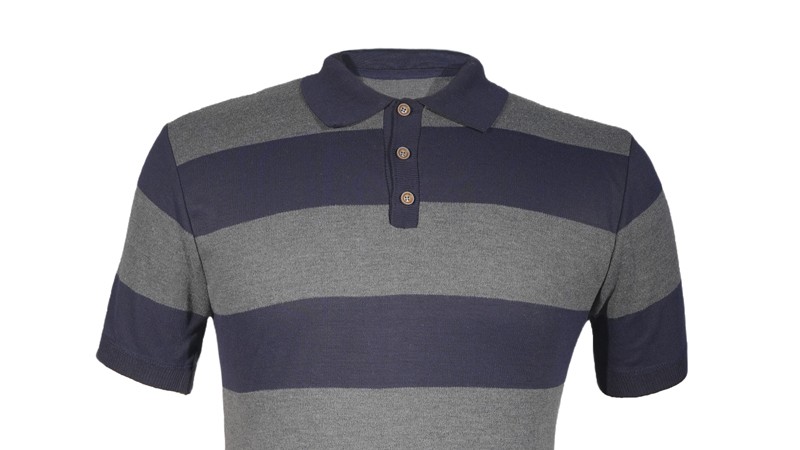
When evaluating a 12GG striped knit polo shirt for resort wear or corporate uniform programs, buyers must distinguish between surface-level aesthetics and structural suitability. The gauge, yarn composition, rib construction, and collar execution directly affect drape, durability, breathability, and perceived value—especially in high-visibility applications like branded uniforms or seasonal resort collections. For private label knitwear collections targeting men’s casualwear or promotional apparel, this isn’t just about color blocking; it’s about confirming whether the base specification supports intended use cases without compromising fit consistency or production scalability.
Why Gauge and Yarn Matter in Men’s Knit Polo Shirt Development
Gauge (measured in needles per inch) defines fabric density, hand feel, and weight distribution. A 12GG construction sits mid-range: denser than 7GG–9GG sporty knits but more breathable and flexible than 14GG+ fine-gauge polos. At approximately 311g per piece, this Men’s Knit Polo Shirt delivers structured drape without stiffness—ideal for warm-weather settings where airflow and shape retention are both priorities. Unlike cotton-blend piques, the 100% polyester base offers inherent moisture-wicking and quick-dry performance, making it functionally appropriate for resort environments and active corporate roles (e.g., hospitality staff, event coordinators).
However, polyester also requires careful evaluation of yarn twist, filament fineness, and finishing to avoid shine or static issues—details that must be confirmed during sampling, not assumed from material declaration alone.
Striping, Ribbing, and Collar Construction: Functional Implications
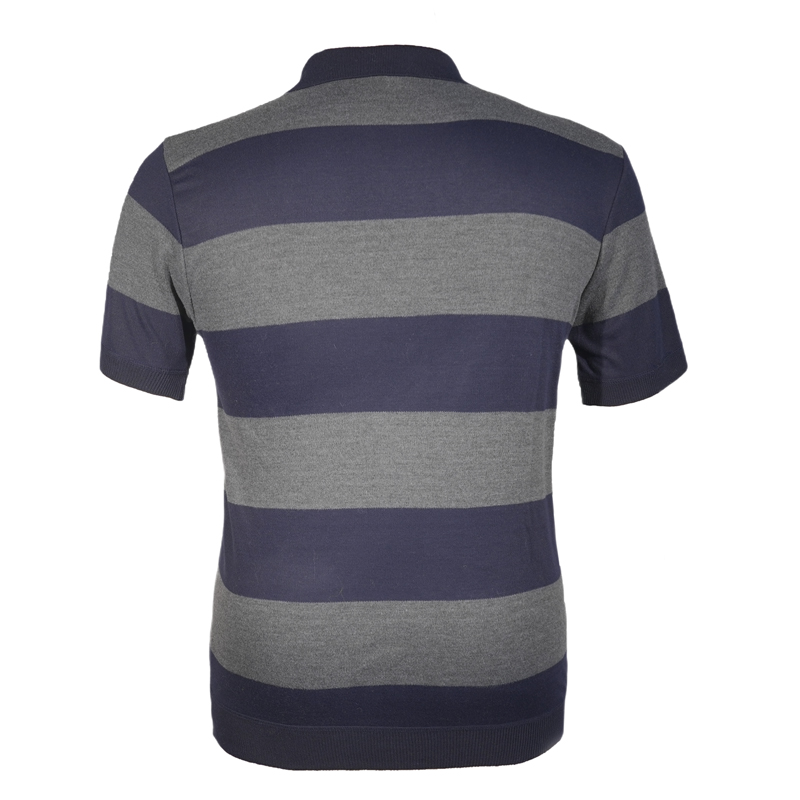
The navy blue and grey color combination is applied via striped knitting—not dyeing or printing—meaning stripe alignment, width consistency, and tension balance across panels impact visual cohesion. Buyers should verify stripe continuity at side seams, underarm gussets, and across the placket.
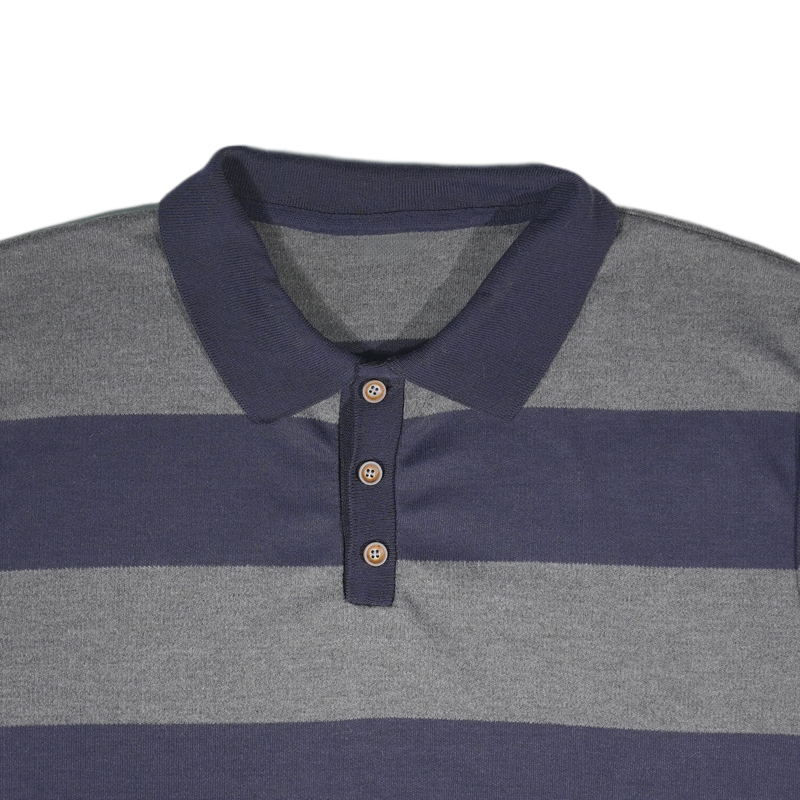
Similarly, ribbed cuffs and ribbed hem contribute to recovery and fit retention, but rib height, elasticity ratio (e.g., 1×1 vs. 2×2), and attachment method (self-fabric vs. separate band) influence both comfort and long-term appearance. The classic polo collar with button placket adds structure, yet its stability depends on interlining type, stitching density, and collar roll behavior—critical for corporate programs where uniformity across hundreds of units is non-negotiable. These aren’t aesthetic footnotes; they’re development checkpoints requiring physical sample review.
Matching the Men’s Knit Polo Shirt to Your Brand’s Use Case
No single Men’s Knit Polo Shirt suits all scenarios equally. Buyers should map the base specification to their specific end use before committing to bulk production:
- Resort wear: Prioritize UV resistance, ease of care, and relaxed-but-refined silhouette—making 12GG polyester a practical middle ground between lightweight jersey and heavy pique.
- Corporate uniform programs: Consistency across sizes, colorfastness to chlorine/sweat, and seam durability become primary criteria; here, the fixed navy/grey palette simplifies inventory but limits flexibility for brand-aligned palettes.
- Promotional apparel: The key question is whether the stripe pattern allows clean logo placement (e.g., chest embroidery without disrupting stripe rhythm).
- Private label knitwear collections: The challenge is scaling from capsule offerings into full size runs while maintaining stitch definition and color fidelity—where MOQs of 100 pieces per color, 300 per style set realistic entry thresholds but require upfront clarity on shade matching and trim sourcing.
OEM/ODM Development Checklist for This Style
Before finalizing tech packs or approving prototypes, sourcing teams should explicitly confirm:
- Whether custom color combinations require new stripe programming—and if so, whether lead time or MOQ adjustments apply;
- If private labeling includes woven labels, heat-transfer logos, or embroidered branding—and how placement interacts with ribbed hems or collar edges;
- Whether size grading follows standard ISO/ASTM benchmarks or brand-specific blocks, particularly for sleeve cap height and shoulder slope;
- If care labeling reflects actual test results (e.g., wash shrinkage, colorfastness to rubbing), not generic polyester guidelines;
- How ribbed cuff/hem elasticity is measured (e.g., % recovery after 50 cycles) and whether samples include stretch-and-recovery documentation.
None of these items are implied by the base spec—they must be negotiated, documented, and validated in pre-production samples.
Material Realities: Polyester Beyond the Label
Saying “100% polyester” reveals nothing about filament type (e.g., textured vs. smooth, hollow vs. solid), denier count, or dope-dyed vs. piece-dyed processing—all of which affect luster, softness, pilling resistance, and environmental profile. For example, a dope-dyed polyester minimizes water use and improves color permanence but may limit shade options. A textured filament enhances opacity and reduces cling but adds weight.
Buyers developing for ESG-conscious markets should request fiber certifications (e.g., GRS, OEKO-TEX) and clarify whether the 311g weight includes packaging or reflects garment-only measurement. Without this, comparisons across suppliers remain superficial.
Recommended Product
OEM Men’s 12GG Striped Knit Polo Shirt Manufacturer — Designed for brands requiring consistent stripe alignment, ribbed edge integrity, and scalable OEM production across resort, corporate, and private label applications. Supports custom labeling and color adaptations within defined parameters.
Frequently Asked Questions
What is the minimum order quantity for this 12GG striped knit polo shirt?
The MOQ is 100 pieces per color and 300 pieces per style, based on the product page. Custom color combinations may require confirmation.
What material is used in this striped knit polo, and what is the gauge?
The polo is made from 100% polyester and knitted at 12GG. It weighs approximately 311g per piece.
Does this polo shirt support OEM customization such as private labels and custom colors?
Yes, the product page states it is available for OEM manufacturing and wholesale orders, with a specified color combination of navy blue and grey.
How should buyers evaluate stripe consistency before bulk production?
Stripe alignment must be assessed across all body panels and sleeves using flat-lay photos and physical measurement of stripe width variation. Side seam joins and placket transitions should be inspected under natural light to detect tension mismatches or color shifts.
What fit and sizing information is required to initiate OEM development?
Brands must supply a complete size chart with graded measurements (not just S/M/L), plus a reference fit garment or detailed block specifications—including front/back length ratio, sleeve inseam, and collar stand height—to ensure accurate pattern adaptation.
Conclusion
Choosing a 12GG striped knit polo shirt isn’t about selecting the “best” gauge or material—it’s about aligning technical execution with brand positioning, end-user needs, and operational constraints. A navy/grey polyester polo works well for resort wear due to its performance and maintenance profile, and fits corporate programs where color control and durability matter—but only if rib recovery, collar stability, and stripe precision are verified pre-production.
There is no universal optimal solution. The right path depends on whether your priority is speed-to-market, sustainability compliance, visual differentiation, or cost-per-unit predictability.