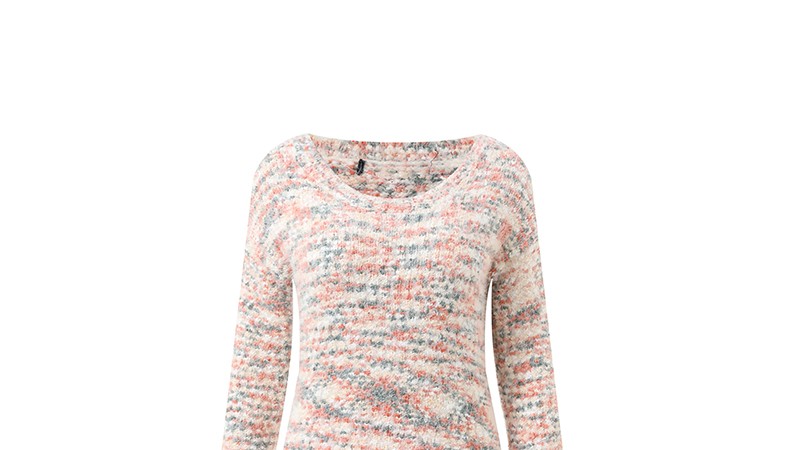
Why Gauge, Yarn Blend, and Construction Define Commercial Viability for Mouliné Crewnecks
When developing Women’s Sweater / Knitwear for autumn/winter private label collections or commercial chunky knitwear programs, inconsistent color distribution and poor shape retention in marl styles directly affect bulk production yield, rework rates, and seasonal sell-through. This is especially critical for brands sourcing mouline crewneck knitwear OEM, where the visual appeal of the multi-tone effect must remain stable across production runs — without relying on post-knit dyeing or hand-sorting. The interplay of 5GG heavyweight sweater factory capability, acrylic-nylon yarn behavior, and rib reinforcement is not theoretical: it determines whether a marl sweater maintains its intended texture, silhouette, and tonal balance after washing, wear, and repeated handling in retail environments.
Understanding the Technical Foundation: 5GG, 486g, and Marl Yarn Behavior
A 5GG gauge indicates a coarse, open-loop structure suited to heavyweight knits — but it also increases sensitivity to yarn tension variation and stitch definition loss during knitting and finishing. At 486g, this style falls firmly into the acrylic nylon blend sweater category optimized for cold-weather layering and shelf presence. The 45% acrylic / 55% nylon blended marl yarn is not selected for drape or softness alone: nylon contributes tensile strength and recovery, while acrylic provides bulk, opacity, and color absorption. This ratio supports twist retention in the marl strand, which helps reduce tone migration between panels — a common issue when high-acrylic blends dominate.
Mouliné Effect ≠ Random Marling: Why Construction Dictates Color Stability
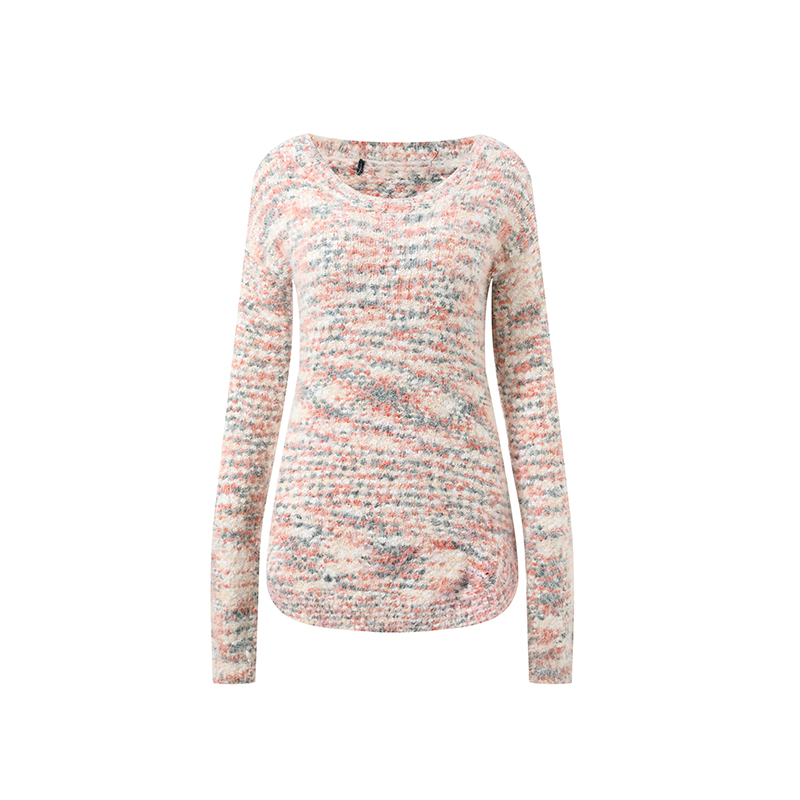
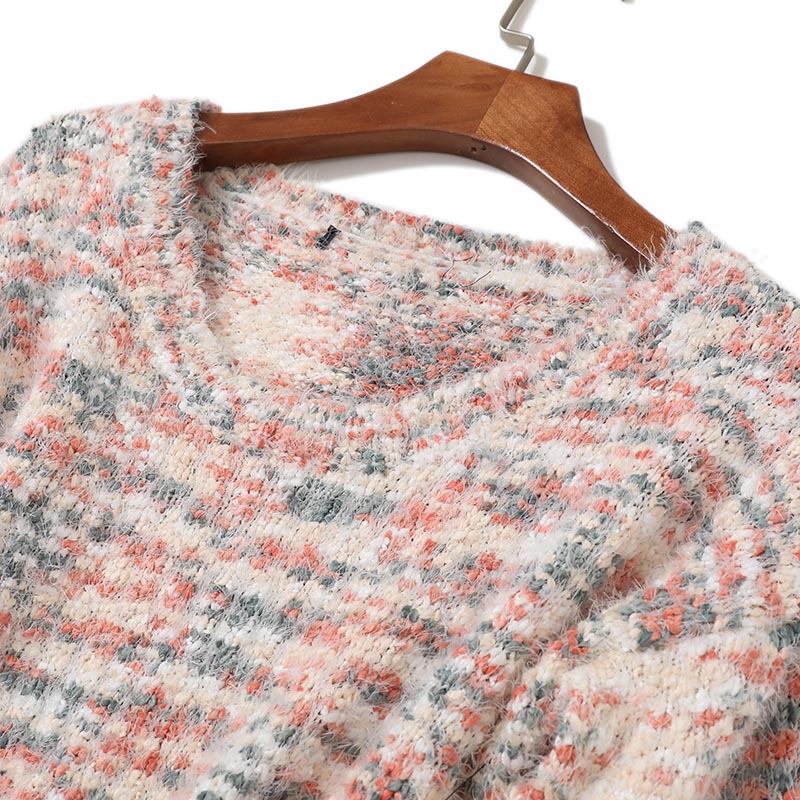
The multi-tone mouliné effect relies on controlled yarn irregularity, not random fiber mixing. A true mouliné marl is spun from two or more dyed filaments twisted together before knitting, creating tonal shifts that repeat predictably across the fabric surface. In contrast, heathered or space-dyed yarns can fade unevenly or show batch-to-batch chromatic drift. For private label marl knitwear, this means the yarn supplier’s spinning consistency — and the factory’s ability to maintain even feed tension at 5GG — directly affect whether sleeves match bodies in tone, and whether front and back panels align visually after blocking. Reinforced rib construction at cuffs, hem, and neckline does more than improve fit security: it anchors the marl yarn’s torsional memory, minimizing twist relaxation that can flatten the multi-tone depth over time.
Fit, Fabric, and Seasonal Context: Matching Development to Brand Positioning
No single marl sweater specification fits all Women’s autumn/winter private label collections. A premium contemporary brand targeting editorial placement may prioritize exaggerated silhouette and raw-edge finishes, accepting tighter tolerance bands on tone alignment. A mid-tier fashion brand scaling across multiple markets needs repeatable shade matching across dye lots and dimensional stability across its full size range. A value-focused private label program may require simplified rib structures to reduce labor cost — but that trade-off risks compromised shape retention in a 486g garment. Buyers should confirm with the marl sweater manufacturer how color consistency is validated across panels, and whether rib reinforcement is achieved via stitch density, yarn doubling, or structural tuck stitches — each affecting handfeel, weight distribution, and machine compatibility.
OEM/ODM Development Checklist: What to Confirm Before Sampling
- Yarn source documentation: Is the marl yarn pre-spun and specified for lot-to-lot color repeatability? Can lab dips be matched to physical yarn cones, not only digital swatches?
- Gauge calibration: Does the factory use standardized 5GG needle spacing across all machines, or does actual loop length vary by machine age or maintenance cycle?
- Rib construction method: Is reinforcement achieved through tighter stitch count, doubled yarn feed, or structural stitch patterning? How does each method affect rib stretch recovery?
- Blocking protocol: Is steam blocking applied pre- or post-finishing? Does it affect marl tone intensity or panel skew in asymmetric silhouettes?
- Size grading logic: With a 486g base weight, how are incremental grams distributed across sizes? Does weight gain scale linearly or follow body volume curves?
There Is No Universal “Best” Marl Sweater — Only the Right Fit for Your Project
Choosing between fine-gauge marls, cotton-blend heathers, or open-weave bouclés is not about superiority — it is about alignment with your technical pack, target customer’s layering habits, and channel-specific durability expectations. A 5GG acrylic-nylon marl works where visual texture, seasonal weight, and production-scale color fidelity are non-negotiable. It is less appropriate for lightweight transitional layers or collections requiring a high proportion of natural fibers. The decision hinges on explicit trade-offs: higher nylon content improves shape retention but may limit certain fiber-content claims; reinforced ribs enhance longevity but add labor minutes; multi-tone mouliné delivers richness but requires stricter incoming yarn QC than solid-dyed alternatives.
Recommended Products
Marl Sweater Manufacturer China | Women’s Heavyweight Mouliné — Designed for Women’s Sweater / Knitwear programs requiring stable multi-tone appearance across commercial autumn/winter production volumes. Aligns with specifications for 5GG gauge, 486g weight, 45% acrylic / 55% nylon marl yarn, and reinforced rib construction.
Frequently Asked Questions
Q: What gauge and weight define this mouliné crewneck sweater?
This style is constructed at 5GG with a garment weight of 486g. It falls into the heavyweight knitwear category suitable for commercial autumn/winter production.
Q: How is the multi-tone marl effect achieved in this sweater?
The mouliné effect is created using a blended marl yarn composed of 45% acrylic and 55% nylon. This produces a multi-tone appearance with stable color distribution across the garment.
Q: What construction features support shape retention in this heavyweight knit?
The sweater uses reinforced rib construction. Combined with the acrylic-nylon yarn blend, this supports shape retention for the commercial autumn/winter season.
Conclusion
Selecting a marl sweater manufacturer for Women’s Sweater / Knitwear development demands clarity on what “consistency” means for your brand: tonal harmony across sizes, dimensional stability after care, or uniform rib recovery across a production run. The 5GG, 486g, acrylic-nylon marl configuration offers a defined starting point — but final suitability depends on your fit strategy, sourcing timeline, quality gate thresholds, and end-market expectations. We support OEM and ODM development for private label marl knitwear and welcome discussion of your specific technical, aesthetic, and production requirements.