Fleece-Lined Flannel Shirt Jackets for Cold-Weather Collections: A Buyer’s Specification Framework
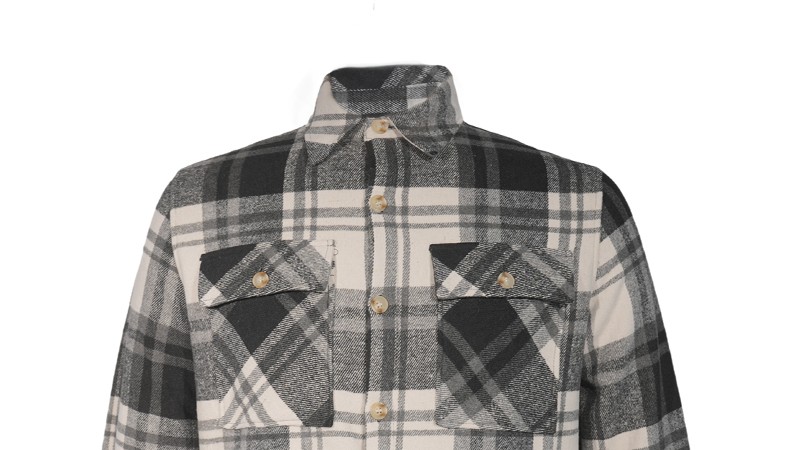
For menswear brands building fall/winter programs, the Men’s Fleece-Lined Flannel Shirt Jacket occupies a specific category position: not a standard flannel shirt, not an insulated outerwear piece. Its commercial viability depends on three locked specifications: the 80% polyester / 20% cotton woven plaid shell, the fleece lining, and the approximately 870g garment weight. This framework helps OEM buyers evaluate whether this construction aligns with their collection’s thermal intent, channel positioning, and end-user layering behavior—before committing to sampling.
Shell Construction: Woven Plaid, Not Brushed Flannel
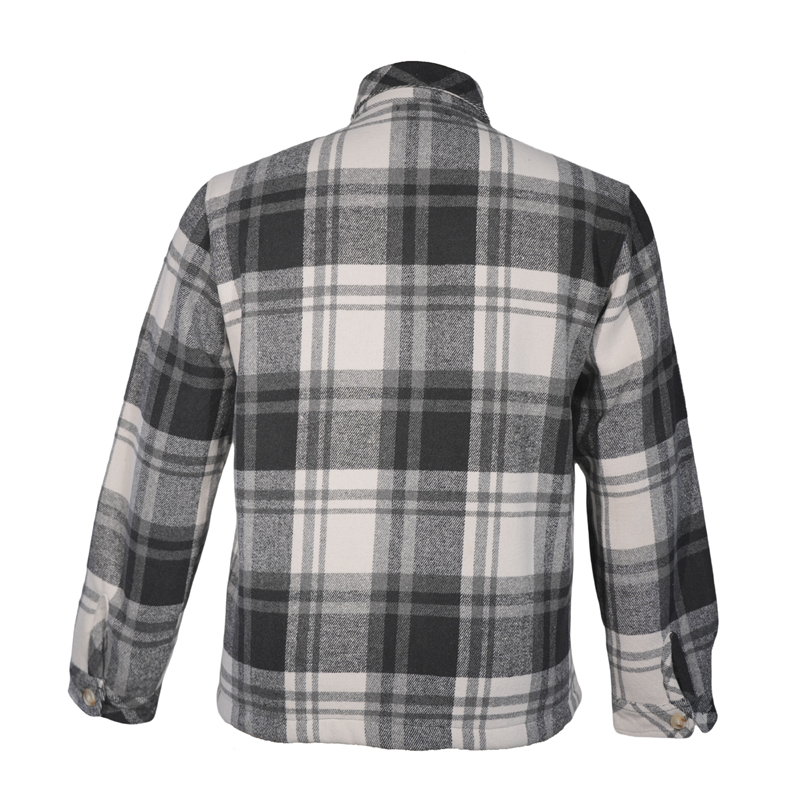
The outer fabric is an 80% polyester / 20% cotton woven plaid. This distinction matters for buyers comparing it against traditional flannel shirting. Woven plaid achieves its texture and visual depth through yarn interlacing—not surface brushing. Polyester contributes tensile strength, shape retention, and shrink resistance; cotton adds breathability and tactile softness. The practical implication: this construction resists the high-pile fuzzing that brushed 100% cotton flannels can develop after repeated laundering. For private label programs where long-term consistency across repeat orders matters, this is a relevant differentiator. Buyers should specify weave structure (twill, plain, or herringbone) and yarn count in the tech pack, as these influence hand feel and fleece bonding compatibility.
Garment Weight as a Functional Specification
At approximately 870g, this shirt jacket sits in a deliberate weight band. It is substantial enough to function as a layering piece—worn over merino tees or light knits, and under wool overcoats—without being positioned as standalone winter outerwear. For brands targeting urban commuters or outdoor-adjacent casual wear, the 870g benchmark should be evaluated against three fit variables: sleeve articulation, shoulder ease, and hem drop. These affect perceived mobility and silhouette, particularly when the fleece lining adds internal bulk. During sampling, confirm the acceptable weight tolerance (± grams) with the manufacturer, as fabric lot variation and lining attachment method can shift final garment weight.
Fleece Lining: Specification Decisions Buyers Must Lock
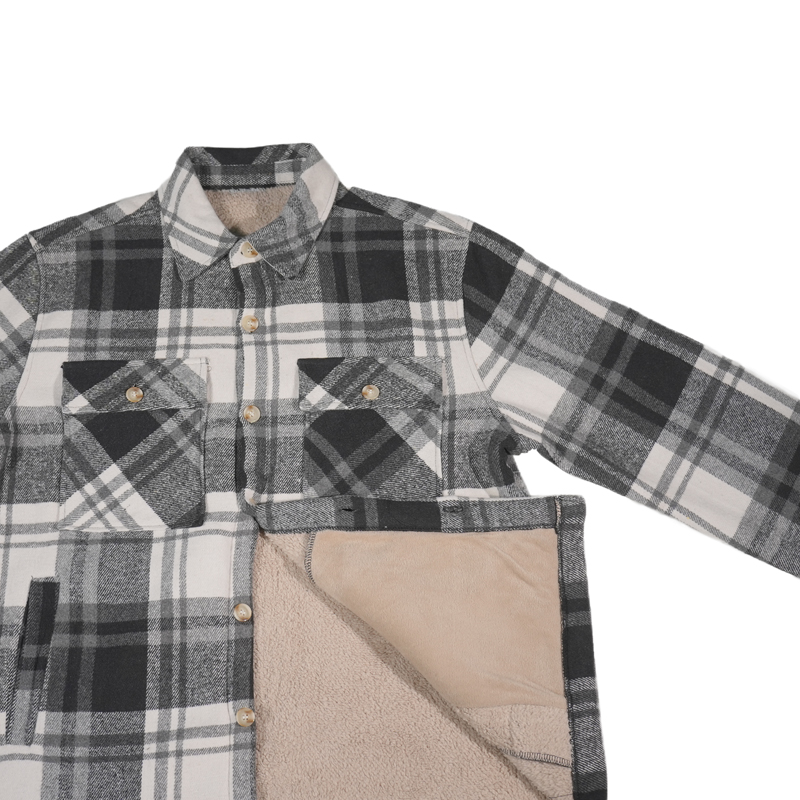
The fleece lining provides thermal insulation, but its commercial performance depends on specifications the source page does not fix. Buyers should clarify three parameters during technical alignment: whether the fleece is bonded or sewn-in, its gram weight (gsm), and its fiber content (100% polyester vs. recycled variants). A heavier fleece increases warmth but can reduce breathability and add bulk at seams and collar. In heritage workwear-inspired programs, a mid-weight, low-pill fleece typically supports authenticity without compromising wearability. Because the product page states that lining can be customized, brands developing seasonal capsules for different geographies should define thermal requirements at the tech-pack stage—not after sampling.
Collar, Button-Front, and Chest Pockets: Construction Constraints
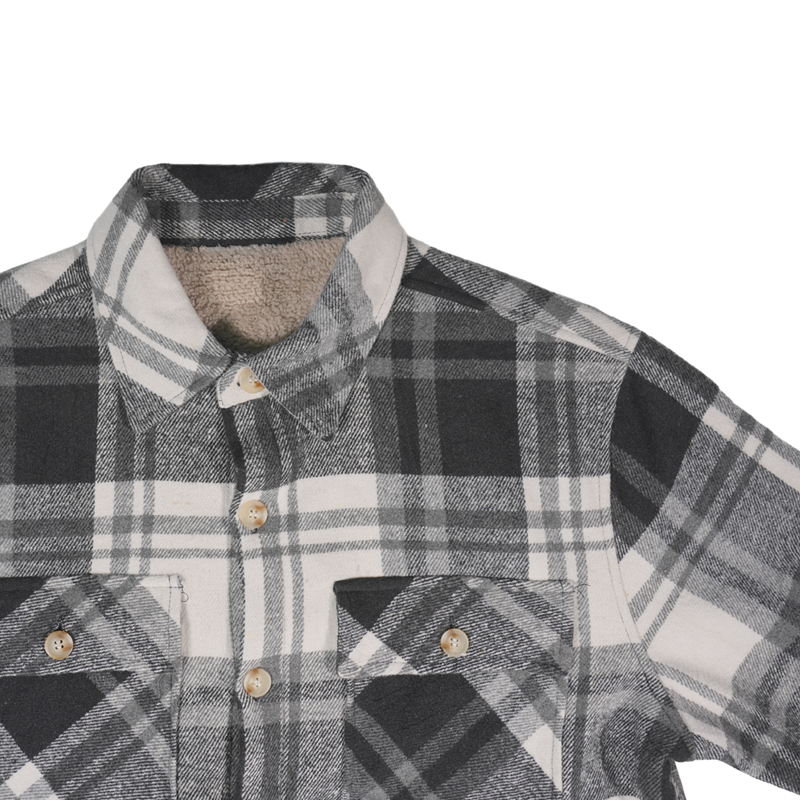
The turn-down collar and button-front closure are functional anchors that drive production complexity. A structured turn-down collar demands precise interfacing and seam allowance management to prevent gapping or curling. Button placement, spacing, and shank length must accommodate the combined thickness of the 80/20 shell and fleece lining. Two chest pockets reinforce the utility positioning but introduce additional specs: pocket bag fabric (matching shell or contrast), flap reinforcement, and bar-tack placement for durability. These elements collectively affect grading accuracy across the S–5XL size range. Because the collar sits directly against the fleece-lined neckline seam, bulk production tolerances for collar roll and button alignment should be defined in the tech pack before sampling.
Customization Scope: What the Product Page Confirms
The product page explicitly lists customizable parameters: fabric composition, lining, plaid colors, garment weight, fit, and branding. This scope supports both OEM (buyer-provided designs) and ODM (factory-assisted development) models. Practical constraints exist within each parameter. Changing fabric composition to 95/5 poly-cotton alters dye uptake and shrinkage behavior. Adjusting garment weight by ±100g may require re-engineering seam allowances and lining attachment methods. Plaid color customization presumes access to digital color libraries or physical strike-offs. Fit development requires full-size graded patterns and at least one fit sample round. Branding options (woven labels, heat-transfer logos) depend on placement and substrate compatibility. None of these are automatic—each must be scoped during initial technical discussions.
OEM/ODM Development Checklist
- Confirm plaid scale and repeat: fixed or adjustable per design
- Specify fleece type (anti-pill, brushed, recycled content) and weight (gsm)
- Define garment weight tolerance (± grams) against the approximately 870g benchmark
- Provide fit specs: chest ease, sleeve cap height, back length, front/back balance
- Clarify labeling and packaging: hangtags, polybags, folding method
- Confirm whether sample lead time starts upon tech pack approval or includes shipping
- Identify required certifications for target markets; not stated on the source page
- Lock size range (S–5XL) and grading rules before bulk sign-off
How Brand Positioning Maps to Specification Choices
There is no universal optimal configuration for this shirt jacket. A premium heritage brand may prioritize natural fiber content and minimize synthetic visibility—accepting higher shrinkage risk as a trade-off. A performance-oriented lifestyle brand may lean toward enhanced moisture-wicking polyester blends and streamlined seam construction. A fast-cycle private label program may standardize plaid palettes and fleece weights to compress development time. The appropriate choice depends on customer expectation, channel (direct-to-consumer vs. wholesale), price positioning, and collection continuity—not on which specification appears “most advanced.” Because the base 80/20 poly-cotton shell and fleece lining are already fixed on the product page, the real differentiation happens in fit, plaid color, and branding execution.
Recommended Product
Custom Men’s Fleece-Lined Flannel Shirt Jacket Manufacturer — Supports OEM and ODM development with customization of fabric composition, plaid colors, fleece lining, garment weight, fit, and branding. Positioned for cold-weather menswear collections, fall/winter casual layering, and heritage workwear-inspired shirt jacket programs.
Frequently Asked Questions
Q: What is the actual fiber composition of the outer shell and lining?
The outer shell is 80% polyester / 20% cotton woven plaid. The lining is fleece. Total garment weight is approximately 870g. Because the shell is woven rather than knitted, its drape and dimensional stability differ from traditional flannel shirting.
Q: Which specifications can be customized for private label development?
The product page lists fabric composition, lining, plaid colors, garment weight, fit, and branding as customizable. Fleece type, plaid scale, and weight tolerance should be confirmed during technical alignment, as the source page does not specify these values.
Q: What should buyers include in the tech pack before sampling?
A completed tech pack should contain base measurements, plaid color references (Pantone or digital files), fleece lining preferences, branding assets, and fit intent (relaxed, regular, or slim). Size range (S–5XL) and grading rules should also be confirmed upfront.
Q: How does the turn-down collar interact with the fleece lining during production?
The turn-down collar requires interfacing, collar band attachment, and topstitching precision. Its contact with the fleece lining—especially at the neckline seam—needs sample-level evaluation to prevent bulk or rolling. Bulk tolerances for collar roll and button alignment should be defined in the tech pack.
Q: Are certifications or compliance documents stated on the product page?
The source product page does not state certifications for this shirt jacket. Buyers targeting specific markets should identify required certifications during initial technical discussions and confirm them before bulk production.
Conclusion
Developing a Men’s Fleece-Lined Flannel Shirt Jacket for cold-weather collections requires disciplined specification alignment—not assumptions about “warmth” or “heaviness.” The 80/20 poly-cotton woven plaid shell, approximately 870g weight, and fleece lining define a distinct category position: functional, layered, and adaptable across fall/winter menswear contexts. Success depends on translating collection goals into verifiable parameters: plaid repeat, fleece gsm, garment weight tolerance, fit specs, and branding placement. There is no single best configuration—only the configuration most appropriate for your customer, channel, and seasonal strategy. Contact our team to discuss your knitwear project and explore customized manufacturing solutions.