Why Fiber Composition Matters in Girls’ Knitwear Sourcing
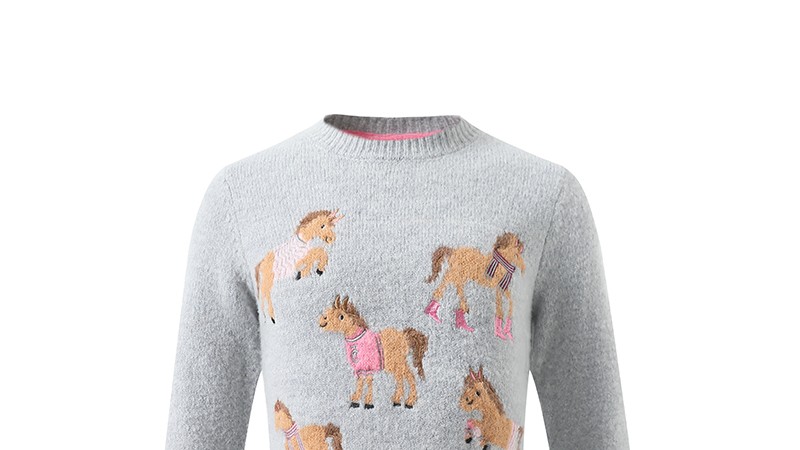
When evaluating a girls knitwear manufacturer for private label development, the yarn blend directly affects wearability, durability, and production feasibility — especially for seasonal collections targeting Autumn/Winter/Early Spring. A 34% acrylic / 30% wool / 33% nylon / 3% spandex composition balances warmth, softness, abrasion resistance, and recovery stretch. Unlike pure wool or cotton blends, this 4-fiber structure avoids common trade-offs: wool’s natural insulation without itchiness (mitigated via soft-finish yarns and taped neckline), acrylic’s lightweight hand without pilling vulnerability, nylon’s tensile strength in high-stress zones (elbows, cuffs), and spandex’s shape retention after repeated laundering.
5GG Gauge: What It Means for Fit, Drape, and Development
Gauge defines needle density and directly influences fabric weight, opacity, elasticity, and visual texture. At 5GG, the sweater achieves a midweight structure (213g ±10g) suitable for layering — heavier than summer knits but lighter than bulky winter pullovers. This gauge supports clean intarsia jacquard patterning on the front panel while maintaining full-garment knitting integrity. Buyers should confirm that 5GG aligns with target silhouette: it delivers moderate drape and controlled stretch, making it appropriate for crewnecks worn over collared shirts (equestrian themes) or under lightweight jackets (boutique retail). Finer gauges (e.g., 7GG+) would reduce weight but limit yarn thickness options and jacquard definition; coarser gauges (3GG) increase bulk and may compromise fit consistency across 2Y–14Y size grading.
Full-Garment Knitting vs. Cut-and-Sew: Implications for Customization
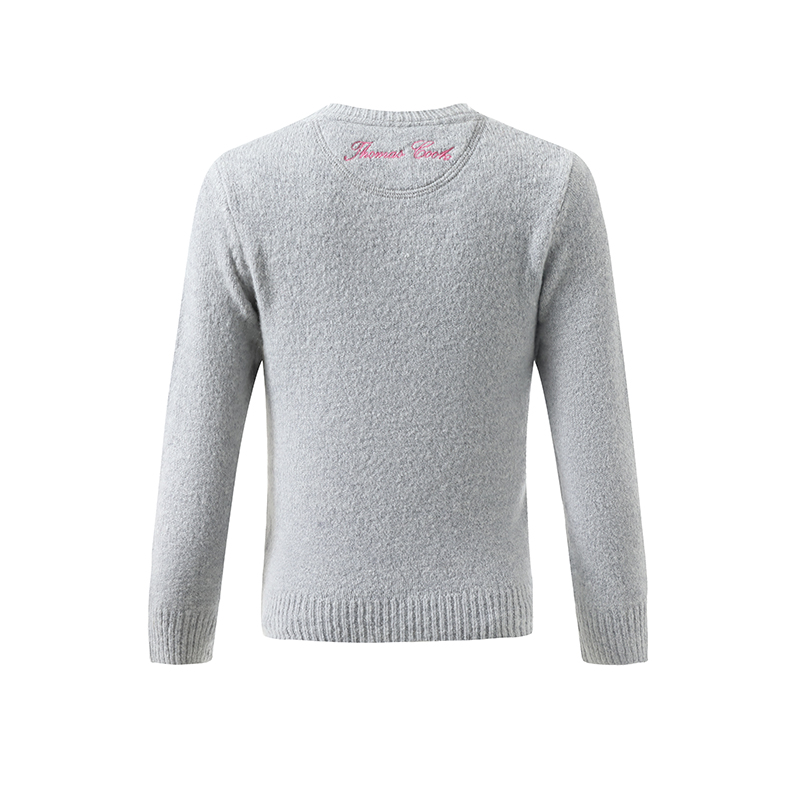
Full-garment knitting eliminates side seams and reduces labor-intensive assembly — a structural advantage when integrating complex front-panel jacquard motifs. Unlike cut-and-sew methods where patterns must be matched across seams, full-garment construction allows seamless motif continuity from shoulder to hem. However, buyers must verify that their artwork fits within the machine’s repeat width and that color transitions (especially in multi-color intarsia) meet production tolerance. Embroidery or secondary branding elements added post-knitting require separate lead time and QC checkpoints. For e-commerce private brands launching seasonal drops, full-garment + jacquard front offers strong shelf impact without compromising scalability.
Low MOQ Sourcing: Realistic Expectations for Private Label Startups
A 100-pcs-per-color MOQ reflects material commitment and setup economics — not flexibility as a service. Brands entering kids clothing OEM should treat this as a minimum test quantity, not a scalable launch volume. It enables validation of fit, wash performance, and customer response before committing to larger batches. That said, MOQ does not imply reduced customization: jacquard pattern, yarn ratio, colorway, embroidery, and private label branding remain fully available within this threshold. Buyers must clarify whether size grading (2Y–14Y) is included in the base MOQ or requires proportional allocation per size — a critical detail affecting inventory planning for boutique retail or e-commerce fulfillment.
OEM/ODM Development Checklist Before Sampling
- Confirm Pantone TPX/TCX or physical swatch for color matching — digital proofs do not represent final yarn dye lot behavior
- Provide vector-based artwork for jacquard conversion; specify motif placement, scale, and color count (affects stitch complexity)
- Define private label application method (woven label, heat transfer, embroidery) and location
- Specify size grading rules if custom grading is required beyond standard 2Y–14Y progression
- Clarify wash care instructions and whether OEKO-TEX® Standard 100 certification is requested
How Brand Positioning Shapes Technical Choices
No single specification suits all scenarios. A boutique retailer emphasizing tactile luxury may prioritize higher wool content and softer finishing, accepting slightly lower abrasion resistance. An e-commerce private brand scaling fast may optimize for 33% nylon’s durability and consistent shrinkage control — critical for direct-to-consumer returns management. Equestrian-themed collections benefit from structured ribbing at cuffs/hem and precise jacquard alignment on the chest panel to support crest or monogram integration. For seasonal children’s wear sourcing, the 213g weight ensures warmth without overheating during active play — a functional requirement often overlooked in aesthetic-led development.
Recommended Products
Custom Private Label Girls‘ Wool Blend Stretch Jacquard Sweater — Designed for brands needing a balanced, low-MOQ entry point into private label knitwear, this 5GG crewneck supports full-garment construction with front-panel intarsia, making it ideal for kids’ fashion brand development and e-commerce private brand creation.
Girls‘ 5GG Wool Blend Stretch Jacquard Crewneck Sweater Technical Specifications — A reference-ready spec sheet for sourcing teams evaluating fiber performance, seasonality, and customization scope within the Kids’ Knitwear > Girls‘ Sweaters > Custom Private Label Knitwear category.
Frequently Asked Questions
Why choose a wool/acrylic/nylon/spandex blend for children’s sweaters?
This 4-fiber blend combines wool‘s natural warmth, acrylic’s softness and lightweight feel, nylon‘s durability and abrasion resistance, and spandex’s stretch recovery — creating a comfortable, long-lasting garment that holds its shape through active wear and repeated washing.
How does 33% nylon improve durability?
The high nylon content significantly enhances tensile strength and wear resistance, especially in high-friction areas like elbows and cuffs, extending the sweater‘s lifespan.
Is the wool blend itchy for children?
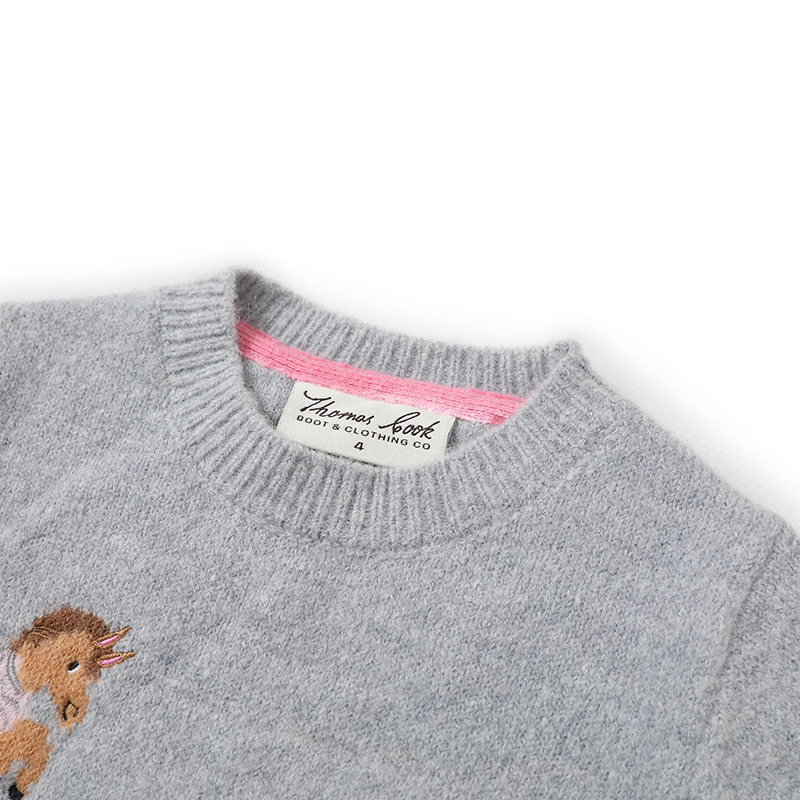
No. The yarn is selected and finished for softness, and the inner neckline is covered with a soft knitted tape to reduce friction. OEKO‑TEX® Standard 100 certified materials are also available upon request.
Can we customize the jacquard pattern with our own design?
Yes. We can convert your logo, mascot, seasonal artwork, or any exclusive graphic into a 5GG intarsia jacquard pattern for your private label collection.
What are the MOQ and production timeline?
Standard MOQ is 100 pcs per color. Sample development takes 7–10 days, and bulk production typically requires 25–35 days, depending on order complexity.
Conclusion: Matching Specifications to Strategic Needs
Selecting a custom children’s sweater supplier isn’t about optimizing one parameter — it’s about aligning fiber, gauge, construction, and customization scope with brand identity, channel requirements, and development capacity. The 5GG wool blend jacquard sweater offers a defined technical foundation: autumn/winter-appropriate weight, full-garment efficiency, and scalable personalization. But its suitability depends entirely on whether those attributes match your audience’s expectations — not on universal superiority. For stretch knitwear factory partnerships, always anchor decisions in sample evaluation, not spec sheets alone. Contact our team to discuss your knitwear project and explore customized manufacturing solutions.