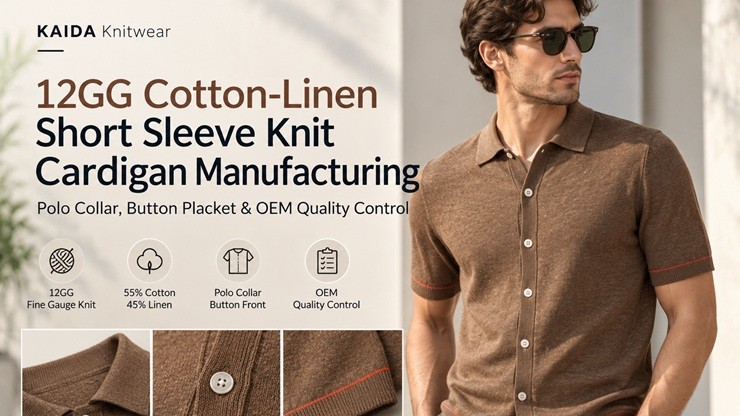
Developing a men’s short sleeve knit cardigan for a spring or summer collection requires careful coordination between yarn selection, knitting gauge, collar construction, garment fit, and production quality control. For fashion brands and private label buyers, these technical decisions affect not only the finished appearance but also sampling accuracy, manufacturing consistency, and the reliability of repeat orders.
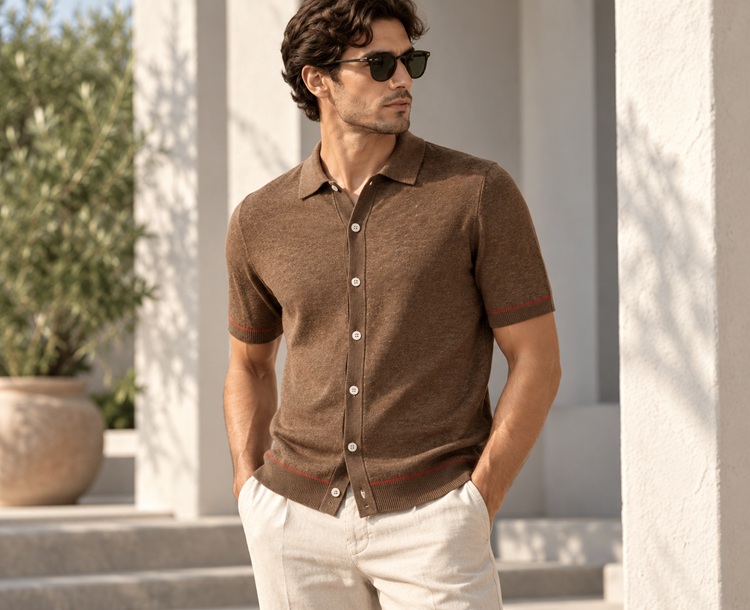
A 12GG cotton-linen cardigan offers an interesting option for contemporary menswear because it combines a relatively fine knitted structure with the natural texture of cotton and linen. However, successful manufacturing depends on more than choosing the right fiber composition. Collar stability, button placket alignment, ribbed finishing, and dimensional changes after laundering must all be evaluated during product development.
This guide examines the manufacturing considerations behind a 12GG cotton-linen short sleeve knit cardigan, using KAIDA Knitwear’s Men’s 12GG Cotton-Linen Short Sleeve Polo Collar Knit Cardigan as a reference. The product specification includes 55% cotton, 45% linen, a stated garment weight of 201g, short sleeves, a polo-style collar, and a button-front construction.
1. What Defines a Short Sleeve Polo Collar Knit Cardigan?
A short sleeve polo collar knit cardigan combines elements of a knitted polo shirt and a button-front cardigan. Unlike a conventional pullover polo, the front opening is designed as a cardigan-style closure, while the polo collar provides a more structured neckline appearance.
This construction can work well for spring and summer menswear collections, particularly when brands want a garment that sits between casual knitwear and smart-casual apparel.
Key Construction Features
- Short sleeve design: Supports warm-weather styling and requires controlled sleeve opening dimensions.
- Polo-style collar: Creates a defined neckline that must maintain its shape during wear and laundering.
- Button-front opening: Requires consistent placket construction, button positioning, and buttonhole finishing.
- Fine-gauge knitted body: Provides the foundation for the garment’s surface appearance, drape, and fit.
- Ribbed cuffs and hem: Help define the garment’s silhouette and finished edges.
For OEM development, each of these features should be documented in the technical package. A reference photograph alone is not sufficient to communicate the intended construction method, measurements, or quality requirements.
2. Understanding 12GG Knit Construction for Summer Menswear
Knitting gauge is one of the first technical specifications buyers encounter when sourcing custom knitwear.
The reference cardigan uses a 12GG knitting gauge, indicating a machine needle density commonly associated with relatively fine knitted structures.
Compared with coarser gauges such as 5GG or 7GG, 12GG generally supports finer stitch definition when compatible yarns and knitting structures are used. However, gauge alone does not determine the finished garment’s thickness, weight, breathability, or durability.
12GG Compared with Coarser Knitting Gauges
| Knitting Gauge | Typical Characteristics | Common Development Considerations |
|---|---|---|
| 5GG | Relatively coarse stitch appearance | Chunkier textures, heavier visual structures, larger stitch definition |
| 7GG | Medium-coarse knitted appearance | Structured casual knitwear, visible stitch patterns, yarn compatibility |
| 9GG | Intermediate stitch definition | Balance between fabric texture, weight, and garment structure |
| 12GG | Relatively fine stitch definition | Fine-gauge surfaces, lightweight design targets, yarn and tension control |
These descriptions are general manufacturing references rather than fixed performance standards. Two garments produced at the same gauge may behave differently because of yarn count, stitch structure, fabric density, finishing, and garment dimensions.
Why Gauge Consistency Matters
During bulk production, knitting settings and fabric characteristics must remain consistent with the approved sample.
Changes in yarn tension, machine setup, or finishing conditions can affect stitch dimensions and the final garment measurements.
Manufacturers should therefore establish measurable fabric and garment specifications during sampling, rather than relying exclusively on the stated machine gauge.
3. Evaluating the 55% Cotton / 45% Linen Yarn Blend
The reference men’s knit cardigan uses a 55% cotton / 45% linen fiber composition.
This blend combines the familiar characteristics of cotton with the distinctive texture of linen, making it relevant for fashion brands developing natural-fiber-focused spring and summer collections.
Role of Cotton in the Blend
Cotton is commonly selected for its softness, moisture absorption, and versatility in knitted garments.
Depending on yarn construction and finishing, cotton can contribute to a comfortable fabric surface and a relatively smooth hand feel.
Role of Linen in the Blend
Linen is valued for its natural appearance, characteristic texture, and moisture-management properties. It can contribute a distinctive visual and tactile quality to lightweight knitwear.
However, linen has different elongation and recovery characteristics from many synthetic fibers. Its behavior in a knitted garment depends on the blend, yarn structure, stitch construction, and finishing process.
Important Performance Considerations
- Fabric hand feel: Assess whether the finished knit meets the brand’s desired softness and texture.
- Drape: Evaluate how the fabric hangs when worn, particularly around the shoulders and front opening.
- Dimensional stability: Measure changes after the agreed laundering or care procedure.
- Color consistency: Check shade variation between approved samples and production materials.
- Surface appearance: Evaluate unwanted yarn irregularities, visible defects, and pilling where relevant.
- Care requirements: Establish suitable care instructions based on the finished garment’s tested performance.
The 55/45 blend ratio is an important starting specification, but it does not independently establish the garment’s shrinkage resistance, durability, or comfort performance. These properties should be evaluated using representative samples and appropriate test methods.
4. Polo Collar Construction: Shape, Symmetry and Stability
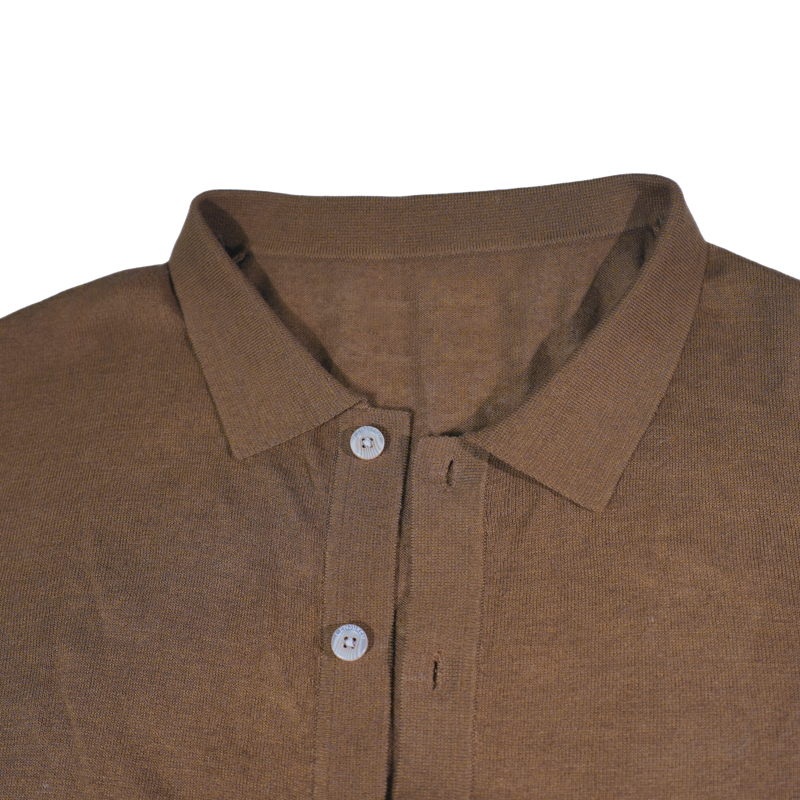
The polo collar is one of the most visible design elements in a short sleeve knit cardigan.
Unlike a basic crew-neck finish, a polo-style collar introduces additional requirements for neckline shaping, collar dimensions, edge finishing, and its connection to the front placket.
Collar Shape and Dimensions
During development, the brand and manufacturer should agree on the intended collar width, depth, shape, and relationship to the neckline opening.
For smart-casual menswear, the collar should maintain a balanced appearance when the cardigan is worn both buttoned and unbuttoned.
Collar Edge Construction
Depending on the design, collar construction may involve ribbed knitting, a double-layer knitted structure, or other suitable finishing methods.
The chosen method should be evaluated for:
- Collar symmetry and overall shape.
- Edge curling or distortion.
- Neckline stability after washing.
- Consistency of collar dimensions.
- Appearance when the top button is fastened or left open.
Why Cotton-Linen Collars Require Careful Sampling
Cotton-linen yarns may respond differently to knitting tension and finishing compared with highly elastic yarn blends.
Manufacturers should evaluate the collar’s finished appearance and recovery characteristics using the selected yarn and approved construction method.
For repeat production, an approved collar specification helps reduce variation between manufacturing batches.
5. Button Placket Manufacturing and Quality Control
A button-front cardigan requires a stable front opening that remains visually balanced during wear.
The placket must support the selected buttons and buttonholes without excessive stretching, twisting, or distortion.
Front Placket Alignment
Manufacturers should check whether the left and right front panels align correctly when the cardigan is buttoned.
Important considerations include the position of the top and bottom buttons, placket width, button spacing, and the relationship between the collar and front opening.
Buttonhole Construction
Buttonholes must be compatible with the selected button size and the surrounding knitted structure.
Incorrect buttonhole dimensions can make fastening difficult or allow buttons to slip through during wear.
The appropriate construction and reinforcement method should be confirmed during sampling.
Recommended Button Placket Inspection Points
- Consistent button spacing.
- Correct button and buttonhole dimensions.
- Straight center-front alignment.
- Secure button attachment.
- Clean buttonhole finishing.
- No visible twisting or excessive stretching.
- Consistent placket appearance after laundering.
Any numerical acceptance criteria should be established in the approved technical specifications and verified using agreed inspection methods.
6. Short Sleeve Construction and Ribbed Finishing
Short sleeves may appear simpler than long sleeves, but their dimensions and finishing influence both comfort and garment proportions.
For a men’s short sleeve cardigan, sleeve length, opening width, armhole construction, and cuff finishing should be coordinated with the intended fit.
Sleeve Opening and Fit
The sleeve opening should be developed according to the brand’s size chart and desired silhouette.
An excessively narrow opening may restrict movement, while an overly loose opening may change the intended visual proportions.
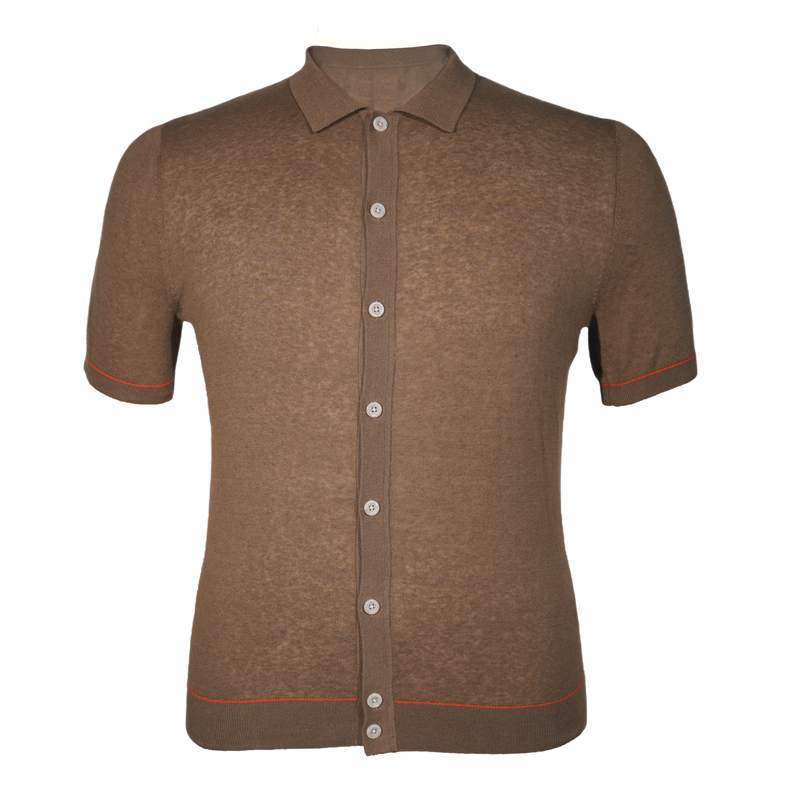
Fit evaluation should consider the relationship between the sleeve opening, upper arm measurements, shoulder width, and body shape.
Ribbed Cuffs and Hem
The reference cardigan features ribbed finishing at the cuffs and hem.
Ribbed structures can provide a defined edge and influence garment fit. Their performance depends on yarn characteristics, rib construction, stitch density, and finishing.
For cotton-linen knitwear, manufacturers should assess whether the selected rib structure maintains the intended appearance after wear and care testing.
Key Quality Checkpoints
- Consistent sleeve length between left and right sides.
- Correct sleeve opening measurements.
- Balanced sleeve attachment.
- Uniform cuff width and rib appearance.
- Consistent hem dimensions.
- No visible seam puckering or distortion.
7. Garment Weight: Interpreting the 201g Reference Specification
The reference KAIDA Knitwear cardigan lists a finished garment weight of 201g.
Garment weight is useful when comparing approved samples, but it should not be interpreted as a complete measure of fabric thickness, comfort, or seasonal suitability.
Factors Affecting Finished Garment Weight
- Garment size and measurements.
- Yarn count and fiber composition.
- Knitting gauge and stitch density.
- Collar and placket construction.
- Ribbed cuffs and hem.
- Buttons and other trims.
- Finishing and moisture conditions.
When setting a production weight tolerance, buyers should specify the reference sample size and the conditions under which garment weight will be measured.
A 201g reference garment should not be used to establish the expected weight of every size without accounting for grading and construction differences.
8. OEM Customization Options for Private Label Menswear
For fashion brands, OEM and ODM development involves adapting the reference design to the requirements of a particular collection.
Potential customization areas include yarn composition, colors, garment measurements, collar construction, buttons, labels, and packaging.
Yarn and Material Customization
Brands may explore alternative cotton-linen ratios or other fiber blends depending on their target market, desired hand feel, and price positioning.
Any material substitution should be evaluated through sampling because changes in yarn composition can affect gauge compatibility, fabric behavior, and finishing requirements.
Color Development
The reference product uses a brown colorway.
For private label programs, buyers can provide Pantone references or approved color standards to communicate their requirements.
Final shade approval should be based on suitable physical samples and agreed lighting or evaluation conditions.
Branding and Trims
Customization may include:
- Woven main labels.
- Care and composition labels.
- Custom buttons.
- Hangtags.
- Branded packaging.
- Alternative collar or cuff details.
Before placing an order, buyers should confirm the technical feasibility, minimum quantities, development costs, and lead times associated with each customization request.
9. OEM Sampling Workflow: From Tech Pack to Approved Sample
A structured sampling process reduces uncertainty before bulk production.
For a custom cotton-linen short sleeve knit cardigan, the following workflow provides a practical development framework.
Step 1: Technical Requirement Review
The buyer provides design drawings, measurement specifications, yarn requirements, color references, and construction details.
The manufacturer reviews the proposed design and identifies any technical questions requiring clarification.
Step 2: Yarn and Gauge Confirmation
The selected yarn must be evaluated for compatibility with the intended knitting gauge and stitch structure.
For a 12GG cardigan, the development team should confirm yarn count, fabric appearance, and the required garment characteristics.
Step 3: Initial Sample Development
The first sample allows the brand to assess collar shape, placket construction, sleeve fit, ribbed finishing, and overall garment proportions.
At this stage, design or construction issues can be identified before larger quantities are produced.
Step 4: Fit and Measurement Review
The sample should be checked against the approved measurement chart.
Any required adjustments should be documented, including changes to body length, chest width, shoulder measurements, sleeve openings, and collar dimensions.
Step 5: Material and Care Performance Review
Where required by the project, representative samples should be evaluated for dimensional stability, colorfastness, and other relevant performance characteristics.
The testing methods and acceptance criteria should be agreed upon by the buyer and manufacturer.
Step 6: Pre-Production Approval
Before bulk production, the brand should approve the final sample, material specifications, trims, measurements, and quality requirements.
The approved sample and technical documents then provide a reference for manufacturing and inspection.
10. Quality Control Checklist for 12GG Cotton-Linen Knit Cardigans
Effective OEM quality control depends on clear inspection criteria that can be communicated and repeated during production.
The following checklist highlights important quality checkpoints for a short sleeve polo collar knit cardigan.
| Inspection Area | Key Quality Check | Reference Requirement |
|---|---|---|
| Yarn Composition | Fiber content and material consistency | Approved yarn specification |
| Knitting Construction | Gauge, stitch appearance, fabric consistency | Approved knitted sample |
| Polo Collar | Symmetry, shape, edge stability | Approved collar dimensions |
| Button Placket | Alignment, spacing, buttonhole finishing | Approved construction details |
| Short Sleeves | Length, opening width, symmetry | Approved size specification |
| Ribbed Cuffs | Width, appearance, recovery | Approved cuff construction |
| Ribbed Hem | Dimensions, alignment, finishing | Approved hem specification |
| Garment Measurements | Fit and dimensional consistency | Approved graded measurement chart |
| Color Consistency | Shade matching and visible variation | Approved color standard |
| Care Performance | Dimensional change and appearance after care | Agreed testing requirements |
| Final Appearance | Visible defects, loose threads, seam quality | Approved workmanship standard |
This checklist is a suggested inspection framework. Actual quality control procedures, sampling plans, test methods, and tolerances should be confirmed with the manufacturer for each production project.
11. MOQ, Sampling Time and Bulk Production Planning
Commercial planning is another important part of private label knitwear sourcing.
The reference KAIDA Knitwear product information indicates an MOQ starting from 100 pieces per color and an advertised sampling period of 7–12 days, subject to project confirmation.
These figures should be treated as initial sourcing references rather than guaranteed conditions for every customized order.
Factors That Can Affect MOQ
- Availability of the selected yarn.
- Custom dyeing requirements.
- Number of colors and sizes.
- Complexity of the collar and garment construction.
- Special buttons, labels, or packaging.
- Production scheduling and material purchasing requirements.
Factors That Can Affect Sampling Time
- Completeness of the technical package.
- Availability of suitable yarn and trims.
- Number of required sample revisions.
- Custom color development.
- Required testing or approval procedures.
Buyers should request written confirmation of MOQ, sampling costs, production lead times, and delivery terms before finalizing a purchase order.
12. How to Evaluate a Cotton-Linen Knit Cardigan Manufacturer
Choosing a reliable cotton linen knit cardigan manufacturer requires evaluating technical capability and communication quality alongside commercial terms.
A supplier should be able to explain how the requested construction will be developed, what specifications need confirmation, and how quality will be evaluated during production.
Questions to Ask Before Selecting an OEM Partner
- Can the manufacturer develop the requested 12GG cotton-linen fabric?
- How will polo collar shape and placket alignment be controlled?
- What sample approval process is used?
- Can the supplier accommodate custom measurements and grading?
- What material and garment testing can be arranged?
- How are color standards and production shade variations managed?
- What are the confirmed MOQ and production lead times?
- How are technical revisions documented before bulk manufacturing?
Where certifications or compliance documentation are relevant, buyers should request current evidence applicable to the specific materials, products, and destination markets.
13. Reference Product: Men’s 12GG Cotton-Linen Short Sleeve Polo Collar Knit Cardigan
KAIDA Knitwear’s Men’s 12GG Cotton-Linen Short Sleeve Polo Collar Knit Cardigan provides a reference for fashion brands developing lightweight men’s knitwear collections.
| Product Feature | Reference Specification |
|---|---|
| Product Type | Men’s Short Sleeve Polo Collar Knit Cardigan |
| Knitting Gauge | 12GG |
| Fiber Composition | 55% Cotton / 45% Linen |
| Garment Weight | 201g (reference specification) |
| Color | Brown |
| Sleeve Length | Short Sleeve |
| Collar | Polo Collar |
| Front Construction | Button-Front Opening |
| Cuffs | Ribbed Construction |
| Hem | Ribbed Construction |
| Customization | OEM/ODM Options Subject to Confirmation |
| MOQ | Advertised From 100 Pieces Per Color; Confirm Before Ordering |
| Sampling Time | Advertised 7–12 Days; Subject to Project Confirmation |
These specifications describe the reference product and should not be treated as universal manufacturing requirements. Alternative materials, colorways, measurements, and trims may require additional technical development and sample approval.
14. Frequently Asked Questions About Cotton-Linen Knit Cardigan Manufacturing
Why is 12GG suitable for a men’s cotton-linen short sleeve knit cardigan?
A 12GG construction can support a relatively fine knitted appearance suitable for lightweight seasonal menswear. However, final fabric thickness, drape, and breathability also depend on yarn count, stitch structure, knitting tension, and finishing.
What are the benefits of a 55% cotton and 45% linen blend for summer knitwear?
Cotton can contribute softness and moisture absorption, while linen offers a distinctive natural texture. Final fabric feel, dimensional stability, and care performance depend on yarn construction and finishing, so brands should evaluate an approved sample.
What should buyers check when developing a polo collar knit cardigan?
Important checkpoints include collar symmetry, neckline dimensions, collar edge stability, button placket alignment, buttonhole finishing, and the garment’s appearance after washing.
Can the yarn composition, color, and branding be customized?
KAIDA lists OEM/ODM customization options covering yarn selection, Pantone color references, collar details, sleeve construction, labels, and packaging. Final specifications should be confirmed during technical review and sample development.
What is the minimum order quantity for custom short sleeve knit cardigans?
The reference product information advertises an MOQ starting from 100 pieces per color. The final minimum order quantity depends on the selected yarn, colors, customization requirements, and confirmed production arrangement.
What quality control checks are important for cotton-linen knit cardigans?
Buyers should verify gauge consistency, collar shape, button attachment, garment measurements, seam appearance, ribbed finishing, color consistency, and dimensional stability against the approved technical specifications.
15. Final Considerations for Private Label Summer Knitwear
Successful 12GG cotton-linen short sleeve knit cardigan manufacturing requires coordination between material selection, knitting construction, garment development, and production quality control.
For fashion brands, the most important sourcing decisions should be resolved before bulk production: yarn composition, collar structure, placket construction, sleeve dimensions, sample approval, and measurable quality standards.
Rather than evaluating a garment only by its appearance or quoted price, buyers should request representative samples, review technical specifications, and confirm the manufacturing requirements that affect fit, consistency, and long-term product performance.
Explore the Men’s 12GG Cotton-Linen Short Sleeve Polo Collar Knit Cardigan from KAIDA Knitwear as a starting point for your next private label menswear collection. For custom yarns, colors, sizing, labels, or production requirements, contact the KAIDA Knitwear team to discuss technical feasibility, sampling, MOQ, and bulk manufacturing arrangements.