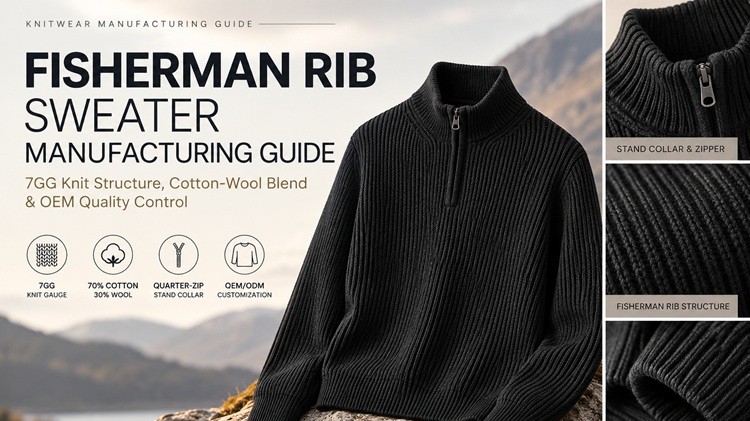
Choosing a reliable fisherman rib sweater manufacturer requires more than comparing fabric appearance, yarn composition, or minimum order quantities. For international menswear brands and private label buyers, the main challenge is reproducing the approved rib texture, garment dimensions, collar shape, and quarter-zip construction consistently throughout bulk production.
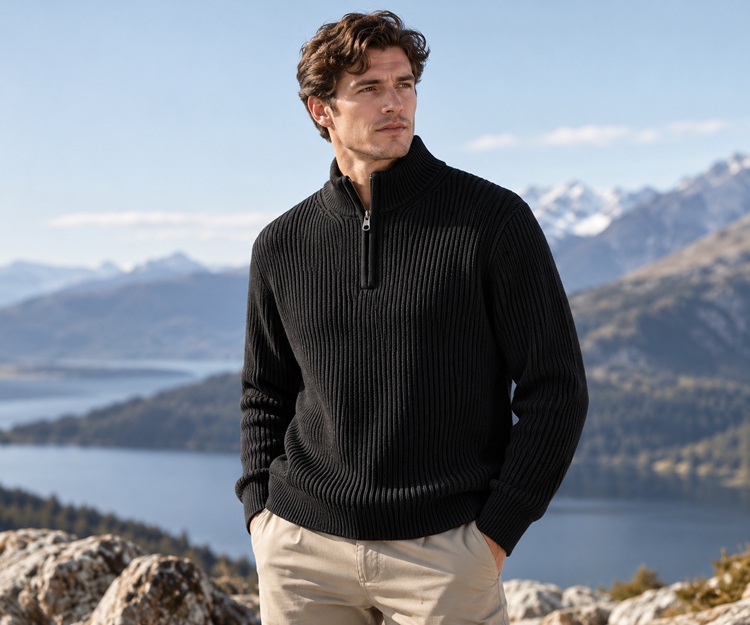
A 7GG fisherman rib sweater made from a 70% combed cotton and 30% wool blend provides a useful reference for understanding how knitting structure, yarn selection, garment weight, and finishing influence OEM manufacturing decisions.
This guide examines fisherman rib construction, the technical considerations behind 7GG knitwear, cotton-wool blend performance, quarter-zip garment development, and practical quality control requirements. It also explains what buyers should verify before approving samples or placing a custom knitwear order.
1. What Is Fisherman Rib Knitting?
Fisherman rib is a textured rib knitting structure characterized by prominent vertical ridges, recessed channels, and a relatively full, elastic fabric appearance.
Depending on the knitting method and terminology used by the manufacturer, fisherman rib may be produced using tuck-stitch techniques and is often associated with full cardigan rib structures.
However, knitting terminology is not always applied consistently across suppliers. Buyers should confirm the actual stitch construction through a physical fabric swatch or knitting specification rather than relying on the name alone.
Key Characteristics of Fisherman Rib
- Pronounced vertical texture: Raised ribs create a distinctive surface appearance suitable for heritage-inspired menswear.
- Fabric volume: The stitch structure can produce a fuller fabric than a comparable basic rib construction.
- Natural stretch: Rib-based structures generally allow lateral extension, although recovery depends on yarn and knitting parameters.
- Soft drape: The combination of yarn composition and stitch construction influences how the garment hangs on the body.
- Visible stitch definition: Consistent knitting tension and finishing help maintain a uniform appearance.
These characteristics make fisherman rib suitable for textured sweaters, cardigans, quarter-zip pullovers, and other casual or premium knitwear designs.
Fisherman Rib vs. Full Cardigan Rib
Fisherman rib and full cardigan rib are sometimes used interchangeably in commercial product descriptions. However, the precise construction can vary according to machine programming and knitting technique.
For OEM development, buyers should request confirmation of the stitch structure, fabric appearance, gauge, and target dimensions.
An approved knitted swatch is particularly important when comparing quotations from multiple manufacturers.
2. Fisherman Rib vs. Standard Rib, Cable Knit, and Waffle Knit
Different knit structures influence fabric appearance, elasticity, production requirements, and garment weight. Understanding these differences helps brands select an appropriate construction for their target market.
| Knit Structure | Typical Appearance | Manufacturing Considerations | Common Applications |
|---|---|---|---|
| Fisherman Rib | Deep vertical ridges and a full textured surface | Stitch consistency, fabric relaxation, dimensional stability, and yarn consumption | Textured sweaters, quarter-zip pullovers, cardigans |
| 1×1 Rib | Regular alternating knit and purl columns | Elastic recovery, stitch density, and edge stability | Cuffs, hems, collars, fitted knitwear |
| 2×2 Rib | Wider rib columns with a structured appearance | Rib width, recovery, and dimensional consistency | Collars, cuffs, sweater bodies |
| Cable Knit | Raised twisted or braided patterns | Pattern programming, yarn consumption, and panel measurements | Heritage sweaters, textured pullovers |
| Waffle Knit | Repeating recessed geometric texture | Pattern definition, fabric weight, and finishing behavior | Casual sweaters, layering garments |
No single structure is universally warmer, more breathable, or more durable. Performance depends on fiber composition, yarn count, stitch density, fabric thickness, finishing, and garment design.
For brands developing a custom fisherman rib sweater, the appropriate structure should be selected through sample evaluation rather than appearance alone.
3. Why Choose 7GG for Fisherman Rib Sweater Manufacturing?
Knitting gauge is an important specification in sweater manufacturing because it helps determine the range of yarns and stitch structures a knitting machine can accommodate.
A 7GG fisherman rib sweater uses a machine gauge commonly associated with medium-to-chunky knitwear, although the final fabric thickness and weight depend on additional production variables.
What Does 7GG Mean?
In flat knitting, 7GG generally refers to a machine needle density of seven needles per inch.
It does not mean that the finished sweater contains exactly seven visible stitches per inch. Actual stitch density is affected by yarn size, machine settings, knitting structure, and finishing.
7GG Compared with 5GG and 12GG
| Gauge | General Characteristics | Typical Development Considerations |
|---|---|---|
| 5GG | Coarser machine gauge commonly used for chunkier knitwear | Yarn thickness, fabric bulk, stitch definition, and garment weight |
| 7GG | Intermediate gauge suitable for many textured sweater constructions | Balance of rib appearance, yarn compatibility, fabric density, and fit |
| 12GG | Finer machine gauge often used for lighter or more refined knit structures | Fine-yarn compatibility, stitch uniformity, and dimensional control |
These descriptions are general guidelines rather than fixed performance rankings. A 7GG garment is not automatically more durable or dimensionally stable than a 5GG or 12GG garment.
For OEM development, the manufacturer should confirm that the selected yarn count and stitch structure are compatible with the intended machine gauge.
Important 7GG Production Variables
- Yarn count and ply: Affect fabric density, surface appearance, and knitting feasibility.
- Stitch length: Influences fabric dimensions, elasticity, and yarn consumption.
- Knitting tension: Helps control rib definition and production consistency.
- Fabric relaxation: Can change panel dimensions before and after finishing.
- Finishing conditions: Influence garment measurements, hand feel, and final appearance.
Buyers should evaluate the combined effect of these variables through approved fabric swatches and garment samples.
4. Material Selection: 70% Combed Cotton and 30% Wool
The reference sweater uses a 70% combed cotton / 30% wool composition. This blend combines characteristics of cotton and wool while allowing manufacturers to develop a textured knit suitable for men’s casualwear.
Role of Combed Cotton
Combed cotton undergoes additional fiber preparation to remove some shorter fibers and impurities before spinning.
Depending on the cotton quality and yarn construction, this process can support a smoother and more uniform yarn.
In sweater manufacturing, cotton contributes:
- Comfortable hand feel.
- Moisture absorption.
- Natural fiber appeal.
- Versatility for casual and transitional-season knitwear.
Role of Wool
Wool contributes characteristics such as natural crimp, resilience, moisture management, and thermal comfort.
Its influence on the finished sweater depends on wool quality, fiber diameter, yarn construction, and the overall fabric structure.
A 30% wool content does not automatically guarantee a specific warmth level, shrinkage resistance, or care classification.
Why Blend Cotton and Wool?
Blending cotton and wool allows brands to develop products with a different balance of hand feel, appearance, warmth, and material cost compared with single-fiber constructions.
However, the final result should be evaluated through physical sampling and appropriate performance testing.
For private label development, buyers should confirm:
- Exact fiber composition and applicable labeling requirements.
- Yarn count, ply, and construction.
- Wool characteristics where relevant to the product specification.
- Color and dyeing requirements.
- Fabric weight and intended hand feel.
- Dimensional stability after the agreed care procedure.
- Pilling resistance and appearance after wear simulation, where required.
Care instructions should be established based on the actual garment and relevant testing rather than fiber percentages alone.
5. Quarter-Zip Stand Collar Construction
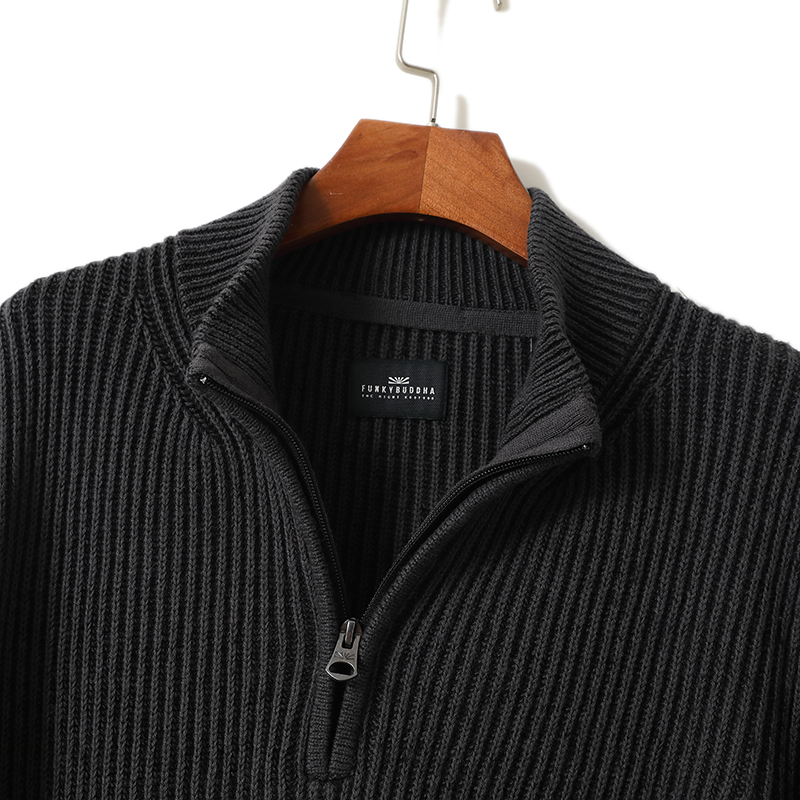
The quarter-zip stand collar is a defining feature of the reference fisherman rib sweater.
It provides an adjustable neckline and a structured appearance suitable for casual menswear, heritage-inspired collections, and premium layering garments.
However, combining a zipper with an elastic rib-knit fabric introduces several manufacturing considerations.
Zipper Alignment and Installation
Rib-knit fabric can stretch during handling and sewing. If the zipper opening is not stabilized appropriately, the finished garment may show puckering, distortion, or uneven zipper placement.
During sampling, buyers should inspect:
- Zipper opening length.
- Alignment with the center front.
- Symmetry of the surrounding rib structure.
- Smooth opening and closing.
- Fabric distortion near the zipper tape.
- Comfort and appearance of the zipper finish.
Stand Collar Shape and Stability
The stand collar should maintain the intended height and shape when the zipper is open or closed.
Its performance depends on the collar knitting structure, yarn characteristics, finishing, and attachment method.
For OEM projects, buyers should specify the desired collar height and appearance using technical drawings or an approved physical sample.
Metal Zipper Puller Considerations
The reference product features a quarter-zip design with a metal puller.
For customized orders, brands may discuss zipper color, puller design, tape appearance, and branding requirements.
Any alternative zipper specification should be evaluated for compatibility with the knitted fabric and intended garment design.
6. Fully Fashioned Knit Construction and Garment Assembly
Fully fashioned knitting is commonly used to produce shaped garment panels with controlled dimensions and construction details.
Unlike cutting garment panels from large pieces of knitted fabric, fully fashioned production can incorporate shaping directly into the knitting process.
This may reduce certain forms of cutting waste, although the overall material efficiency depends on the garment design and production method.
Key Manufacturing Considerations
- Panel shaping: Knitted components should follow the approved garment dimensions.
- Rib continuity: Visible rib patterns should align with the approved design where panels meet.
- Seam construction: Joining methods should provide appropriate strength and appearance.
- Collar attachment: The neckline and stand collar should maintain the intended shape.
- Size grading: Each size should follow the approved measurement and construction specifications.
For textured knitwear, the interaction between stitch structure and panel shaping deserves particular attention.
A pattern that works well in a medium-size sample may require additional evaluation when developed across a wider size range.
7. OEM Manufacturing Process: From Design to Bulk Production
A structured OEM workflow helps buyers identify potential problems before they affect production schedules or finished garment quality.
Step 1: Design and Technical Specification Review
The buyer provides technical drawings, reference samples, or a complete tech pack describing the intended sweater.
Important specifications include:
- Garment silhouette and fit.
- 7GG knitting gauge.
- Fisherman rib stitch structure.
- 70% combed cotton / 30% wool composition.
- Quarter-zip opening and collar dimensions.
- Target garment weight and measurement chart.
- Color, labeling, and packaging requirements.
Step 2: Yarn and Fabric Swatch Approval
Before garment sampling, buyers should review representative knitted swatches to evaluate the proposed yarn and rib construction.
The swatch approval process should consider surface texture, stitch definition, hand feel, color, stretch behavior, and dimensional changes after appropriate finishing.
Step 3: Prototype Development
A garment prototype allows buyers to assess fit, collar shape, zipper placement, rib continuity, and overall appearance.
Any changes should be documented clearly so that revised samples can be compared against the previous version.
Step 4: Pre-Production Confirmation
Before bulk knitting begins, both parties should confirm the approved sample and final production specifications.
These should include yarn, color, knitting settings, garment dimensions, construction details, labels, packaging, and quality acceptance requirements.
Step 5: Bulk Knitting and Assembly
During bulk production, manufacturers should monitor yarn consistency, stitch formation, panel dimensions, seam construction, and zipper installation.
Production deviations should be identified and addressed before they affect a large number of garments.
Step 6: Finishing and Final Inspection
Finishing may influence garment dimensions, fabric appearance, and hand feel.
After finishing, garments should be evaluated against the approved specifications using the agreed inspection methods.
The inspection plan should be established before production rather than introduced only after defects occur.
8. Quality Control Requirements for 7GG Fisherman Rib Sweaters
Effective OEM knitwear quality control depends on clear specifications and measurable acceptance criteria.
For fisherman rib sweaters, buyers should pay particular attention to the following areas.
| Inspection Area | Potential Issues | Recommended Buyer Check |
|---|---|---|
| Yarn Consistency | Variation in color, texture, or yarn characteristics | Compare production yarn with approved material references. |
| Rib Structure | Uneven ridges, inconsistent stitch appearance, or visible knitting defects | Inspect against approved fabric and garment samples. |
| Garment Measurements | Variation in body length, chest width, sleeves, or collar dimensions | Use agreed measurement points and tolerances. |
| Zipper Installation | Puckering, misalignment, or poor zipper operation | Check zipper appearance and function. |
| Collar Construction | Uneven collar height or distortion | Compare collar shape with the approved reference. |
| Seam Quality | Weak joining, uneven seams, or visible construction defects | Conduct visual and appropriate physical inspections. |
| Dimensional Stability | Unexpected changes after washing or relaxation | Apply an agreed care and dimensional stability test. |
| Surface Appearance | Pilling, excessive fuzzing, or finishing inconsistency | Evaluate using agreed appearance standards and relevant tests. |
Should Buyers Require AQL Inspection?
Some international buyers use acceptance quality limit (AQL) sampling plans for final garment inspection.
However, a particular AQL level should not be treated as a universal standard for every sweater order.
The appropriate inspection level, defect classification, sample size, and acceptance criteria should be agreed between the buyer and manufacturer before bulk production.
Dimensional Stability and Care Testing
Rib-knit garments can change dimensions through relaxation, washing, and drying.
For cotton-wool blends, buyers should establish the intended care procedure and evaluate dimensional changes using an appropriate test method.
Results should be compared with agreed tolerances rather than assumed performance thresholds.
9. Customization Options for Private Label Fisherman Rib Sweaters
Brands developing private label men’s knitwear may wish to adapt the reference design to their own collections.
Potential customization areas include:
- Yarn composition: Alternative cotton-wool ratios or other suitable blends.
- Knitting structure: Rib width, stitch definition, and texture adjustments.
- Collar design: Stand collar height and neckline proportions.
- Zipper details: Zipper length, finish, puller, and color.
- Garment fit: Regular, relaxed, or other specified silhouettes.
- Size grading: Customized measurements and size ranges.
- Colors: Solid, melange, or seasonal color developments.
- Branding: Woven labels, care labels, hangtags, and packaging.
Each customization request should be reviewed for technical feasibility, yarn availability, sampling requirements, and commercial implications.
10. Featured Product: Custom Fisherman Rib Cotton Wool Quarter-Zip Sweater
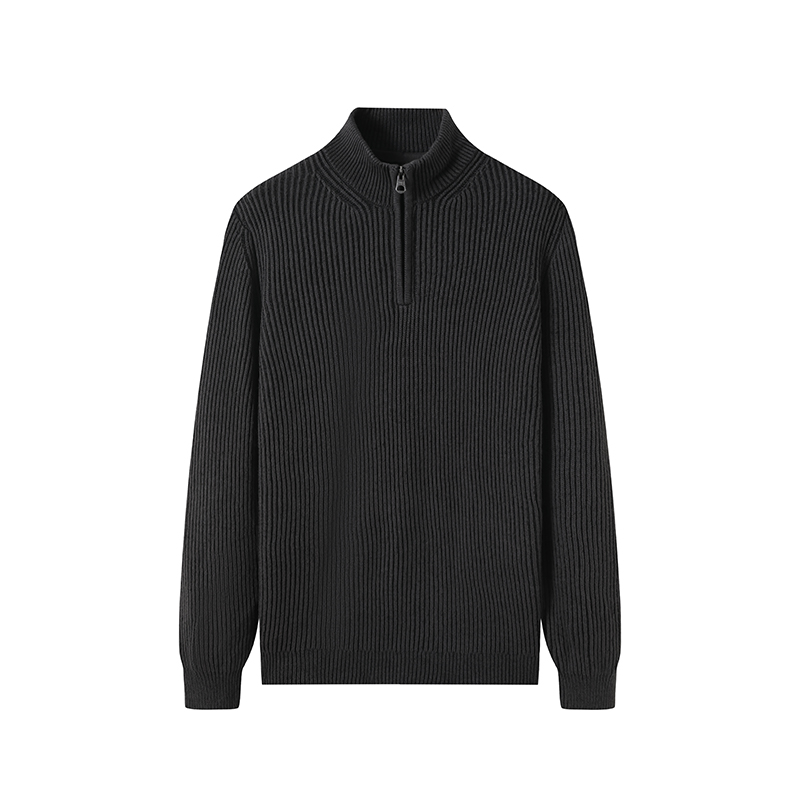
The Custom Fisherman Rib Cotton Wool 1/4 Zip Stand Collar Sweater from Kaida Knitwear provides a reference design for brands developing textured men’s sweaters.
The product combines a 7GG fisherman rib construction with a cotton-wool blend and quarter-zip stand collar.
Reference Product Specifications
- Product Type: Men’s Quarter-Zip Sweater.
- Material: 70% Combed Cotton / 30% Wool.
- Knitting Gauge: 7GG.
- Knit Structure: Fisherman Rib / Full Cardigan Rib.
- Construction: Fully Fashioned Knit.
- Reference Garment Weight: Approximately 720g.
- Collar: Ribbed Stand Collar.
- Closure: Quarter-Zip with Metal Puller.
- Fit: Men’s Regular Fit.
- Listed Size Range: S–5XL or customized sizes, subject to confirmation.
- Customization: Yarn blend, rib structure, collar details, zipper, sizing, and branding options subject to project requirements.
The approximately 720g reference weight describes the listed product configuration. Finished weight may change with garment size, yarn selection, knitting structure, and customization.
This design may suit heritage-inspired menswear, casual knitwear collections, premium private label sweaters, and autumn/winter layering products.
View the Fisherman Rib Quarter-Zip Sweater and Explore OEM Customization.
11. How to Evaluate a Fisherman Rib Sweater Manufacturer
When comparing suppliers, buyers should assess both product development capabilities and production management processes.
Technical Experience
Ask whether the manufacturer has experience with fisherman rib structures, medium-gauge knitting, fully fashioned construction, and quarter-zip sweater assembly.
Where possible, request relevant development samples or production references.
Sampling Capabilities
Confirm how the supplier handles yarn selection, swatch development, garment sampling, fit revisions, and final sample approval.
Sampling timelines should reflect the actual complexity of the project and material availability.
MOQ and Production Planning
Minimum order quantities may vary according to yarn sourcing, color development, size distribution, and customization requirements.
Buyers should clarify whether minimum quantities apply per style, color, or total order.
Quality Documentation
Ask how the supplier records approved materials, garment measurements, construction requirements, and inspection results.
Clear documentation helps reduce misunderstandings between development and production teams.
Communication and Corrective Actions
A reliable supplier should be able to explain how technical questions, sample revisions, and production deviations are handled.
Timely communication is especially important when manufacturing textured knitwear with customized garment details.
12. What Should Buyers Include in a Fisherman Rib Sweater RFQ?
A detailed request for quotation helps suppliers assess manufacturing feasibility and provide more accurate commercial information.
For a custom fisherman rib quarter-zip sweater, buyers should include:
- Product reference or technical drawings.
- Target knitting gauge and rib structure.
- Required yarn composition.
- Garment measurements and size distribution.
- Target fabric or garment weight.
- Collar and zipper specifications.
- Color references.
- Estimated order quantity by style and color.
- Labeling and packaging requirements.
- Applicable testing and inspection requirements.
- Target sampling and delivery schedule.
- Destination market and relevant compliance requirements.
Providing these details early can help identify potential design, sourcing, or production constraints before bulk manufacturing begins.
13. Frequently Asked Questions
What is fisherman rib knitting in sweater manufacturing?
Fisherman rib is a textured rib-based knitting structure characterized by prominent vertical ridges and recessed channels. It can create a fuller fabric appearance than basic rib constructions. Buyers should confirm the precise stitch structure through an approved swatch because terminology can vary between manufacturers.
Why use a 70% cotton and 30% wool blend for a 7GG sweater?
Combed cotton contributes comfortable hand feel and moisture absorption, while wool contributes resilience and thermal comfort. The final garment performance depends on the complete yarn construction, stitch settings, fabric density, and finishing process.
How do manufacturers maintain consistent fisherman rib texture during bulk production?
Manufacturers should monitor yarn consistency, knitting settings, stitch formation, panel measurements, and finishing conditions. Approved reference samples and agreed inspection criteria help identify deviations during production.
Can brands customize the collar, zipper, yarn blend, and sizing?
Yes. Customization may include rib structure, collar height, zipper details, yarn composition, garment measurements, colors, and branding. The available options should be confirmed during technical review and sampling.
What is the difference between fisherman rib and ordinary rib knitting?
Fisherman rib generally creates a more pronounced and voluminous textured surface than basic 1×1 rib knitting. However, the exact appearance, elasticity, and fabric weight depend on yarn selection and stitch construction.
Does 7GG mean a sweater is heavyweight?
Not necessarily. Machine gauge describes needle density, not finished garment weight. A 7GG sweater may be relatively substantial, but its actual weight depends on yarn characteristics, stitch structure, garment dimensions, and finishing.
What quality tests should buyers consider for cotton-wool fisherman rib sweaters?
Depending on the intended market and product specification, buyers may request dimensional stability, colorfastness, pilling resistance, fiber composition, and appearance-after-washing evaluations. Testing methods and acceptance criteria should be agreed before production.
What affects the cost of custom fisherman rib sweater manufacturing?
Important factors include yarn composition, garment weight, knitting complexity, zipper components, size range, order quantity, finishing, testing, and packaging requirements. Buyers should provide detailed specifications to obtain a project-specific quotation.
Conclusion: Building a Reliable Fisherman Rib Sweater OEM Program
Successful fisherman rib sweater manufacturing depends on the coordination of yarn selection, knitting structure, garment construction, finishing, and quality control.
For fashion brands and private label buyers, the most important steps are approving representative fabric swatches, confirming technical specifications, validating fit and zipper construction, and establishing measurable quality requirements before bulk production.
The 7GG cotton-wool fisherman rib quarter-zip sweater provides a useful starting point for developing textured men’s knitwear collections, but each customization should be evaluated according to its technical and commercial requirements.
Explore Kaida Knitwear’s Custom Fisherman Rib Cotton Wool 1/4 Zip Stand Collar Sweater and contact the team to discuss yarn options, sampling, sizing, branding, and OEM production requirements for your next collection.