Why Gauge and Fiber Choice Matter: 7GG Polyester vs. Wool & Cotton Blends
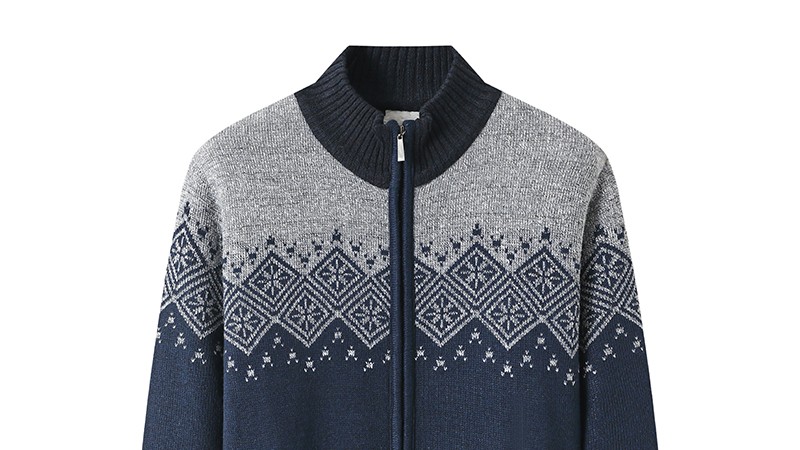
For winter apparel brands developing a Men’s Nordic Jacquard Sweater, selecting the right gauge and base fiber isn’t just about aesthetics—it directly affects drape, structure, layering performance, and cost-per-unit. A 7GG construction delivers higher density and visual definition for intricate Nordic-inspired jacquard patterns, while 100% polyester offers consistent stitch integrity, moisture resistance, and dimensional stability across bulk production runs. Unlike wool or cotton-blend alternatives, this specification prioritizes durability and repeatable texture over natural hand-feel—making it especially relevant for wholesale programs where fit consistency and wash-after-wash performance are non-negotiable.
How 7GG Polyester Defines the Winter Knit Jacket Category
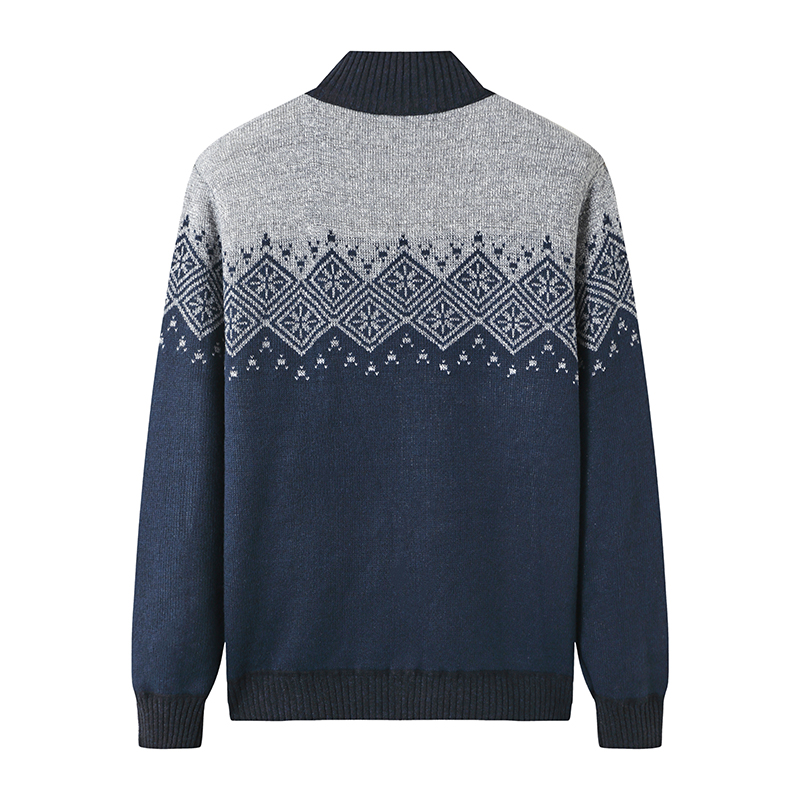
In Men’s Winter Knitwear > Zip-Up Sweater Jackets, gauge determines both technical capability and market positioning. At 7GG, the knit achieves sufficient body to hold a structured silhouette without lining—ideal for mid-layer outerwear in outdoor layering systems. The 740g garment weight places it between lightweight pullovers and heavy parka-weight knits, targeting transitional cold-weather use (0–15°C). Crucially, 100% polyester enables precise jacquard registration across large panels—a key requirement for repeating geometric motifs—and avoids shrinkage-related pattern distortion during finishing. Buyers should confirm whether their target retail price point aligns with polyester’s cost efficiency versus blended alternatives.
Stand Collar + Full-Zip + Reinforced Construction: Functional Implications
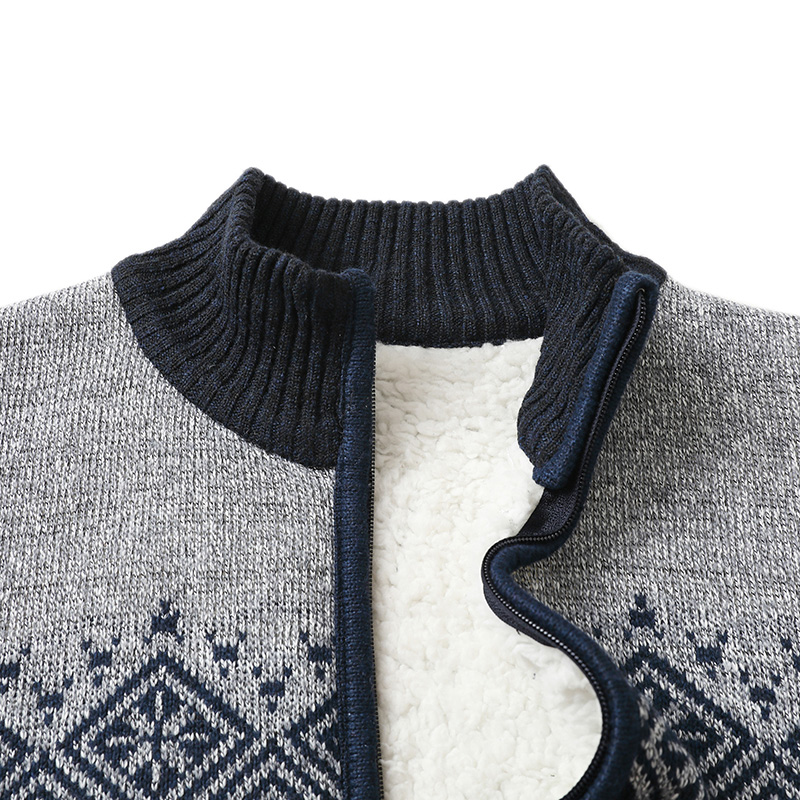
The combination of stand collar, full-zip closure, and reinforced zipper construction signals intentional outerwear functionality—not just styling. A stand collar improves wind resistance and supports helmet-compatible layering for outdoor use; full-zip allows rapid temperature regulation; and reinforcement (e.g., bar-tacked zipper ends, double-layer placket) prevents pull-out under repeated use. Ribbed trims at hem and cuffs provide shape retention and thermal sealing—but also require tighter tension control during knitting to avoid torque or spiraling. These features collectively shift the product from casual knitwear into the technical adjacent space—where buyers must verify seam strength, zipper slider durability, and rib recovery in pre-production samples.
Private Label & Wholesale Readiness: What It Actually Means
A design labeled ‘for private label and wholesale programs’ indicates modularity—not automatic scalability. For this Nordic Jacquard Knit Jacket, that means: base spec stability (7GG/100% polyester/740g), repeatable jacquard registration, and standardized trim placements (stand collar height, zip length, rib width). However, size grading, packaging, hangtags, and labeling remain project-specific. Brands launching seasonal collections should confirm early whether custom jacquard colorways require new yarn dye lots—and how many development rounds are needed to lock motif alignment across front/back/sleeve panels. No assumptions should be made about minimum order quantities or lead time compression without direct supplier consultation.
OEM/ODM Development Checklist: Critical Confirmation Points
- Jacquard Pattern: Confirm motif repeat dimensions and compatibility with standard fabric width (to minimize waste).
- Zipper Specs: Verify metal vs coil, puller type, tape color match, and reinforcement method.
- Trim Resilience: Review rib trim elasticity and recovery after stretching—especially for sleeve cuffs.
- Tolerance Limits: Define acceptable tolerance for garment weight (±30g) and gauge consistency (±0.5GG).
- Compliance: Specify care labeling requirements (e.g., ISO 3758 compliance, country-specific regulations).
- Sample Approval: Agree on criteria including stitch definition, motif continuity, collar roll, and zipper glide smoothness.
When to Choose This Over Wool or Cotton-Blend Alternatives
This 7GG Zip-Up Sweater Jacket is more appropriate for brands prioritizing uniformity, long-term shape retention, and controlled production yield—particularly in entry-to-mid-tier private label lines. Wool variants offer superior insulation per gram but introduce variability in micron count, crimp, and felting risk; cotton blends improve breathability but reduce jacquard sharpness and increase shrinkage potential. Polyester’s hydrophobic nature also supports faster drying—valuable for urban commuters or light outdoor users. That said, it is less suitable for premium-priced heritage-focused collections where natural fiber provenance and tactile differentiation carry marketing weight. The decision hinges not on ‘better’, but on alignment with channel, customer expectation, and post-purchase performance benchmarks.
Recommended Products
Men’s Nordic Jacquard Zip-Up Sweater Jacket | 7GG Polyester — Designed for winter collections requiring structured knit outerwear with repeatable Nordic patterning, this piece supports private label branding and wholesale program scaling through its stable 7GG/100% polyester foundation and functional full-zip construction.
Frequently Asked Questions
Q: What should buyers provide before sampling begins?
Brands should supply finalized tech packs including graded size charts, approved jacquard artwork (with repeat dimensions), zipper and trim specifications, and care label requirements. Fit comments from previous styles help accelerate first-sample accuracy.
Q: How do you assess jacquard quality in pre-production samples?
Evaluate motif alignment across seams, stitch clarity at motif boundaries, consistency of background texture, and absence of skipped or misregistered floats. Pattern continuity across front, back, and sleeves should be verified on fully assembled samples—not fabric swatches alone.
Q: What are the packaging and labeling requirements for private label orders?
Custom packaging includes brand-specific hangtags, woven labels, and polybags. Buyers must confirm country-specific labeling regulations (such as fiber content and care instructions) before production to ensure compliance and avoid customs delays.
Conclusion: There Is No Universal Optimal Spec
No single gauge, fiber, or construction suits all winter knitwear strategies. A 7GG polyester zip-up excels in reproducibility and functional resilience—but may fall short where natural fiber authenticity drives margin or loyalty. The right choice depends on your brand’s customer profile, distribution channel, price architecture, and long-term collection rhythm. For brands executing seasonal drops, private label rollouts, or outdoor-adjacent layering systems, this spec provides a predictable, scalable foundation—provided development checkpoints are confirmed early and objectively. Contact our team to discuss your knitwear project and explore customized manufacturing solutions.