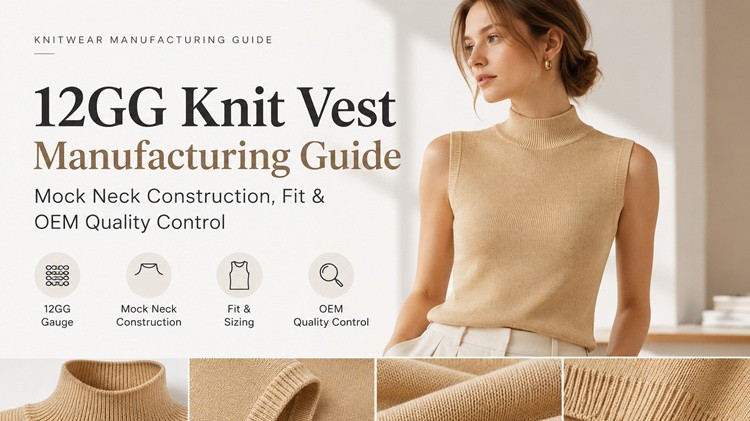
Why 12GG Mock Neck Knit Vest Construction Matters for Private Label Brands
A women’s sleeveless knit vest may appear simpler than a cardigan or pullover sweater, but its construction requires careful coordination of neckline stability, armhole finishing, shoulder shaping, and garment proportions. Without sleeves to balance the silhouette, small variations in shoulder width or armhole dimensions can noticeably affect the finished fit.

For fashion brands developing spring and autumn collections, these details influence how the garment layers over shirts, dresses, and lightweight tops. They also determine whether an approved sample can be reproduced consistently across sizes and bulk production batches.
When evaluating a 12GG knit vest manufacturer, buyers should look beyond product photographs and confirm how the factory manages yarn selection, knitting specifications, sample measurements, finishing, and quality inspection.
This guide explains the technical considerations behind women’s 12GG mock neck sleeveless knit vests and provides a practical framework for OEM and private label development.
Understanding 12GG Knit Vest Manufacturing
In flat knitting, 12GG generally refers to a machine gauge of approximately 12 needles per inch. It is commonly associated with relatively fine knitted structures suitable for lightweight sweaters, sleeveless knitwear, and refined layering garments.
However, machine gauge alone does not determine garment thickness, weight, softness, or durability. Two garments produced on 12GG machines can have significantly different characteristics depending on yarn count, fiber composition, stitch structure, machine settings, and finishing.
How Knitting Gauge Affects Fabric Appearance
Compared with many coarser-gauge structures, 12GG knitting can produce a finer stitch appearance and a relatively smooth fabric surface when paired with appropriate yarns and knitting settings.
For women’s contemporary knitwear, this makes 12GG worth considering for garments requiring a balance of visual refinement, flexibility, and layering comfort.
Buyers should nevertheless evaluate the actual knitted sample rather than treating the gauge number as a guarantee of fabric quality.
Key Technical Specifications to Confirm
Before developing a 12GG sleeveless sweater, the buyer and manufacturer should agree on the following specifications:
- Machine gauge: Confirm the intended 12GG knitting construction and any different gauges used for trims.
- Yarn composition: Specify fiber percentages and relevant yarn characteristics.
- Yarn count: Confirm the yarn count system and number of yarn ends where applicable.
- Stitch structure: Define the body construction and any ribbed or reinforced sections.
- Fabric density: Review stitch length, tension, and finished fabric characteristics.
- Garment weight: Establish a target finished weight if relevant to the collection.
- Finishing requirements: Document washing, steaming, shaping, and dimensional stability expectations.
These specifications should be incorporated into the development documentation and reviewed against the approved physical sample.
Mock Neck Construction: Balancing Collar Shape and Comfort
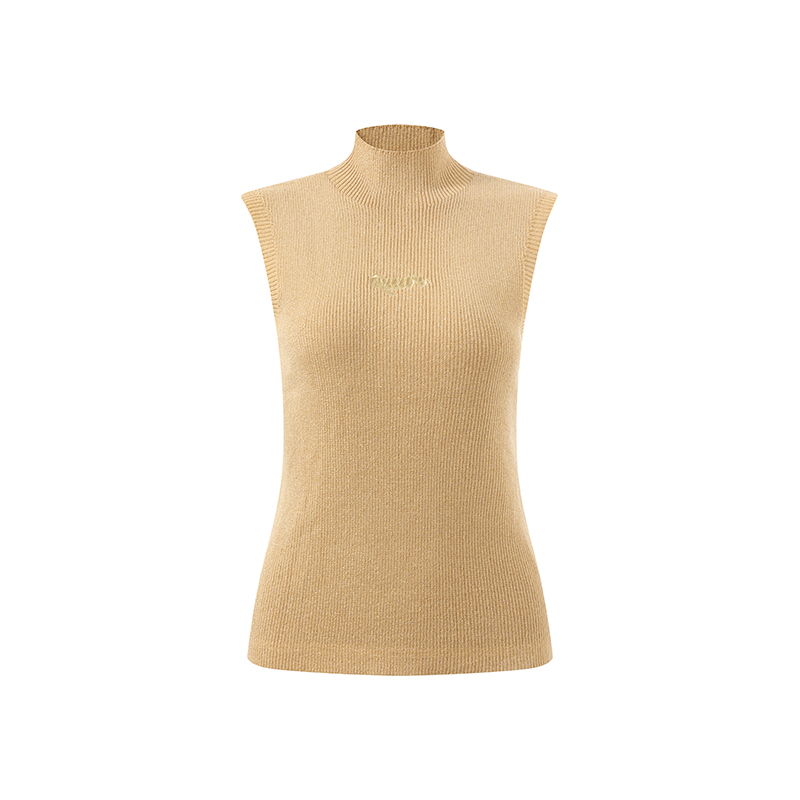
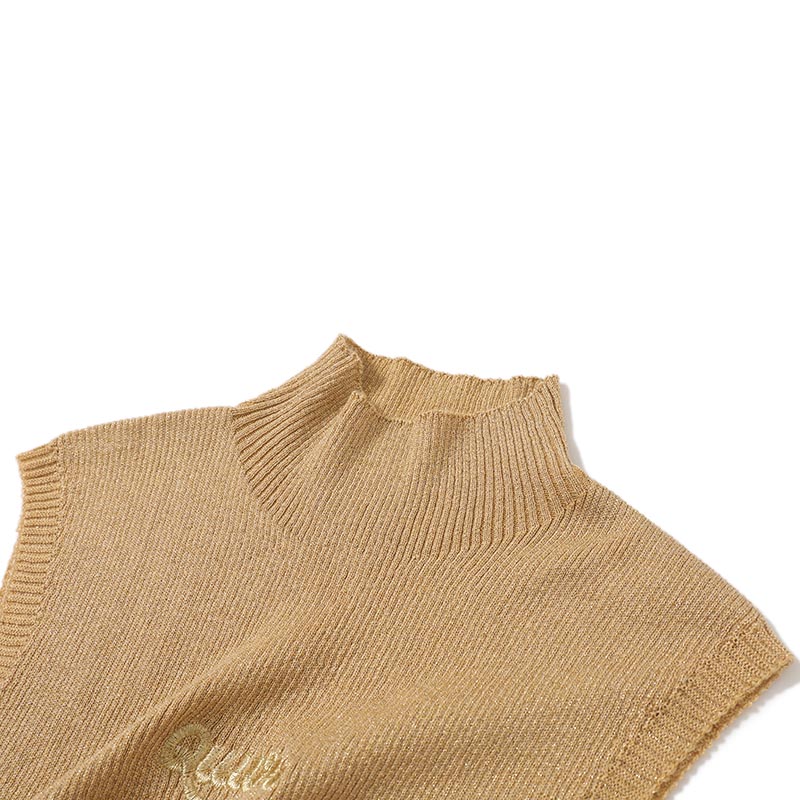
The mock neck is one of the defining design features of this sleeveless knit vest. Unlike a conventional crew neck, a mock neck extends upward around the neckline, creating a more structured appearance without necessarily reaching the height of a full turtleneck.
For mock neck knit vest manufacturing, collar construction must balance shape retention, flexibility, comfort, and ease of dressing.
Collar Height and Neckline Proportions
Mock neck height should be selected according to the intended silhouette, target customer, and yarn characteristics.
A taller collar can create a more structured appearance but may require additional attention to stability and comfort. A shorter collar may be easier to layer while providing a more understated neckline.
Important measurements include:
- Finished mock neck height.
- Neck opening circumference.
- Collar width and shape.
- Front and back neckline depth.
- Collar-to-body attachment dimensions.
- Neckline stretch and recovery.
Collar proportions should be assessed on a worn sample because flat measurements alone cannot fully demonstrate how the neckline sits around the neck and shoulders.
Preventing Collar Collapse, Curling, and Twisting
Common problems in knitted mock neck construction include collar collapse, uneven edges, twisting, and excessive stretching.
These defects may result from unsuitable yarn characteristics, inconsistent knitting tension, collar dimensions, attachment methods, or finishing conditions.
During sample development, buyers should evaluate whether the collar:
- Maintains the intended shape when worn.
- Remains symmetrical around the neckline.
- Allows comfortable movement and dressing.
- Recovers appropriately after stretching.
- Retains acceptable dimensions after laundering.
The appropriate collar construction depends on the design. Rib structures, folded collars, and other knitted constructions may behave differently and should be evaluated against the approved sample.
Armhole Finishing: A Critical Quality Detail in Sleeveless Knitwear
Armhole construction deserves particular attention in women’s knit vest OEM production because the armhole edge remains visible and directly influences fit.
Unlike a sleeved sweater, where the sleeve assembly covers much of the armhole opening, a sleeveless garment requires a clean and stable exposed edge.
Common Armhole Construction Methods
Depending on the garment design and knitting method, armhole finishing may involve:
- Knitted rib binding: A ribbed edge that provides stretch and a defined finish.
- Linked or attached knitted trim: A separately knitted edge joined to the body using a suitable assembly method.
- Integral knitted finishing: Edge shaping incorporated into the knitted panel where the construction allows.
- Alternative binding methods: Selected according to the required appearance, fabric structure, and manufacturing feasibility.
No single method is automatically superior. The most suitable construction depends on the desired appearance, yarn behavior, garment fit, and target quality standard.
Armhole Quality Control Requirements
During sampling and bulk inspection, buyers should check:
- Consistent armhole depth and opening dimensions.
- Symmetry between left and right armholes.
- Clean edge construction without visible defects.
- Absence of excessive curling or puckering.
- Appropriate stretch and recovery.
- Secure trim attachment where applicable.
- Stable appearance after washing and finishing.
Armhole dimensions should be evaluated alongside shoulder width and chest measurements because these specifications jointly influence comfort and coverage.
Shoulder Shaping and Fit Development for Women’s Knit Vests
Fit development is especially important for sleeveless knitwear because the shoulder line and armhole opening define much of the garment’s silhouette.
For a private label knit vest, buyers should establish the intended fit before approving the final technical specifications.
Shoulder Width and Silhouette
A narrower shoulder construction may create a more fitted appearance, while an extended shoulder can produce a relaxed silhouette.
However, shoulder width should not be considered independently. Changes may affect armhole exposure, chest proportions, neckline positioning, and how the garment layers over other clothing.
For contemporary women’s fashion collections, the correct proportions depend on the intended styling and customer fit preferences.
Chest Width and Body Ease
Chest width determines how closely the garment follows the body and how comfortably it can be layered.
Brands developing a fitted sleeveless top may prefer a different amount of ease from those designing a relaxed vest intended to be worn over a shirt.
These decisions should be documented in the measurement specification and evaluated through fit samples.
Body Length and Hem Position
Body length influences the overall proportions of the garment and its compatibility with different styling combinations.
A cropped design may suit contemporary fashion collections, while a longer silhouette may be appropriate for smart casual or layering applications.
Hem construction should support the intended fit without causing excessive rolling, distortion, or unwanted tension.
Material Selection for 12GG Sleeveless Knitwear
Yarn composition affects the appearance, comfort, performance, and production requirements of a knitted vest.
Although the product is identified as a 12GG lightweight mock neck sleeveless sweater, the exact fiber composition and finished garment weight should be confirmed against the current product specification before making purchasing decisions.
Cotton and Cotton-Rich Blends
Cotton-based yarns may be suitable for collections prioritizing a natural-fiber handfeel and familiar comfort characteristics.
However, dimensional stability, recovery, and garment weight depend on the yarn construction, stitch structure, and finishing process.
Wool and Wool-Blend Yarns
Wool and wool-blend yarns may be considered for collections requiring different thermal properties, handfeel, or premium material positioning.
Buyers should evaluate pilling resistance, care requirements, shrinkage behavior, and the finished garment’s suitability for the intended season.
Synthetic and Blended Yarns
Fibers such as nylon, acrylic, and polyester may be incorporated into knitwear for different performance, aesthetic, or cost objectives.
The effect of each fiber depends on the blend ratio, yarn construction, and finished fabric. Material performance should be verified rather than assumed from fiber composition alone.
Material Testing and Approval
For OEM production, buyers may request testing or documented evaluation of:
- Fiber composition.
- Dimensional stability after laundering.
- Colorfastness to washing and rubbing.
- Pilling performance.
- Fabric appearance after repeated care cycles.
- Stretch and recovery where relevant.
- Finished garment weight and measurement consistency.
Any sustainability or textile certification claims should be supported by valid documentation applicable to the relevant materials or products. Buyers should not assume certification based solely on fiber descriptions.
OEM and Private Label Customization Options
Custom knit vest development can involve changes to the garment’s appearance, construction, sizing, and branding.
For fashion brands developing a distinctive collection, the following options may be considered during the OEM or ODM development process.
Design and Construction Customization
- Mock neck height and neckline proportions.
- Shoulder width and silhouette.
- Armhole depth and edge construction.
- Body length and garment ease.
- Hem structure and rib dimensions.
- Yarn composition and color selection.
- Stitch structure and surface texture.
Private Label Branding
Branding requirements may include woven neck labels, printed labels, care labels, hangtags, and retail packaging.
Buyers should confirm which options are available for the selected style and whether custom materials or packaging affect minimum order quantities and lead times.
OEM Development Process: From Tech Pack to Approved Sample
A structured development process helps reduce misunderstandings between the buyer and manufacturer and improves consistency when moving from sample development to bulk production.
Step 1: Prepare the Technical Specification
The buyer should provide design references, target measurements, intended fit, material preferences, color requirements, and branding instructions.
For a 12GG mock neck vest, the technical specification should clearly identify neckline dimensions, shoulder width, chest width, body length, armhole depth, and hem construction.
Step 2: Confirm Yarn and Knitting Requirements
The manufacturer and buyer should review yarn composition, yarn count, knitting gauge, stitch structure, and expected fabric characteristics.
Material availability and production feasibility should be confirmed before sample development begins.
Step 3: Develop the First Sample
The first physical sample should be evaluated for overall appearance, fit, construction, and measurement accuracy.
Particular attention should be given to mock neck stability, shoulder shaping, armhole finishing, and hem behavior.
Step 4: Review Fit and Construction
Buyers should compare the sample against the approved measurement chart and assess how the garment performs when worn.
Any required changes should be documented clearly, including updated measurements, construction instructions, and visual references.
Step 5: Approve the Pre-Production Specifications
Before bulk production, the buyer should confirm the final sample, yarn specifications, colors, sizing, labels, packaging, and quality acceptance criteria.
Where appropriate, a pre-production sample using the intended bulk materials can serve as the reference for production and inspection.
Bulk Production Quality Control for 12GG Knit Vests
For 12GG knit vest manufacturing, quality control should focus on maintaining consistency between the approved sample and finished production garments.
Inspection requirements should be established before manufacturing begins and adjusted according to the buyer’s quality standards and intended market.
1. Neckline Stability
- Verify mock neck height and circumference.
- Check collar symmetry and shape.
- Inspect for twisting, curling, or uneven construction.
- Evaluate dimensional stability after laundering where required.
2. Armhole Construction
- Confirm left and right armhole symmetry.
- Check edge finishing and trim attachment.
- Inspect for stretching, puckering, and curling.
- Verify armhole measurements against approved tolerances.
3. Shoulder and Body Measurements
- Measure shoulder width, chest width, and body length.
- Check garment balance and overall silhouette.
- Confirm size grading consistency.
- Identify unacceptable dimensional variation.
4. Fabric and Finishing Quality
- Inspect for dropped stitches, holes, and visible knitting defects.
- Check color consistency and surface appearance.
- Review seam construction and loose yarn ends.
- Verify hem finishing and garment presentation.
Inspection tolerances and any AQL-based acceptance criteria should be agreed upon by the buyer and manufacturer. AQL terminology alone does not establish an appropriate inspection plan without a defined sampling standard and defect classification.
MOQ, Sampling Lead Time, and Production Planning
Minimum order quantities and development schedules are important considerations for emerging fashion brands, boutique labels, and established apparel sourcing teams.
KAIDA’s general OEM information indicates minimum order quantities starting from approximately 100 pieces and typical sampling periods of 7–12 working days for certain projects.
However, these figures should not be treated as guaranteed conditions for every private label knit vest order.
The actual MOQ and production schedule may depend on:
- Yarn composition and material availability.
- Custom color requirements.
- Size distribution and order quantities.
- Mock neck and armhole construction complexity.
- Branding and packaging requirements.
- Sample revisions and approval timing.
- Production capacity and scheduling.
Buyers should request a style-specific quotation and confirm when the production lead time begins, particularly whether it is calculated from sample approval, material confirmation, payment, or another agreed milestone.
Recommended Product: Women’s 12GG Lightweight Mock Neck Sleeveless Knit Vest
The Women’s 12GG Lightweight Mock Neck Sleeveless Knit Vest from KAIDA Knitwear provides a relevant starting point for brands developing contemporary women’s knitwear and lightweight layering collections.
The product combines a 12GG knitted construction with a mock neck and sleeveless silhouette, making it suitable for evaluating customized fit, neckline proportions, armhole finishing, and private label design requirements.
Potential collection applications include:
- Women’s contemporary fashion collections.
- Spring and autumn layering garments.
- Smart casual knitwear collections.
- Boutique private label apparel.
- Minimalist and modern women’s knitwear ranges.
Buyers can use the existing product as a design reference and discuss potential adjustments to yarn selection, sizing, collar dimensions, armhole construction, colors, and branding.
Material composition, garment weight, minimum order quantity, and production lead time should be confirmed for the specific development project.
View the Women’s 12GG Mock Neck Knit Vest
Frequently Asked Questions
What does 12GG mean in knit vest manufacturing?
12GG generally refers to a flat knitting machine gauge of approximately 12 needles per inch. It is commonly used for relatively fine knitted structures. Finished garment weight, texture, and drape also depend on yarn count, stitch construction, knitting settings, and finishing.
How should the armholes of a sleeveless knit vest be finished?
Armholes should have clean, symmetrical, and dimensionally stable edges. Depending on the design, finishing may involve knitted rib binding, attached knitted trims, or integral knitted construction. Buyers should evaluate edge appearance, stretch, recovery, and stability during sample approval.
Can the mock neck height and vest fit be customized?
Mock neck height, shoulder width, chest measurements, body length, armhole depth, and hem construction can be discussed during OEM development. Final customization depends on the approved design, yarn characteristics, and manufacturing feasibility.
What is the MOQ and sampling lead time for private label knit vests?
KAIDA’s general OEM information indicates minimum order quantities starting from approximately 100 pieces and typical sampling periods of 7–12 working days for certain projects. The exact MOQ, sampling schedule, and bulk production lead time for this style should be confirmed directly with the manufacturer.
What should a tech pack include for a 12GG mock neck knit vest?
A suitable tech pack should include design sketches, yarn specifications, knitting gauge, stitch structure, measurement charts, size grading, mock neck dimensions, armhole construction, hem finishing, color references, labels, packaging requirements, and agreed quality acceptance criteria.
How can buyers reduce quality problems during bulk knit vest production?
Buyers should approve representative samples, document critical measurements, confirm material specifications, establish inspection requirements, and communicate any design revisions before bulk manufacturing. Neckline stability, armhole symmetry, shoulder measurements, and dimensional consistency deserve particular attention.
Conclusion: Develop 12GG Knit Vests with Clear Technical Specifications
Successful 12GG knit vest manufacturing depends on more than selecting a knitting gauge or an attractive silhouette. Yarn characteristics, mock neck construction, armhole finishing, shoulder shaping, and garment measurements must work together to achieve the intended appearance and fit.
For fashion brands and sourcing managers, clearly documented specifications and representative sample approval provide a stronger foundation for consistent OEM production.
KAIDA Knitwear’s Women’s 12GG Lightweight Mock Neck Sleeveless Knit Vest offers a product reference for developing customized women’s sleeveless knitwear collections.
Planning a private label knit vest collection? Share your design references, preferred yarn composition, target measurements, estimated order quantity, and branding requirements with KAIDA Knitwear to discuss sample development, customization feasibility, and production planning.